Archive for March 2009

March 18, 2009

March 17, 2009

March 15, 2009

Charles Messier and the Messier Objects

Filed under: astronomy, Astrophotography, Messier Objects, Podcast — Ed @ 7:10 pm

Today is another of my podcasts found at 365 days of Astronomy, here. My topic is one of my favorite things about the night sky, the Messier Objects. While my podcast pretty much gives an overview of who Charles Messier was and what his objects are, I thought I'd have a post showing some of my favorite objects. Last year, I actually imaged all 110 of the Messier Objects. Those images can be seen here. All of those images were taken using the same setup, so they are roughly comparable one to another (although each of them was stretched a bit differently). The following images all have different exposure times, but show off some of my favorites:

The Dumbbell Nebula, M27, is probably my favorite planetary nebula in the Messier Catalog. It's big, easy to see and wonderful to image.

M45-The Pleiades, also known as the Seven Sisters, is my favorite open cluster. It also has quite a wonderful reflection nebula surrounding it.

M51, the Whirlpool Galaxy, is a wonderful target particularly for imaging.

M20, the Trifid Nebula is a beautiful emission and reflection nebula found in Sagittarius.

M31, the Andromeda Galaxy, is a wonderful galaxy that is visible, under dark skies, to the naked eye.

M42, the Great Orion Nebula, is also a naked eye visible Messier Object. It's one of the most wondeful targets to view or image with a telescope.

M13, the Great Hercules Cluster, is my favorite among the globular clusters. It's easy to find and just is wonderful through the scope.

These are just a sample of the 110 wonderful objects found in Charles Messier's catalog. I hope folks go out and try to see them all. It's worth the effort.

March 7, 2009

March 6, 2009

March 5, 2009

Stellarium Landscape

Filed under: astronomy, Equipment — Tags: stellarium — Ed @ 10:39 pm

Because of the clouds this evening, I haven't gotten the scope out, but before it got dark I took images for 360° while standing in my driveway where I put my scope. I then used Autostitch software to create a panorama from those images. After a bit of image work, making the sky transparent, I tried using the panorama as a landscape in my Stellarium planetarium software. WOW! It does a great job of letting me see what things will look like now. A big problem for me is my house blocks much of the eastern view from my driveway where I observe. Now I can, with reasonable accuracy, determine when things will rise above my roof.

Lunar Mountains on 3/4/09

Filed under: astronomy, Astrophotography, Moon, Observation Journal — Ed @ 1:05 am

Tonight I just concentrated on the Moon. I particularly focused on the three mountain ranges in the image above. The Alps, Caucasus and Appanines are found among the craters of the Moon. If you click on the image, you can see a highly annotated version, noting most of the craters,seas and mountains. And if you go to the largest version, you can see a number of peaks casting their own shadows. The shadow of the rim of Crater Plato in the upper left is really quite interesting. The crazy thing is that as detailed as this image is, it's much more detailed through the eyepiece.

I also got a shot of the Moon in its entirety:

March 3, 2009

Why I dislike news about space junk

Filed under: astronomy — Tags: pet peeve, satellite, satellites, space — Ed @ 6:12 pm

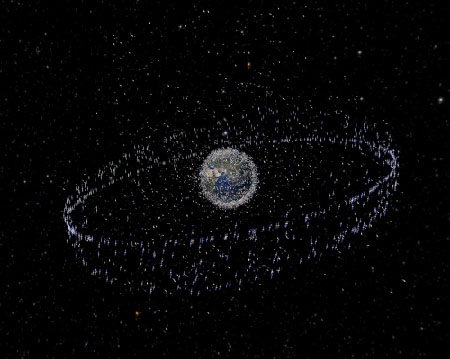
I don't rant often, really ever, on my blog, but I've seen something with so many news stories lately with the crash of the Iridium satellite and the Russian satellite that I've gotten somewhat fed up. Here's an example what bugs me:

Satellites around the Earth (huge) Image from cnn.com
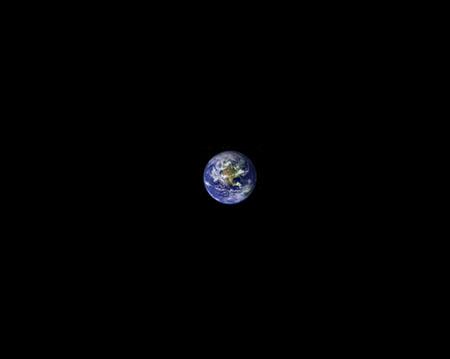
When you look at that image, it looks like space around the Earth is incredibly crowded. The problem, though, is scale. The diameter of the Earth is 7,926 miles. Which means that the 54 pixel high Earth in the image has a scale that (not accounting for things being closer or farther in the image) roughly translates to 146 miles per pixel. While many of the satellites are represented by more than one pixel, let's assume that they are all one pixel. That means that what we're seeing are thousands of 146+ mile-across satellites. Now I love massive space stuff as much as the next guy, but the ISS is (by a lot) the largest man-made thing in space. At it's widest, it is around 350 feet. This is merely 1/2200th of 146 miles. The vast majority of satellites are around the size of a car, and generally a small car at that. The largest satellites (other than the ISS) are around the size of a bus. I understand that they are trying to illustrate a point - how many objects are orbiting the Earth - but the graphics convey other information so wrongly and powerfully that whatever their initial point, what people take away is incorrect. Here is what they should show instead:

satellite2 The Earth, with all of its man-made satellites

Okay, rant over...