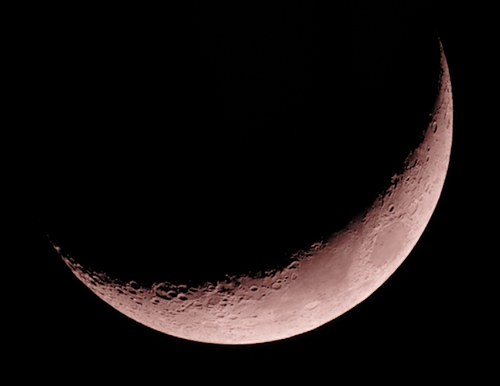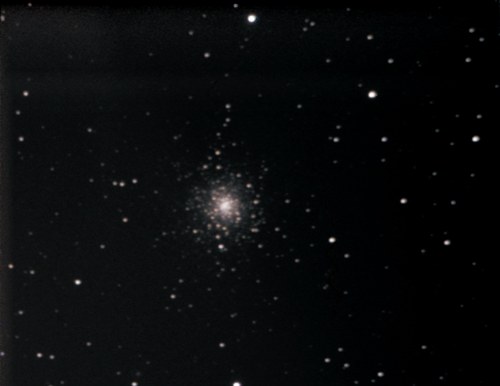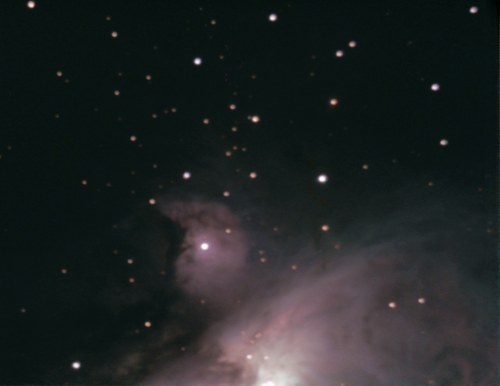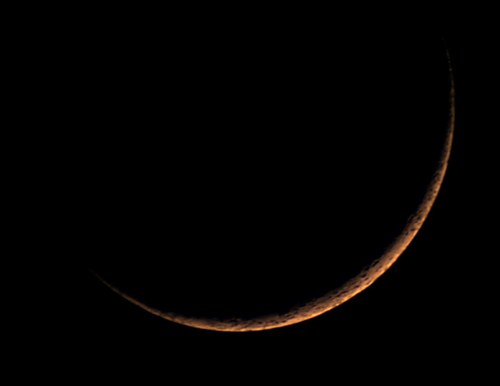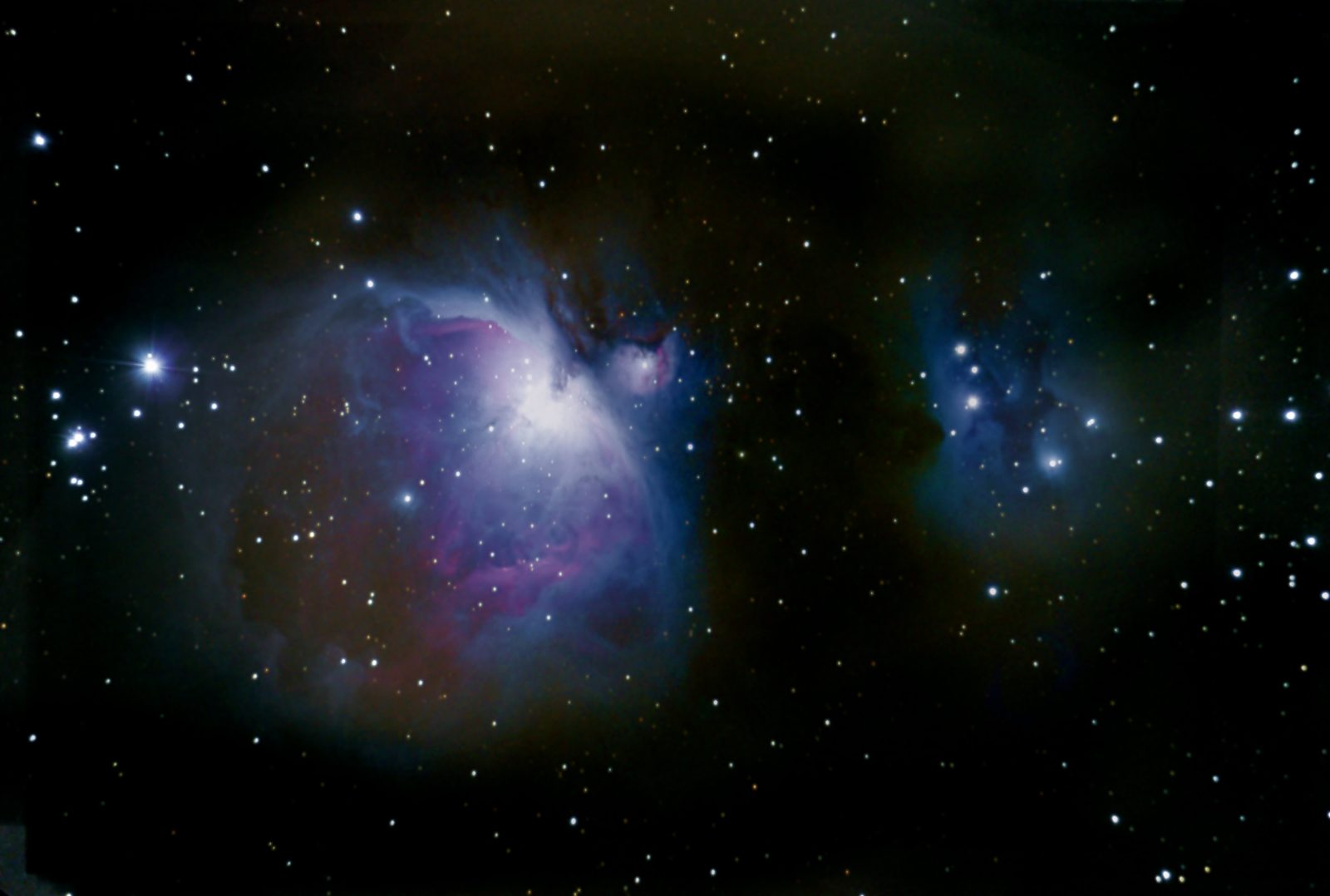
The Great Orion Nebula (M42) and the Running Man Nebula, photographed from Flintstone, Georgia

Flintstone Stargazing

Astronomical observations by a guy in Flintstone, Georgia

M42 – the Great Orion Nebula, February 2009

Category: astronomy

February 19, 2008

Meade Deep Sky Imager Shootout
Filed under: astronomy, Astrophotography, Equipment, Messier Objects, Observation Journal — Tags: M42, Orion — Ed @ 11:47 pm


M42 with DSI

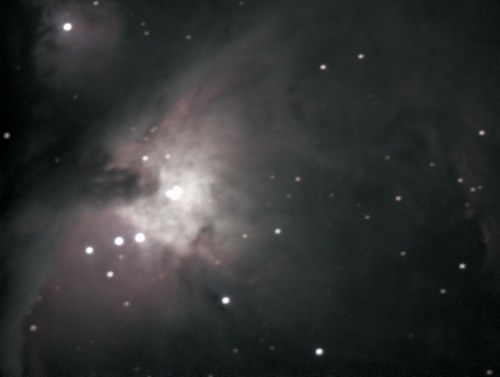
Tonight, I decided to do a test to compare some of the Meade Deep Sky Imager (DSI) models. I personally own a DSI Color and a DSI II Color camera. My friend Dave lent me his original DSI camera which is black and white and uses colored filters. I thought it would be an interesting test to see how they compared. The results were not what I expected. I chose one of my favorite targets - M42-The Great Orion Nebula and I started with the original black and white DSI. I took 4 second exposures of each of the channels - Red, Green, Blue and then a Luminance channel as well. I composited 50 images of each to create these and then I combined them in Photoshop. The result is above. Wow. The detail was way beyond what I expected, particularly considering this is the first generation DSI camera. I then took fifty 4 second images with the DSI Color. Here is the result:
M42 with DSI Color
M42 with DSI Color

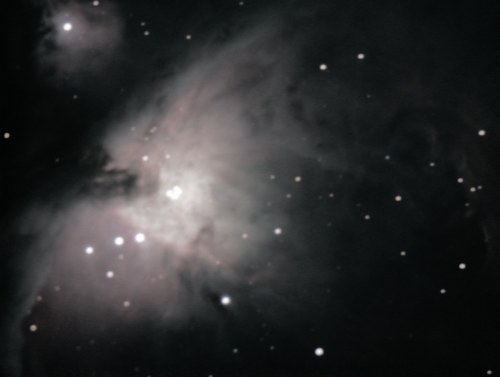
While this is a fine image, the result is nowhere near the quality of the DSI. This is pretty much what I expected. Of course, now that I'm thinking about it, to really compare I probably should have used 200 images stacked because with the DSI image I used 50 of each channel and there were 4 channels. Oh well.

Finally I got out my DSI II Color. This camera has a larger chip so I resized the image down to compare it to the other one, but the results are not as good as I'd hoped. Here's what I got:
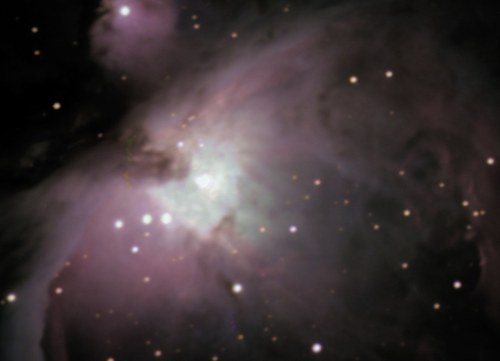
M42 with DSI II Color

Some of the differences between these images are in the way that they were processed. Also, the filters I use for the DSI camera are not pure RG & B filters - the red is actually slightly Orange for example - so the color I'm getting there is going to vary somewhat.

I think the results speak for themselves. For detail, the original black and white DSI camera gave the best shot hands down. I don't have a DSI II black and white version, but I'd bet it'd be even better, with lower noise. The downside to the original DSI camera is that by using the filters, you can't get instant results - it takes some time to combine the images and you have to swap the filters out and stuff all of which takes a lot more time and effort, but for the highest quality images, I think it's clear that the results of that effort are worth it.
February 18, 2008

Eclipse Party Wednesday Night - You're Invited

Filed under: astronomy, lunar eclipse, Moon — Tags: eclipse, party — Ed @ 5:03 pm

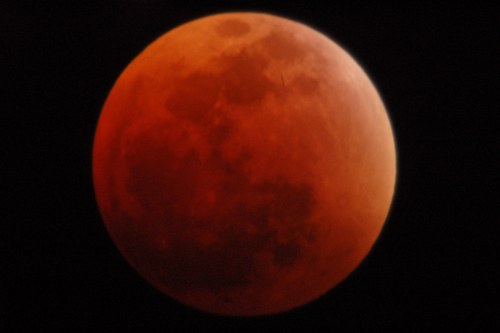
Total Lunar Eclipse on 8/28/07

I do this with a bit of trepedation, but I'm inviting anyone who wants to come, particularly if you have a telescope (but even if you don't), to an Eclipse Party starting at 8:30pm (8 if you're bringing a telescope) on Wednesday Night, February 20th. Currently the weather looks reasonably favorable (though I'll call it in case of rain or heavy clouds so check the site before you come) for the total lunar eclipse that night. This eclipse will be the last total lunar eclipse until 2010 and we've got a great seat for this celestial show. I'm planning on having hot chocolate, telescopes and cameras to record the event and it'll be a fun time to learn about astronomy. If you have a telescope (even a small one that doesn't get used much), please bring it with you. If you'd like to learn more about observing or about your scope, I'll be glad to give you what advice I can. Otherwise, we'll just be enjoying this rare event together as well as viewing other night sky wonders (Mars, Saturn and more).

 The eclipse starts at around 8:45 and will be total at 10pm. Totality will be for around an hour. While I'm planning on taking a some images during this time, I'll also use the now dark skies as a chance to show off some other celestial sights.

Where do I live? [Address/Directions removed after the party at the request of my wife :)]

I hope to see you there!

P.S. Dress warmly.

February 17, 2008

The Terminator

Filed under: astronomy, Astrophotography, Moon, Observation Journal — Ed @ 11:59 pm


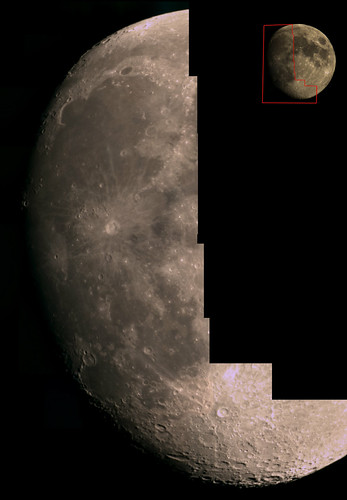
Moon Terminator Detail on 2/17/08

Tonight, we had storms and then all of a sudden, it was clear - very humid, but clear. I brought the scope out and after setting up realized there was too much wind for any long exposures, so I headed straight for the Moon. It was quite bright, casting shadows on the ground and after taking an overall shot (used above to display the detailed area) I decided to use my 3X Barlow to take a series of images that I could combine into a larger panorama. The terminator is the line where the shadow and light come together as the moon grows or shrinks and is usually the most interesting place to look at the moon. This is because shadows are magnified near the terminator because of the angle that the light shines on the features found there. I was able to stitch together this series of 18 images that cover the entire length of the terminator. If you'd like to really see the detail click on the image and you can see a much larger version (go to "all sizes") or see notes about some of the features visible in the image. You can see how Sinus Iridum which I imaged yesterday has changed just in the past 24 hours.

The Bay of Rainbows and Copernicus Crater

Filed under: astronomy, Astrophotography, Moon, Observation Journal — Tags: craters — Ed @ 1:40 am


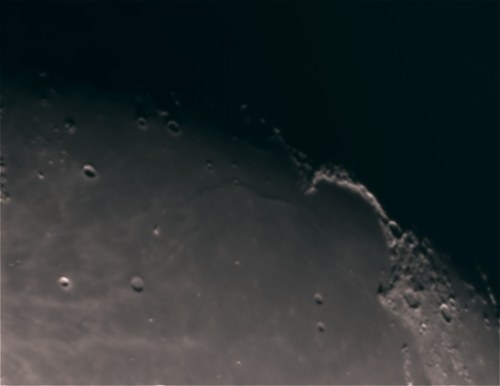
Sinus Iridum-Bay of Rainbows on 2/17/08

Here are the two areas of detail that I imaged this evening. Sinus Iridum - The Bay of Rainbows is always one of my favorite areas of the moon - the smooth plain (okay it has some ripples) and the beatiful curve of the rim are striking and if conditions are just right sometimes top of the rim is illuminated but the plain is not which results in what looks like a mountain range to nowhere.

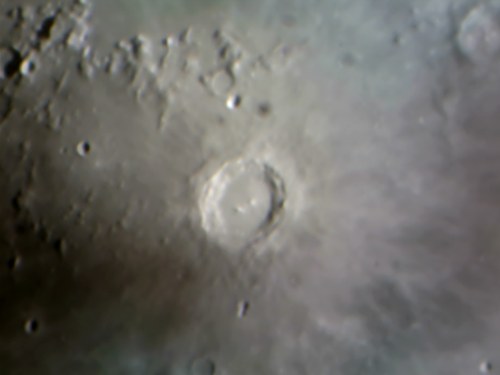
The image below is of Copernicus Crater one of the largest craters on the moon. Each of these images was captured using my cheapo Meade web cam - I captured 60s worth of video on each and then used Registax to pull out detail. Both of these features can be found in my previous post featuring an image of the moon this evening - they are both found in the top part of the image.

Copernicus Crater on 2/17/08

Added: This image shows how Sinus Irudum connects to Mare Imbrium - the Sea of Rains. It was not taken using the webcam - it was taken with my Meade DSI II Color camera and then stacked in RegiStax.

Mare Imbrium and Sinus Iridum on 2/17/08

February 16, 2008

The Moon on 2/16/08

Filed under: astronomy, Astrophotography, Moon, Observation Journal — Ed @ 11:58 pm


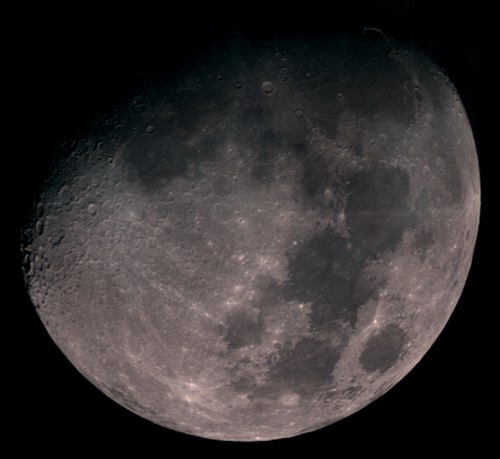
The Moon on 2/16/08

Tonight started off very cloudy and I planned on just staying inside. At around 9:50 though, when I walked by the window, I thought I saw stars. After going outside, sure enough it had cleared. While it was still somewhat hazy, the Moon is bright enough to be clearly visible to the scope and so I figured I should get some shots. I also took some lunar crater detail shots and some images of Saturn that I need to process before I upload them so it'll probably be some time tomorrow before they show up here. It's also quite warm out - somewhere around 55°F so I've been quite comfortable.

February 15, 2008

Cleaning/Aligning and a Club Meeting

Filed under: astronomy, Equipment — Tags: Telescope — Ed @ 11:08 pm

Last night, I had the pleasure of attending my first Barnard Astronomical Society meeting. The BAS is the Chattanooga astronomy club and has a history that goes back to 1923. Last night's presentation was by a recent graduate of the UTC geology program and she gave a presentation on Saturn's moon Titan. It was an interesting presentation featuring a lot of imaging from the Cassini.Huygens mission and discussion of the "geological" processes that science is discovering there. The folks in the club were very nice and of course it's always nice to talk about an obsession with like-minded people, so I really enjoyed myself. I'm looking forward to getting to know the folks there. The meeting broke up at close to 10pm so I didn't get any scope time last night even though it was really nice out.

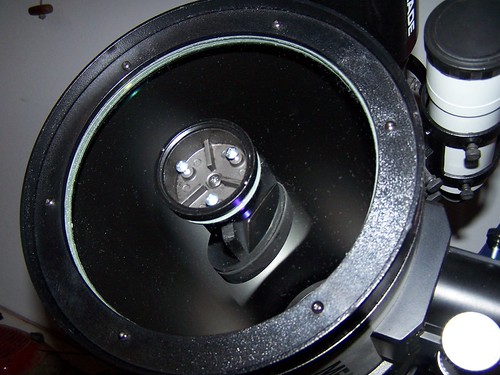
Tonight, it's cloudy and so I thought I would fix a problem with my scope. The corrector plate is the glass in the front of my telescope and when it arrived, it was smeared and (I feared) a bit scratched. Actually, I'm sure the glass is most likely unscratched, but the corrector plate has what are called Ultra-High Transmission Coatings (UHTC) on it which allow the glass to pass quite a bit more light than glass by itself. It is this coating on the corrector plate that I was concerned about. Here is what my corrector plate looked like before clearning:

Corrector Plate Smearing
My smeared corrector plate on my LXD75

I had gotten some feedback online from Cloudy Nights as well as on some Flickr groups about how to clean it. The general consensus was to use the method described here: http://www.arksky.org/asoclean.htm and so I went off and purchased everything except the Photoflow that they recommended. After following the instructions very carefully this was the result:

Cleaned Corrector Plate
My clean corrector plate on my LXD75

I actually took the corrector plate assembly off the front of the scope (which includes the secondary mirror so I was very careful) and cleaned the inside of the plate as well. I did not remove the plate from the outer assembly because it apparently is nearly impossible to get it properly realigned after you do that. I've read more than one story of people having to ship the scope back to the factory to get it fixed.  Also, while I was in there, I also took out the primary mirror and gently cleaned it as well.

Overall, I think it worked really well. While there may be some faint scratches on the corrector plate, I believe those predate my ownership of the scope and hope they won't cause too much trouble. In the end, I think I've got a much cleaner telescope that should provide me with even more light gathering capacity and crisp detail than before.

February 10, 2008

Tonight's astrophotography

Filed under: astronomy, Astrophotography, Messier Objects, Moon, Observation Journal — Tags: M43, M79 — Ed @ 10:39 pm


The Moon on 2/10/08

Tonight was very nice, but a bit windy (which made it feel colder than the 45°F that the thermometer was reading). It also meant that the telescope would shake a bit too much to get many long term exposures. Realizing this, I decided to start with the Moon. When imaging the moon I used an exposure of .003s through my refractor which is quick enough to block out most of the wind movement. I thought this image came out nice and sharp. When looking, particularly at higher magnification, visually I could see a lot of turbulence between me and the Moon. Actually, I suppose that most of that turbulence is close to me. It's probably just the first 100 miles or so that are turbulent. After that it's clear for the next 180,000 miles.

M79 on 2/10/08
M79 on 2/10/08

After getting the moon, I thought I'd have a go at the only globular cluster Messier object visible in the early evening, M79. I was able to get one hundred 30s images that were stacked to give me the image above.

M43-de Mairan's Nebula on 2/10/08

Finally, I thought I'd take a look at something brighter since the wind was picking up so I pointed the scope at M43-de Mairan's Nebula which is the "knob" on the end of the Great Orion Nebula. I took a bunch of 8s exposures and it turned out okay. I then tried to pull the image into DeepSkyStacker, but it seems that the newest version of that software is having some problems with finding stars in images. The guy who writes the software updates it pretty often so I'm hoping he'll have a fix soon. and I'll be able to reprocess a number of images that I've taken recently.

February 8, 2008

February 6, 2008

Windy, then clouds

Filed under: astronomy, Observation Journal — Ed @ 9:06 pm

I hadn't been able to get the scope out for several days because of the rain. Tonight, it was very clear with really dark skies and so I got the scope out. I knew it was windy and I wouldn't be able to hook up the camera (too much shaking), but figured I could get the polar scope realigned and then do some visual observing. It took me about 45 minutes to get the polar properly centered because it's really hard adjusting things when they show you an upside-down image. I kept moving the opposite set screw from what I wanted, but I finally found the center and then set the scope up. After running the Autostar alignment procedure I got the magic "Less than 5' from the pole" message which tells me it's as aligned as the scope can determine (though for really long-term photos, I might need to do some drift alignment to ensure it's perfectly on the pole). That was very encouraging since I'd had so much trouble with the polar scope during the hypertune that I was a bit worried I might have damaged something (other than the scratches). This tells me I'm probably okay.

Once the scope was aligned, I pointed it at Mars and used the opportunity to get the piggy-backed scope better aligned to the main one. After a couple minutes, the four older boys came out real quick to take a look. Everybody saw it through the refractor which is lower, around their eye level and then ran back inside. The temperature was around 50° out, but with the wind, it felt colder, particularly to boys in pajamas (they had their coats on). After a couple minutes of looking at the Pleiades the clouds rolled in and I packed everything up. The wind was really starting to pick up at that point anyway.

February 2, 2008

Saturn, Queen of the Skies

Filed under: astronomy, Astrophotography, Messier Objects, Observation Journal, Planets, Saturn — Tags: M81 — Ed @ 1:37 am


Saturn on 2/1/08

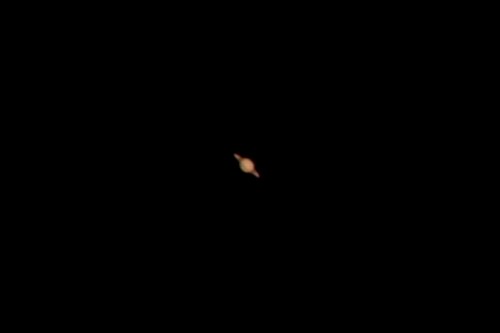
I stayed up late tonight and was finally able to see Saturn with the new scope. This image, however, is not from the 8" - it's from my Wal-Mart special scope. While this image was being captured, I was viewing the ringed planet through my bigger scope. It was beautiful. I could barely make out the Cassini division in the rings and could discern a few striations on the planet itself. Unfortunately it was getting so cold that frost was forming on my equipment and I had to head inside before i could get a higher magnification. I'll try for that soon.

Prior to getting my image of Saturn, I was able to get an image of M81 - Bode's Galaxy:

M81-Bode's Galaxy on 2/1/08

Bode's Galaxy is found near the big dipper - just past the part you drink out of. It's very close to M82 - the Cigar Galaxy.

Overall, a nice night - cold (30°F) but not unbearable. The mount worked really well with the exception that I believe I need to further align my polar scope. Other than that it tracked and slewed smoothly. Once I get these last couple kinks out I hope to be able to start doing some really long exposures.