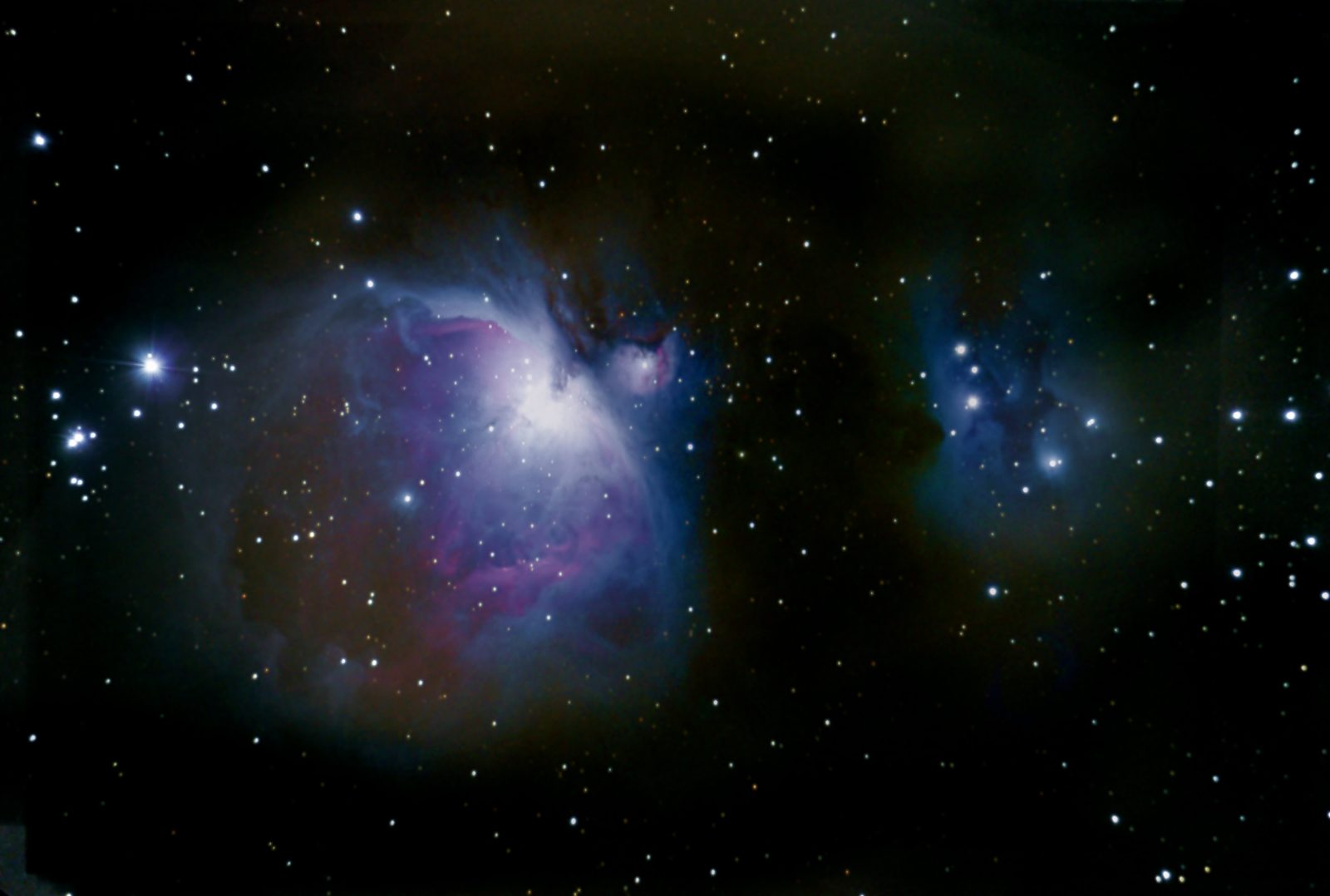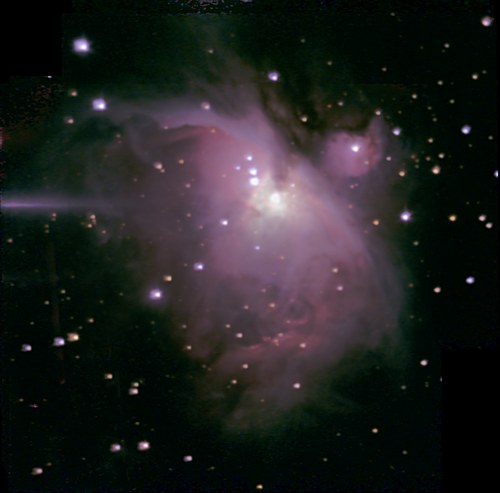
The Great Orion Nebula (M42) and the Running Man Nebula, photographed from Flintstone, Georgia

Flintstone Stargazing

Astronomical observations by a guy in Flintstone, Georgia

M42 – the Great Orion Nebula, February 2009

Category: astronomy

October 17, 2007

Cloudy, but the Moon peeked through

Filed under: astronomy, Astrophotography, Moon, Observation Journal — Ed @ 8:58 pm


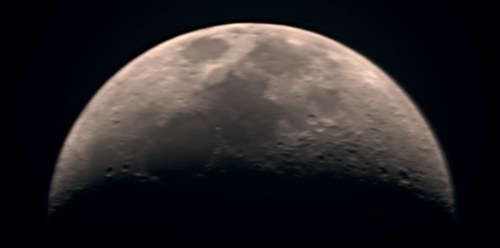
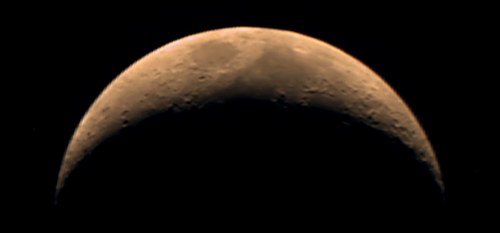
The Moon on 10/17/07

It's been cloudy the past few days around here, though we haven't had any rain. We haven't had rain in about a month, actually. Tonight, the clouds aren't completely covering everything and every so often the Moon would peek through. This image was taken during one of those peek times.

We really need some rain - it's pretty clear from how often I've had good viewing over the past month how little rain we've had. Of course it's nice to be able to do so much imaging, but I'd gladly trade that for a couple days of rain.

October 16, 2007

Reprocessing Omega Nebula (M17)

Filed under: astronomy, Astrophotography, Messier Objects, Observation Journal — Tags: M17 — Ed @ 10:54 pm


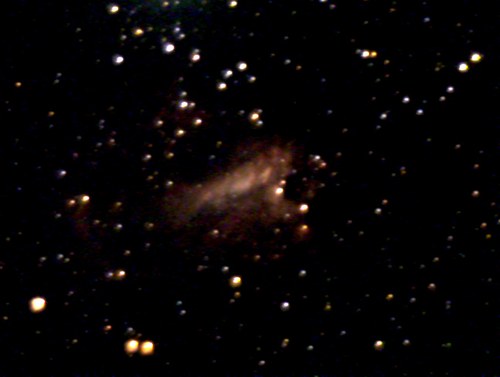
M17-Omega Nebula (Image 3) on 10/5/07

Two weeks ago, I posted two quickly stacked versions of M17 that were created using DeepSkyStacker. The two images I got varied in how I used the stacking software and produced two images that wound up being either washed out or pixelated in the details. They just didn't look all that great. Tonight, since it's cloudy out, I figured I could take the time to reprocess that image and see what results I could get.

The image above was actually processed using the Entropy Weighted Average method (which I've found to give the best results so far on the images I've used DeepSkyStacker on), but so was the brighter of the two images from last time. The big difference was in how I adjusted the luminence curves after the stacking was done. I think the image above is about as good as I could get with the 450 seconds of exposure time I had available. There's a lot more subtlety in the colors and more detail in the darker areas of the Nebula. To see what much better telescopes than mine get for this nebula, you can go here for amateur images or here for Hubble Space Telscope images. Considering the size of my telescope and the limited exposure time (7.5 minutes) I think this image holds up pretty well against some of the amateur images.

October 15, 2007

The Dumbbell Nebula

Filed under: astronomy, Astrophotography, Messier Objects, Observation Journal — Tags: Dummbell Nebula, M27 — Ed @ 10:13 pm


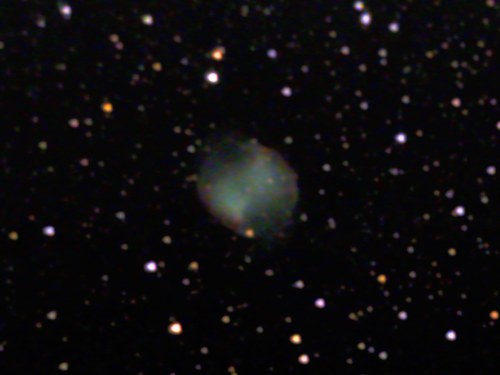
M27-Dumbbell Nebula on 10/15/07

This image is a 25 minute exposure of M27 - The Dumbbell Nebula. I've imaged this before, but never for this long. This image shows a lot more detail than my previous effort. Tonight, prior to observing, I collimated my telescope which I believe made a big difference in how crisp the image was. My previous version had a lot of coma visible in the stars. This one really didn't have that problem nearly as much. I also made sure to get a good focus with my Hartman Mask. All of this paid off with the longer exposure to give a nice depth to this image.

The Moon is back

Filed under: astronomy, Astrophotography, Moon, Observation Journal — Ed @ 9:14 pm


The Moon on 10/15/07

Actually, the Moon made its first appearance in a while last night, but I wasn't quick enough to catch it before it set so this is my first picture of the moon since September's full moon. Because it's so low on the horizon, we're seeing it through the thickness of the atmosphere which gives it the reddish orange color. It will be getting higher each night until it will be full in a couple of weeks, so good, dark viewing is going to start being harder to come by unless I begin viewing in the mornings. Eesh - I'm not a huge fan of getting up early, but I'm also interested in getting some more of the early morning sights like Venus and Saturn. Tonight I'm taking a long exposure shot of The Dumbbell Nebula and then I'm off to bed.

October 14, 2007

The Sword of Orion

Filed under: astronomy, Astrophotography, Messier Objects, Observation Journal — Tags: M42, M43, Orion — Ed @ 2:21 pm


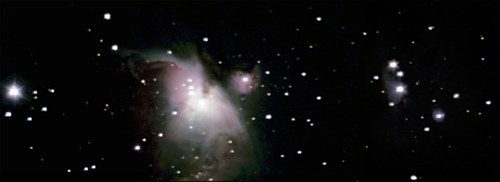
M42-The Great Orion Nebula Panorama on 10/14/07

The other day I got up early and got some shots of the Great Orion Nebula (M42). I was so thrilled by this fantastic deep sky object that I decided to get up early this morning as well. This picture is the result. I got several good images which were stacked and composited to create the panorama you see here. On the left of the image is Na'ir al Saif (officially known as Iota Orionis), a second maginute star which in my previous images bled over into the Orion Nebula(M42). To the left of center is the great orion Nebula with its sweeping reds, blues and purples. Just to the right of that is the smaller de Mairan's Nebula(M43) . I'm not exactly sure why this is considered a separate object, but it is. It's actually part of the Orion Nebula, because the gap you see is not actually a gap, it's dust that obscures our view of that part of the nebula. On the right of the image is NGC 1981, an open star cluster that has just a bit of nebulosity to it - the nebulosity is only partly captured in this image. You can read about the NGC (New General Catalogue) at its Wikipedia Entry.

In the night sky, the area that this panorama images is the sword of Orion (which hangs from his belt). You would turn this image 90° to the left to see the way that it would be seen in the early morning sky right now. These are the three "stars" that make up his sword. Unlike the majority of the objects I take images of, they are visible to the naked eye under normal viewing conditions.

October 13, 2007

October 12, 2007

Stargazing with my son

Filed under: astronomy, Astrophotography, Messier Objects, Observation Journal, Planets — Tags: M13, M19, M25, M26, M28, M30 — Ed @ 10:50 pm


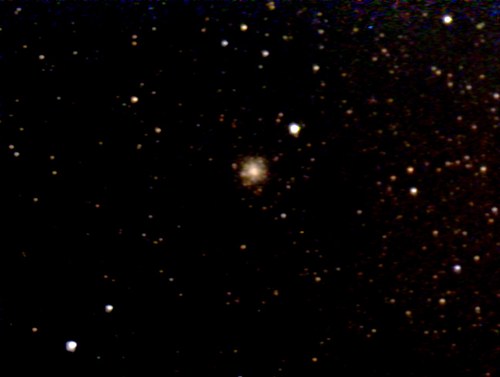
M19 on 10/12/07

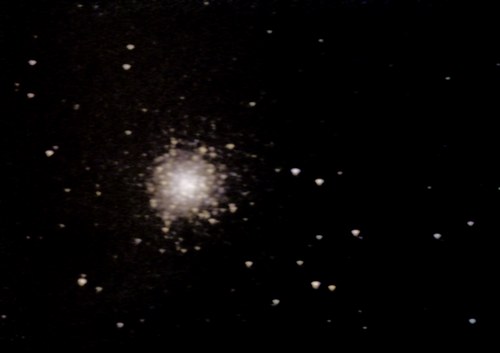
My oldest son Eddie, who is 11, stayed up with me this evening and we captured a bunch of the Messier Objects. This evening we were able to capture M19 (pictured above) as well as M25, M26, M28 and M30. I let Eddie help figure out what we should capture and while we were doing that he suggested we should try to get an image of Pluto. We were able to find it! I'll get another photo in a day or two and post it then so that you can see that it moves against the background of the stars. With the Messier Objects I got this evening I now have 48 Messiers (out of 110) and 5 of the 9 planets (for these purposes, I'm counting Pluto as a planet. :) )

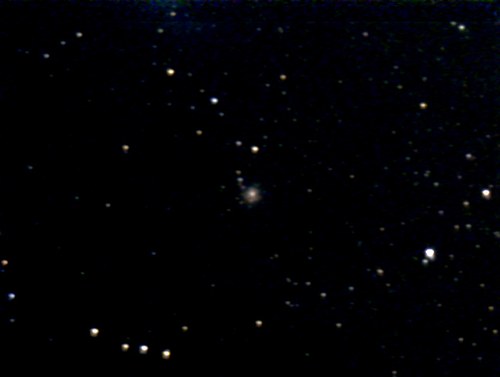
We had a great time. I helped him figure out how to properly point the telescope and explained how the capturing software worked. He had already played with the Starry Night software that I use to find things and had a great time helping me figure out if we were in the right place (which was particularly important with Pluto since it wasn't obvious like the Messiers). We ended up the night with him deciding to do a lot of 15 second exposures of M13 (which we would stack afterward) - a very bright and easy to find target. I told him where to aim the telescope using the red dot finder then he looked through the eyepiece and was able to see the blur of M13. I helped him refine his positioning and get it really centered then we attached the camera. Below is the result:

M13 on 10/12/07
M13 on 10/12/07 (taken by Eddie)

October 11, 2007

The Pinwheel Galaxy (M101)

Filed under: astronomy, Astrophotography, Messier Objects, Observation Journal — Tags: M101, Pinwheel Galaxy — Ed @ 10:50 pm


M101-Pinwheel Galaxy on 10/11/07

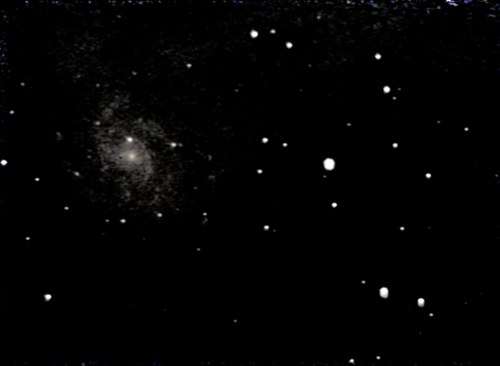
Well lookee there! I've tried to image this at least 3 times with no success. Tonight, though, I was able to finally spot it and get enough images to tease out some detail. The Pinwheel Galaxy is aptly named - you can see the spiral arms of this galaxy as we view it from almost directly overhead (or is it underneath?).

It is located above and in between the two leftmost stars on the handle of the Big Dipper. Actually if you could see it with the naked eye it would appear to form an equilateral triangle with those two stars at the base. The Big Dipper article on Wikipedia includes M101 in it so you can see what I mean here. I also noticed in the Wikipedia article on M101 that in A Wrinkle in Time (one of my favorite books from one of my favorite authors) the planet Uriel is located in the Pinwheel Galaxy. I don't think Uriel is visible in this picture.

There was a lot of noise I had to cut out on this image due to the number of cars shining their headlights right into my telescope (this is low on the horizon and in the northwest so I'm looking right across my street) so I hope to get another version of this somewhere really dark and when it's higher in the sky.

The Sunflower Galaxy (M63)

Filed under: astronomy, Astrophotography, Messier Objects, Observation Journal — Tags: M63 — Ed @ 9:35 pm


M63-Sunflower Galaxy on 10/11/07

The Sunflower Galaxy appears quite small in this picture. That's because I have a very low power telescope. Earlier I mentioned that I needed to get some Messier Objects numbered in the 60's and this is my first one in that range. I wasn't able to get any in the 80's (the only other range I don't have images from) - the only two visible in the evening right now are in the low north which means I'm looking right into the light polution from Chattanooga, cars' headlights that drive up my street and my neighbor's mailbox light. I can barely see second magnitude stars at that angle so those will have to wait until later in the year or I get the opportunity to observe someplace that has a clearer view. I'm going to try to get the Pinwheel Galaxy next. I haven't had much luck in the past - it's pretty faint and hard to spot in my telescope.

A Reprocessed M42 - The Great Orion Nebula

Filed under: astronomy, Astrophotography, Messier Objects, Observation Journal — Tags: M42, M43 — Ed @ 7:07 pm


M42-Orion Nebula/M43-de Mairan's Nebula (Image 3) on 10/10/07

The other day I imaged the Great Orion Nebula and I posted two versions of the image that I did quickly that morning. This evening, I've had some time to restack the images in DeepSkyStacker. I'm starting to really understand better how to get the most out of this program. After restacking, the image showed a lot more detail than it had previously, particularly in the subtleties of the nebulosity and dust channels.

You may also notice the faint green haze around the outside of the nebula. The interesting thing about that is that through binoculars or my telescope, the nebula looks a faint greenish - there's really no hint of purple or red, but as soon as I connected my camera, it's clearly putting out quite a lot of red/purple light and the greenish tinge is really only seen around the edges. I'm not sure if this is the case in a more powerful telescope or not. Does anyone who has seen this through a more powerful telescope know the answer? Let me know.

Right now things are looking good for this evening, so I'm hoping to continue my Messier Hunt.