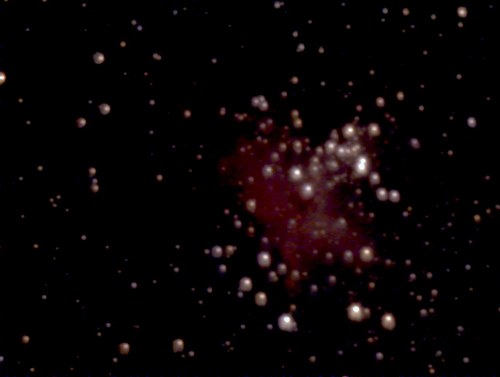
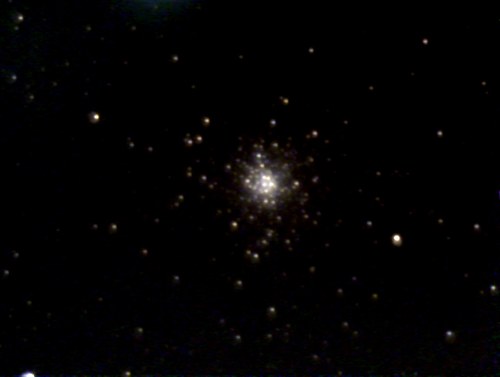
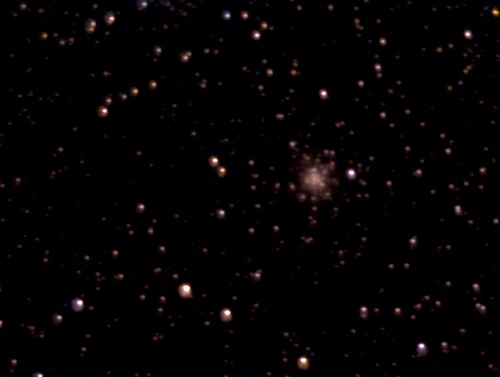
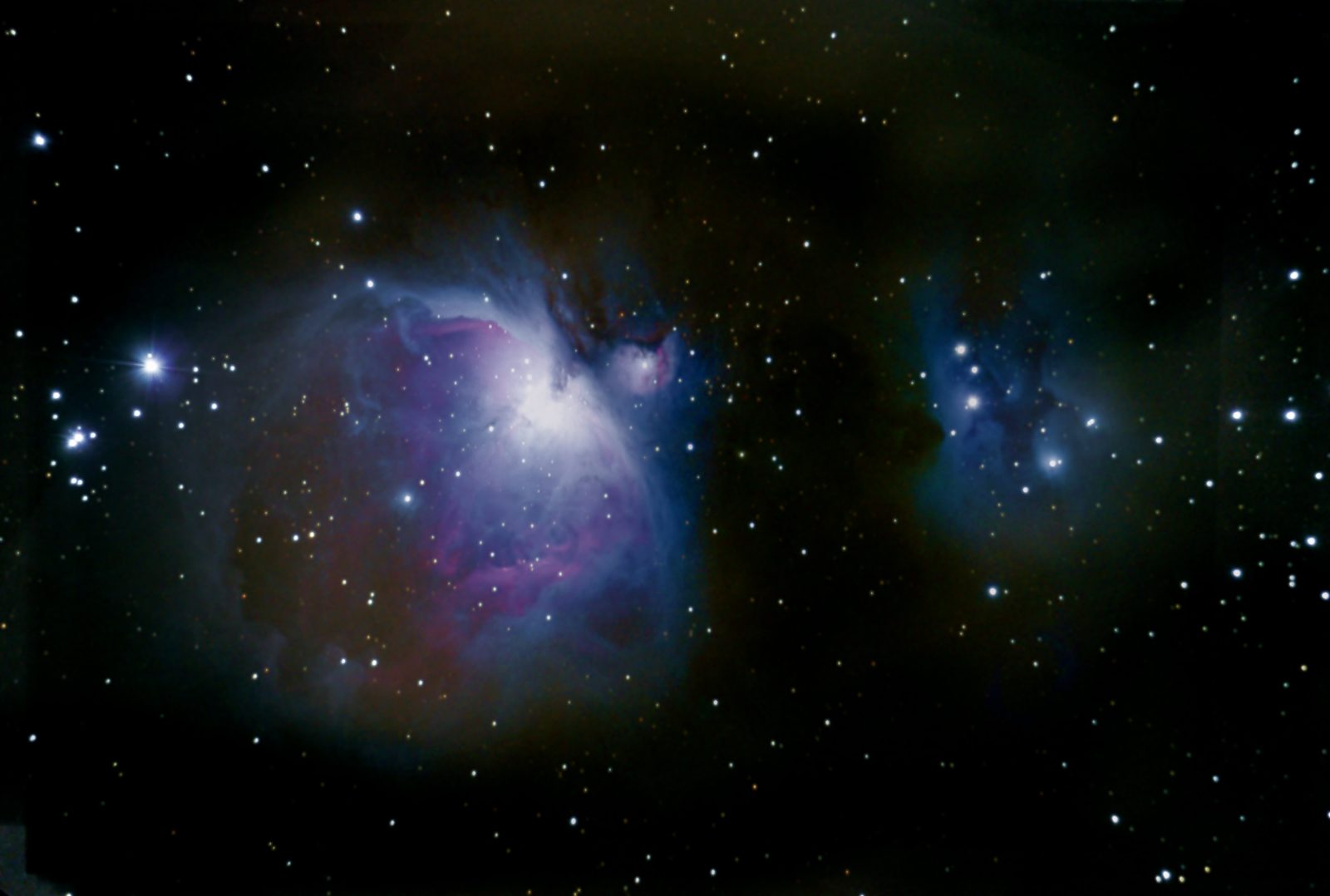
The Great Orion Nebula (M42) and the Running Man Nebula, photographed from Flintstone, Georgia

Flintstone Stargazing

Astronomical observations by a guy in Flintstone, Georgia

M42 – the Great Orion Nebula, February 2009

Category: astronomy

October 2, 2007

M8-The Lagoon Nebula

Filed under: astronomy, Astrophotography, Messier Objects, Observation Journal — Tags: Lagoon Nebula, M8 — Ed @ 11:05 pm


M8-The Lagoon Nebula on 10/2/07

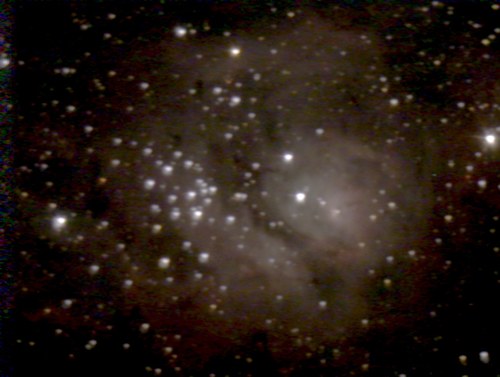
After counting stars with my kids, I turned my attention to some Messier Objects I had not captured before which I'll post later. M8 I had imaged before, but not with my DSI so I took this shot which is a 390 second exposure. You can really see the nebulosity in this - I'm very happy with this image. I'll be posting more soon.

Counting stars with the kids

Filed under: astronomy, ISS, Observation Journal — Tags: International Space Station, kids, worthwhile — Ed @ 9:32 pm


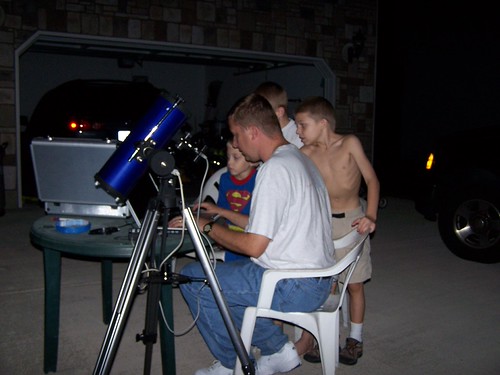
My kids and I doing some stargazing

Tonight has been absolutely gorgeous. Three of my children stayed up a little bit later than normal (until after 9:00) to take part in the Great Worldwide Star Count. First, though, we went out early to catch the International Space Station which was going to be visible in the south. It was really bright!. Then, we lay down on some blankets in our front yard and looked at the constellation Cygnus like we were supposed to. The kids determined that we could see stars up to 5th magnitude based on the charts they provided. We then uploaded the results using my laptop which I had out for my evening's stargazing. I plan to post a number of other pictures later on this evening.

It's not too late to participate in the Great Worldwide Star Count! They are accepting observations through the 15th of this month.

International Space Station at 8:39pm tonight

Filed under: astronomy, ISS — Tags: International Space Station — Ed @ 7:45 pm

The Internation Space Station will be rise above the southwest horizon and head northeast until entering Earth's shadow at 8:44pm near the constellation Cygnus. It should be the brightest thing in the sky and it will go a bit beneath (visually) Jupiter in the sky. Also, if my software is right, there is a Progress mission that should be with it as well and very bright also. While they still may be visible after they enter the Earth's shadow, they will probably be much harder to see. The neat thing is that Cygnus is the constellation that people are supposed to view for the Great Worldwide Star Count over the next two weeks. It looks great for that tonight and I'll be out in my driveway with my kids counting stars. You should participate too!

Note: I've noticed that this post gets a lot of hits, I'm assuming from searches. The ISS's orbit brings it over different parts of the world continuously so while on this particular day it was visible in Flintstone, GA at 8:39pm, there's no guaranteeing it'll be there at that time tonight. That said, if you'd like to find out when it'll be visible in your particular area, please visit Heavens Above. They have a nifty utility that'll calculate all that kind of stuff. In the mean-time, have a look around.

October 1, 2007

Great Worldwide Star Count starts tonight! Please participate.

Filed under: astronomy — Tags: family, fun, kids, worthwhile — Ed @ 1:11 pm

The Great Worldwide Star Count starts tonight. This is a great opportunity to get kids involved in looking at the night sky and actually helps the science of astronomy. If you didn't see my earlier post on this, the Great Worldwide Star Count is an effort to map light polution around the world. Basically what they are asking people to do is to go to a web site and follow these instructions. You don't have to know anything about astronomy - as a matter of fact you may learn something!

To participate, you'll be going outside where you can see the sky an hour after sunset. You'll look almost straight up and compare what you see with the diagrams that the web site provides. You don't actually have to count stars - you just have to make an effort to figure out which of the magnitude charts looks most like what you see. Also, just from my own personal experience, don't just quickly walk outside and look up. Spend a few minutes allowing your eyes to adjust to the dark. Then make an effort to see the fainter stars in the constellation. Sometimes, you can see stars better by looking to the side of them since most people's eyes have more sensitivity outside of the middle of the field of view. You'll log your observations on their web site afterward and that's it!

This is also a great event to get kids involved in. They can participate just like adults can (as a matter of fact, their eyes may be better than adults). I'm planning on having my kids out with me tonight observing and will post some pictures on the site.

Tonight's viewing conditions look very promising right now and so it would be a great night for you to step outside and strike a blow for Science™ or something. And just for reference, last night at my house in Flintstone, GA I was able to easily see 5th magnitude stars and maybe a few beyond that. It was beautiful outside.

Finally, there's nothing preventing you from staying outside longer and looking at the heavens. In my part of the country, there are several other things you can obseve right now. Jupiter is the bright star in the south-southwest early in the evening. The Big Dipper is low in the north-northwest after sunset. Sagittarius is in the south and looks like a teapot. Since the moon doesn't rise until late, if your skies are dark, you should be able to see the milky way running from Sagittarius in the south toward the north-northeast across the entire sky. Last night it was really beautiful. As a bonus for going out early, the ISS will be visible in the south at 8:17pm. 

We plan on having a lot of fun and hope you do too. If you participate, please leave a comment here with what you saw and did. I'd love to hear about it.
September 30, 2007

September 28, 2007

My best view of M13 yet

Filed under: astronomy, Astrophotography, Messier Objects, Observation Journal — Tags: M13 — Ed @ 11:15 pm


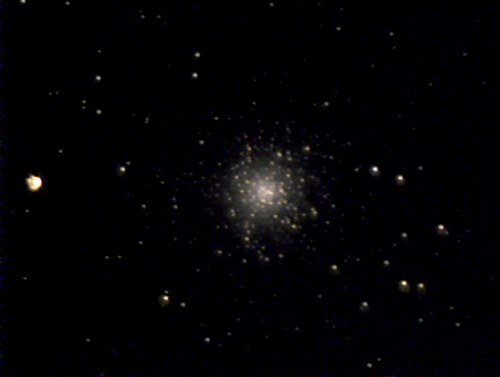
M13 on 9/28/07

Tonight, as I was out in my driveway, my neighbor Matt came over and I was showing him what I was viewing in the driveway. I figured M13 would be a good target to demonstrate what I was up to. Since it was a bit cooler than it has been (around 65) my camera had less noise than normal and I was able to take 50 15second images to put together this image which is my best view yet of M13. This view resolves a lot more stars than my previous views have. I think it's a combination of lower noise, good focus, dark skies and longer exposure times. Anyway, I'm really happy with it.

M9 - with airplanes, no less!

Filed under: astronomy, Astrophotography, Messier Objects, Observation Journal — Tags: M9 — Ed @ 10:59 pm


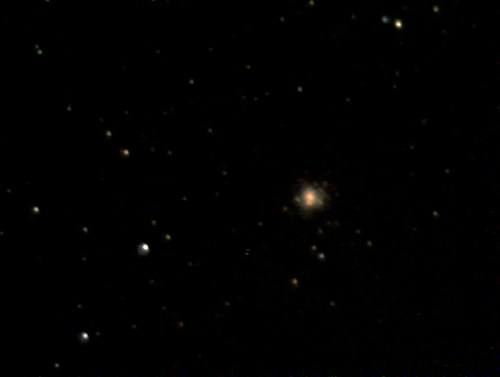
M9 on 9/28/07

My Messier album collection is marching on tonight. I was able to get some good viewing in before the Moon rose and the clouds appeared. While taking this image of M9, I had time to visually look at the little dipper (not the big dipper), which enables you to get some idea what magnitude of stars are visible to you because (as described here) the bowl of the dipper contains 4 stars of magnitude 2, 3, 4.3 and 5. If you can see all four, you've got pretty good skies. I was able to make out 3 easily and eventually the fourth star was visible as well.

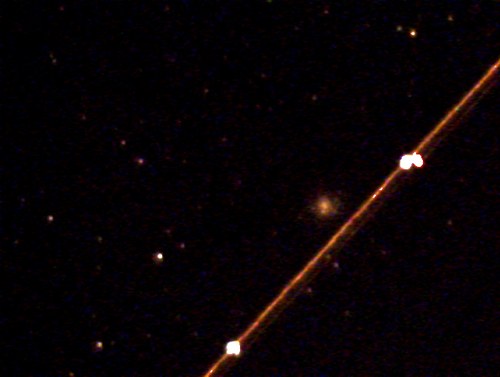
While my camera was taking 15 second exposures of M9 to stack, I noticed a strange diagonal line through the default stacked image (I restacked them later to remove it). When I looked at the individual exposures, I found this in the 7th 15 second frame:

M9 - A plane flies through
M9 - a plane flies through

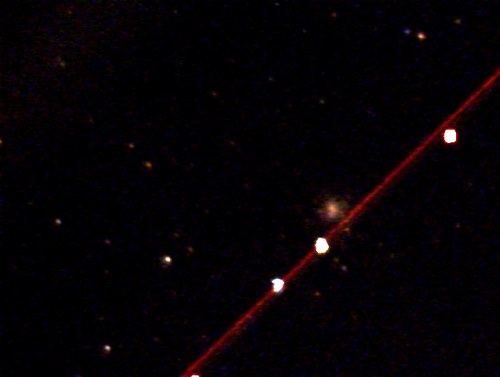
The reddish line is the airplane's normal operating lights, the white spots are a light on the bottom of the plane that flashes periodically. Then, in the 11th 15 second frame (60 seconds later), this is what I found:

M9 - Another plane flies through
M9 - another plane flies through

What are the odds that two planes would fly through this shot a minute apart and would be within a couple arcseconds of difference? Crazy!

M51 - The Whirlpool Galaxy

Filed under: astronomy, Astrophotography, Messier Objects, Observation Journal — Tags: M51, Whirlpool Galaxy — Ed @ 10:01 pm


M51-Whirlpool Galaxy on 9/28/07

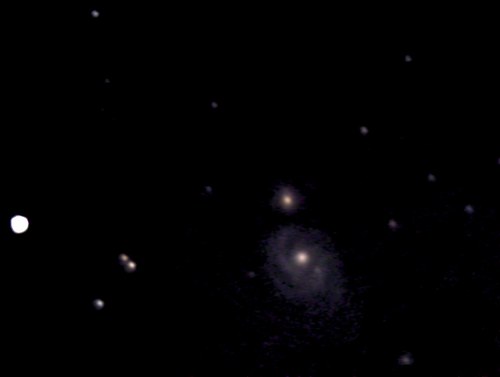
This is a very long exposure of a very faint object. I've tried to image it before, but it's really dark with decent seeing tonight and so I figured now would be a good time to try. You can see, if you look at the pixelization that this image has been level tweaked extensively to bring out the detail in the galaxy. This brings my Messier Album count up to 24 out of 110.

The Great Worldwide Star Count

Filed under: astronomy — Tags: worthwhile — Ed @ 1:38 pm

Here's a way you can help Science™. From October 1-15, you can join the Great Worldwide Star Count and help map global light polution. It's really quite easy and doesn't require a telescope or even binoculers. All you need to do is go outside and look up in the sky and see which of the sky maps on the site matches what you see. It not only will help map light polution, but will give you some idea what you can see in the sky and what you should be able to see. This is a great project for kids and I'm planning on getting my kids involved.

September 27, 2007

M40 - Maybe the oddest Messier Object?

Filed under: astronomy, Astrophotography, Messier Objects, Observation Journal — Tags: M40 — Ed @ 11:22 pm


M40 on 9/27/07

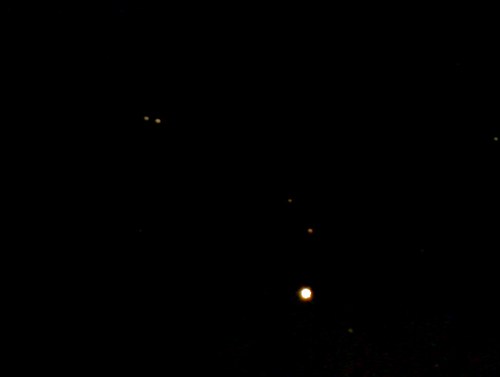
The "Double Star" in the upper left quarter of this image is M40 - an object cataloged by Charles Messier in 1764. While I've only seen 25 or so Messier Objects through my telescope, this is the only one that only involves 2 stars. It also seems almost impossible to confuse with a comet (which is a general characteristic of, though not a requirement for, Messier Objects). The wikipedia entry indicates that Messier was looking for a nebula that had been described by someone else, didn't find it and catalogued this instead. Bizarre.