The Moon on 2/19/10
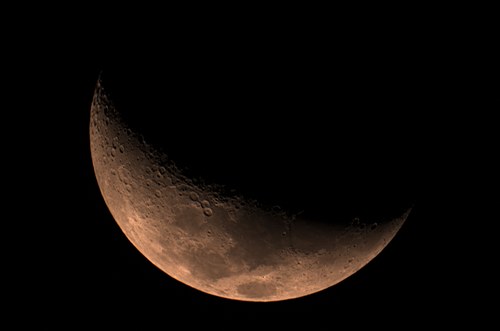
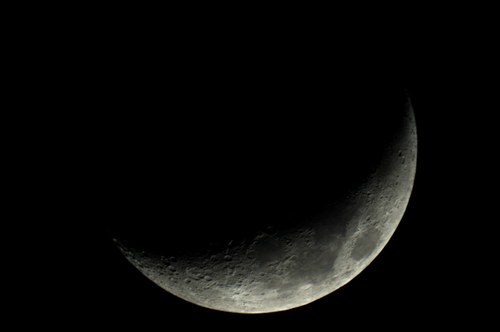
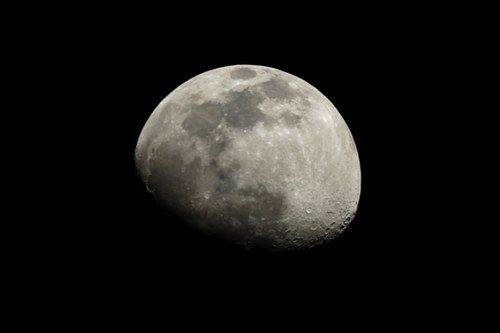
I also got this shot of the Moon through my new Mak. The image doesn't do justice to the view through the scope.
I also got this shot of the Moon through my new Mak. The image doesn't do justice to the view through the scope.
The first clear night in ages, it was a bit cold, but it was nice to get out anyway. Tomorrow's supposed to be nice too.
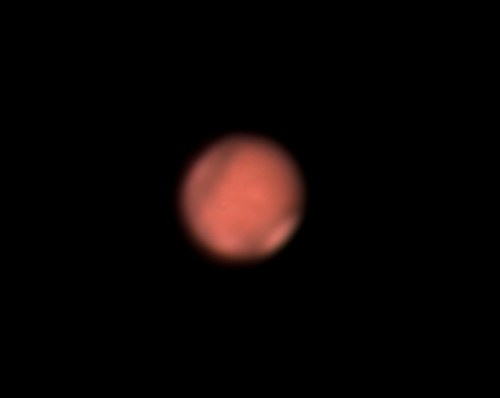
It's been so cold, I haven't been out at all this year yet. It has finally warmed up a bit (high 30's) and so I went out tonight in spite of the light, but growing, clouds. Mars did not disappoint! Through my Maksutov-Cassegrain scope, with my 5X Barlow, I could clearly see the polar cap and a bit of detail on the planet. The camera could pick up even more as you can see. Mars right now is approaching it's largest size for the next 2 years at the end of this month - it's definitely getting bigger and I hope to get more images as it gets closer.
Happy New Year! It's clear, but cold, today and so since the family is hear, I attached my new solar filter (which uses Seymour Solar film) to my new Maksutov telescope and took an image of the Sun. The new sunspot group 1039 is visible in the lower part of the Sun. The Sun has been incredibly quiet for well over a year, with almost no sunspots and those that are there have been very small. It's getting ready to be a lot busier soon and I hope to be able to image our closest star more in the days to come.
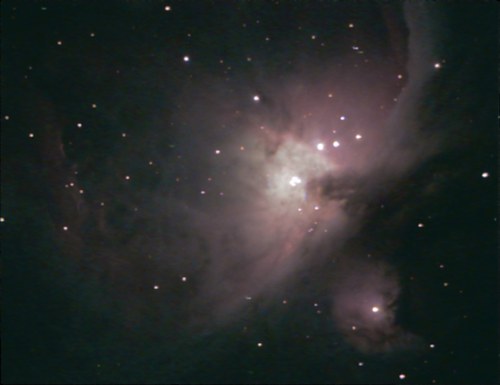
The Orion Nebula is up again and is beautiful as always. Unfortunately, I've lost my remote for the D50 or I would have some nice wide field shots. Before I went in, Mars was peeking over my house and I was able to visually make out a polar cap and a bit of surface detail. Very cool and I hope to image it soon.
The Moon, through my new scope, fills the eyepiece - even the wide angle ones - and the detail is fantastic. Unfortunately, this picture does not do justice to what's visible in the eyepiece. Copernicus Crater was unbelievably striking as was everything else along the terminator. It was really, really cold out, but I bundled up and had a great time viewing and imaging.
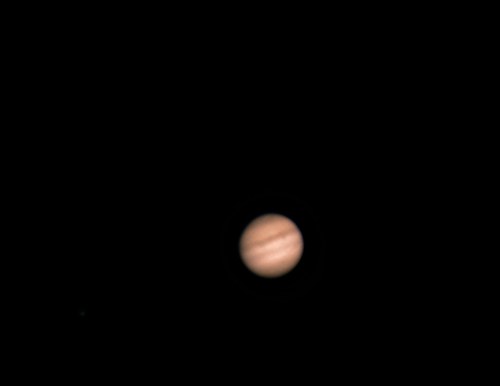
This new scope is going to be wonderful, particularly when it comes to visual observing. It's so much lighter than my big 8" that I actually had to completely remove one of the counterweights. The view of Jupiter was great. It took a while to cool down (and I don't think I waited until it was completely cooled down to take this image), but the views are just incredibly sharp - very, very nice.
Only real problem so far is that I need to put a guide scope on this thing - it's hard to find stuff without one, though I did manage eventually.
After aligning, I immediately sent the scope to Jupiter and the magnification with my 26mm eyepiece was much higher than my 8" (it's focal length is more than twice as long) and the sharpness was just fantastic. I tested collimation by going inside and outside of focus on Vega and it looked dead on. So far, I'm really thinking I'm going to like this scope.
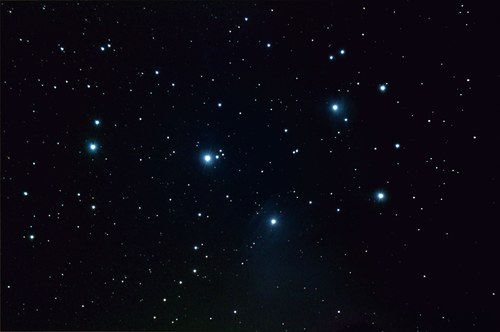
After viewing (and, obviously, imaging) Jupiter for a while, I decided to take a look at some deep sky stuff. M57, the Ring Nebula was clearly defined in shape and easily visible. M27, the Dumbbell Nebula was also large and bright in the scope. M31, the Andromeda Galaxy looked nice as well and M2, a globular cluster, was nice. Once I started looking at open clusters however, the scope really began to shine. The Pleiades were bright and beautiful, but the Double Cluster was just breathtaking. I've never seen it look so beautiful - it looked absolutely 3D.
Again, I think I'm going to love this scope.
The Moon was quite bright last night and so there really wasn't too much use in imaging anything deep sky stuff.
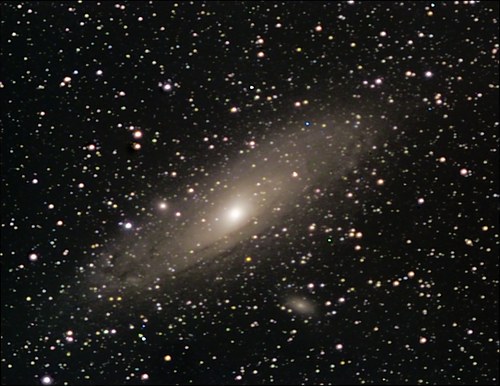
I recently bought a 135mm f/2.8 lens off of eBay. It's an old Soligar (it's about my age) and has a manual focus, Because my DSI uses a T-mount as well as this lens, I just bought a couple spacers and now I'm able to use my DSI to take widefield shots like this one. With my telescope, I can't get the entire Andromeda Galaxy into the frame with my DSLR, but with this lens, it fits on my little DSI just fine. I hope to do a more imaging like this soon.
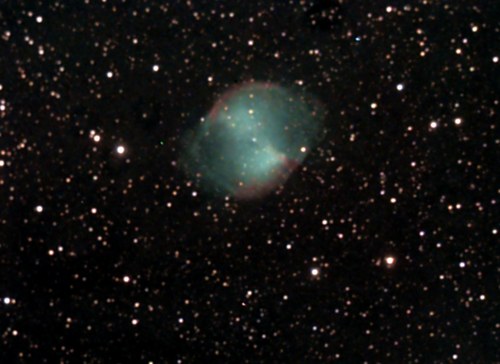
I've decided to just call M27 the Apple Core Nebula. It's also known as TNFKATDN or "The Nebula Formerly Known As The Dumbbell Nebula". It was a pretty nice night, though cold, until about 11, when wispy clouds started to mess up the view. I spent a while earlier seeing if I could gather images with my DSI which could be used for asteroid hunting, but came to the conclusion that with my setup, that's not going to be possible. Anyway, at least I got one good image tonight...