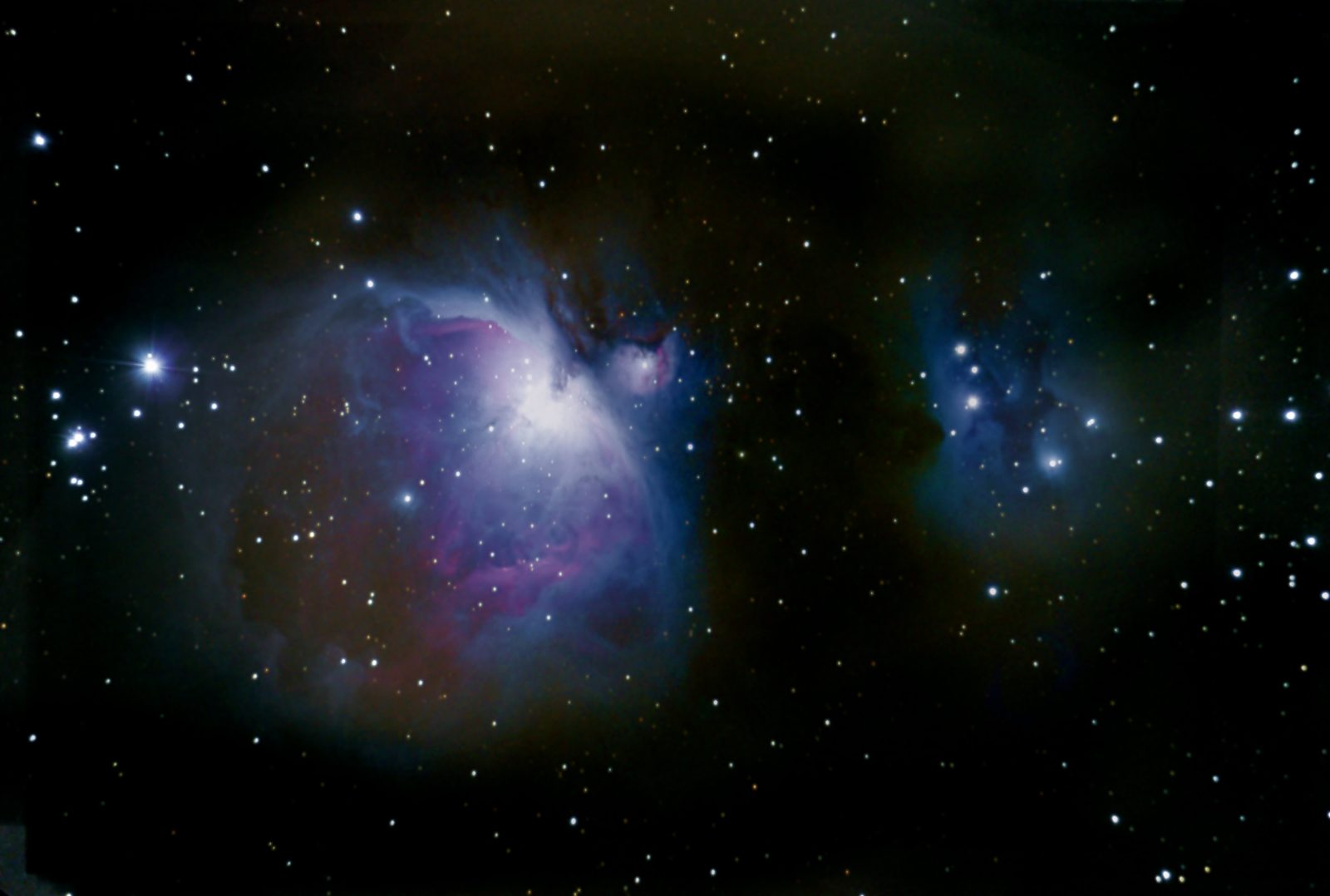
The Great Orion Nebula (M42) and the Running Man Nebula, photographed from Flintstone, Georgia

Flintstone Stargazing

Astronomical observations by a guy in Flintstone, Georgia

M42 – the Great Orion Nebula, February 2009

Category: Messier Objects

September 30, 2007

September 28, 2007

My best view of M13 yet

Filed under: astronomy, Astrophotography, Messier Objects, Observation Journal — Tags: M13 — Ed @ 11:15 pm


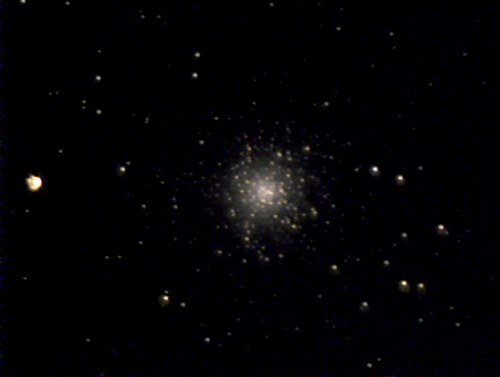
M13 on 9/28/07

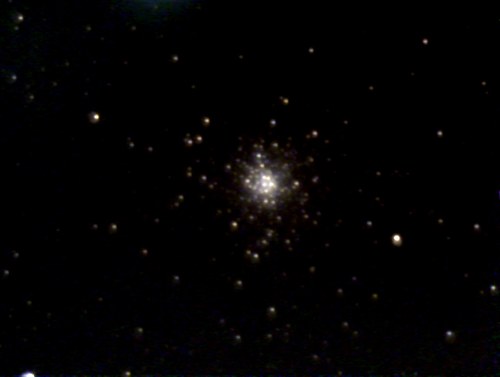
Tonight, as I was out in my driveway, my neighbor Matt came over and I was showing him what I was viewing in the driveway. I figured M13 would be a good target to demonstrate what I was up to. Since it was a bit cooler than it has been (around 65) my camera had less noise than normal and I was able to take 50 15second images to put together this image which is my best view yet of M13. This view resolves a lot more stars than my previous views have. I think it's a combination of lower noise, good focus, dark skies and longer exposure times. Anyway, I'm really happy with it.

M9 - with airplanes, no less!

Filed under: astronomy, Astrophotography, Messier Objects, Observation Journal — Tags: M9 — Ed @ 10:59 pm


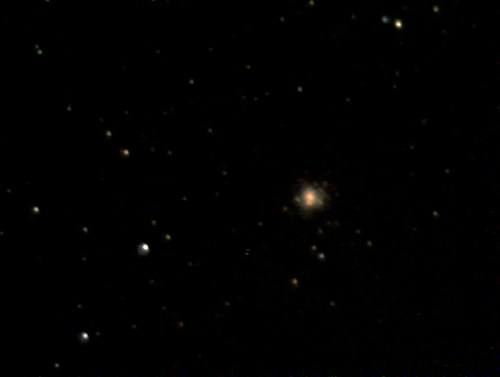
M9 on 9/28/07

My Messier album collection is marching on tonight. I was able to get some good viewing in before the Moon rose and the clouds appeared. While taking this image of M9, I had time to visually look at the little dipper (not the big dipper), which enables you to get some idea what magnitude of stars are visible to you because (as described here) the bowl of the dipper contains 4 stars of magnitude 2, 3, 4.3 and 5. If you can see all four, you've got pretty good skies. I was able to make out 3 easily and eventually the fourth star was visible as well.

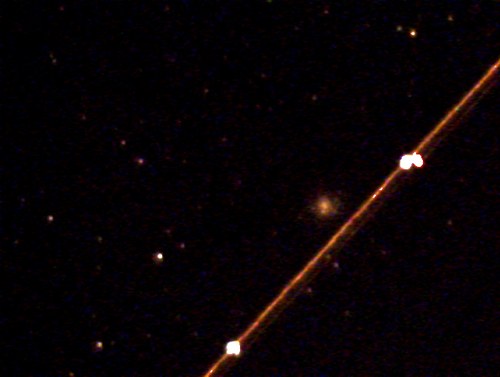
While my camera was taking 15 second exposures of M9 to stack, I noticed a strange diagonal line through the default stacked image (I restacked them later to remove it). When I looked at the individual exposures, I found this in the 7th 15 second frame:

M9 - A plane flies through
M9 - a plane flies through

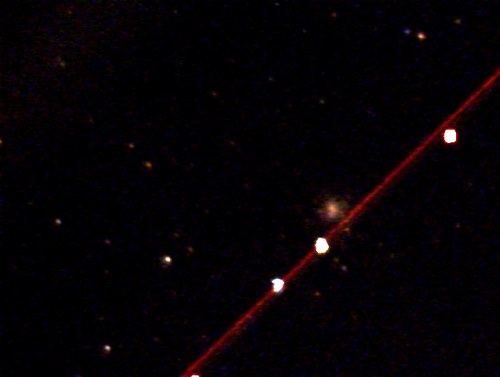
The reddish line is the airplane's normal operating lights, the white spots are a light on the bottom of the plane that flashes periodically. Then, in the 11th 15 second frame (60 seconds later), this is what I found:

M9 - Another plane flies through
M9 - another plane flies through

What are the odds that two planes would fly through this shot a minute apart and would be within a couple arcseconds of difference? Crazy!

M51 - The Whirlpool Galaxy

Filed under: astronomy, Astrophotography, Messier Objects, Observation Journal — Tags: M51, Whirlpool Galaxy — Ed @ 10:01 pm


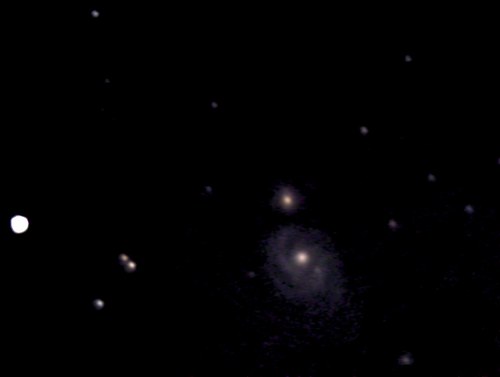
M51-Whirlpool Galaxy on 9/28/07

This is a very long exposure of a very faint object. I've tried to image it before, but it's really dark with decent seeing tonight and so I figured now would be a good time to try. You can see, if you look at the pixelization that this image has been level tweaked extensively to bring out the detail in the galaxy. This brings my Messier Album count up to 24 out of 110.

September 27, 2007

M40 - Maybe the oddest Messier Object?

Filed under: astronomy, Astrophotography, Messier Objects, Observation Journal — Tags: M40 — Ed @ 11:22 pm


M40 on 9/27/07

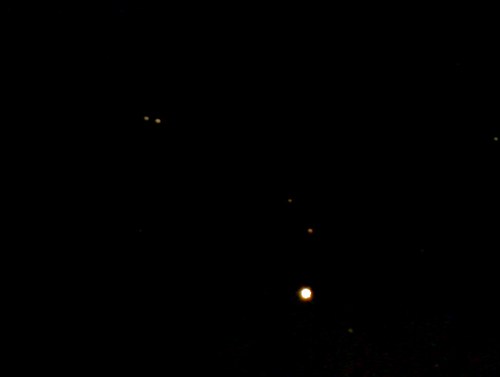
The "Double Star" in the upper left quarter of this image is M40 - an object cataloged by Charles Messier in 1764. While I've only seen 25 or so Messier Objects through my telescope, this is the only one that only involves 2 stars. It also seems almost impossible to confuse with a comet (which is a general characteristic of, though not a requirement for, Messier Objects). The wikipedia entry indicates that Messier was looking for a nebula that had been described by someone else, didn't find it and catalogued this instead. Bizarre.

September 24, 2007

What a difference seconds can make

Filed under: astronomy, Astrophotography, Messier Objects, Observation Journal — Tags: M57 — Ed @ 10:10 pm


M57-Ring Nebula Exposure Levels

In responding to a commenter earlier today, I realized it might be a good idea to put together a post discussing how I capture my images and what difference the length of exposure and stacking makes. The above image of M57-Ring Nebula is a composite of 50 different exposures of the nebula that I took this evening. Each row represents a different exposure time and the columns represent the number of images that have been stacked. For example, row 1, column 5 represents 5 1 second images that have been stacked and row 5, column 8 represents 8 15second images that have been stacked.

From this graphic, it's easy to see why you want to stack the largest number of images that you can when getting images of deep space objects like the Messier Objects. The other thing is that you can also see some things that aren't really intuitive. For example, a single 8 second image looks better than 10 1 second images or even 10 2 second images. The reason for this is that the fluctuations in image noise cancel each other out over time and within that one frame, they have already cancelled each other out, particularly when the image is leveled - the more light that has been captured the brighter the objects will be (the greater the signal to noise ratio) and so it will also make the noise lower and the image clearer.

Side note: the fact that the 8 second images are brighter than the 15 second ones is not because they are necessarily better, it's the way the software auto leveled those images. I haven't actually retouched any of the levels in the above image so that we could compare apples to apples. In pretty much all cases, I pull my final images into Photoshop and then adjust levels to pull out details hidden in the images. (I never paint anything or composite with someone else's images - that would be cheating)

Below is a final image I got - 115 15 second images for a total of 1725 seconds (28m 45s). It also automatically discarded at least 50 images that weren't of high enough quality for inclusion in the stack.
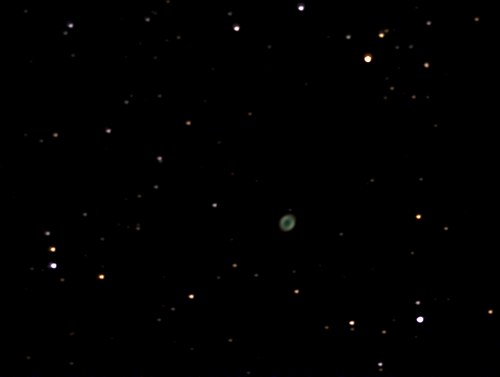
M57-Ring Nebula on 9/24/07
M57-Ring Nebula long exposure
The Seven Sisters


M45 (The Pleiades) on 9/24/07

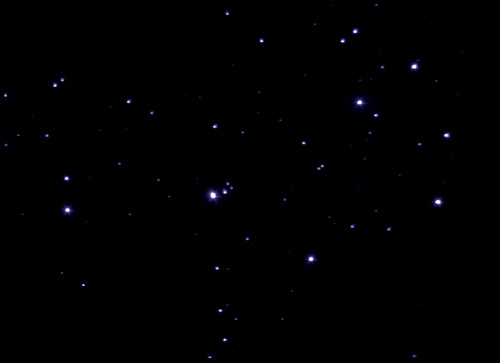
This image of M45 (The Pleiades also known as The Seven Sisters) is a composite of 8 240sec images stitched together in Photoshop. The Pleiades is one of the most fascinating night sky objects visible to the naked eye. This grouping of stars has been known since ancient times and is mentioned in numerous ancient writings (including the books of Job and Amos) and is also featured in a lot of ancient art. When you see it in the sky it's easy to understand why this grouping of stars is so well known and was so well regarded in ancient times. The close proximity of these very bright stars makes it stand out like a spotlight in the sky.

It comes up late this time of year (after midnight at least from my vantage point), but will come up earlier and earlier as the year progresses until in the Winter it will be visible after sunset.

September 22, 2007

M103 in Cassiopeia

Filed under: astronomy, Astrophotography, Messier Objects, Observation Journal — Tags: M103 — Ed @ 11:58 pm


M103 on 9/22/07

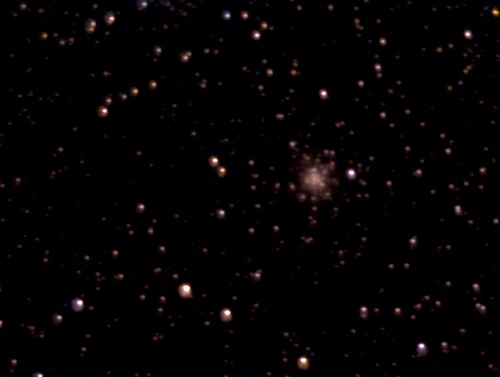
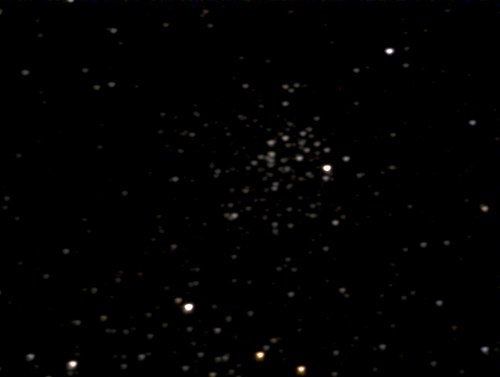
M103 is an open cluster found in Cassiopeia. It doesn't seem to have as many stars as most of the other Messier clusters I've been imaging, but I've got a large number yet to go so we'll see if that perception is correct. Viewing tonight has been hampered by a lot of haze in the atmosphere - it's really humid. You can see the effects of that in the sort of glow around some of the stars.

September 21, 2007

The Little Dumbbell Nebula (M76)

Filed under: astronomy, Astrophotography, Messier Objects, Observation Journal — Tags: M76 — Ed @ 11:53 pm


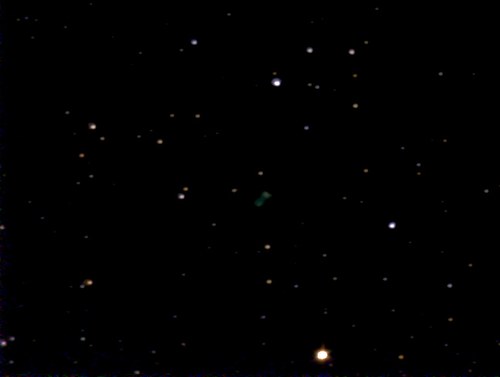
M76-Little Dumbbell Nebula on 9/21/07

This is the Little Dumbbell Nebula (M76) found in the constellation Perseus. It is similar in color and appearance (though smaller) to the Dumbbell Nebula that I imaged last night. Frankly, I think that they should be called the Apple Core Nebulas, but I guess I'm not in charge.

According to Wikipedia, "It is one of the faintest and hardest to see objects in Messier's list." If that's true, then I shouldn't have too much trouble finishing my Messier hunt.