Category: Observation Journal

November 2, 2009

October 28, 2009

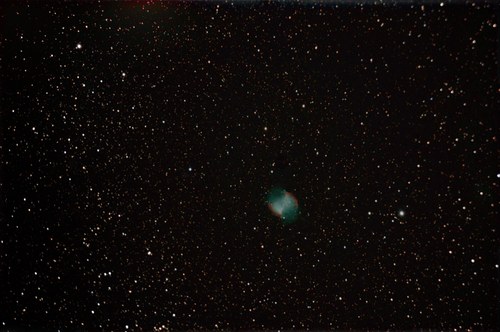
M27-Dumbbell Nebula on 10/28/09

Filed under: astronomy, Astrophotography, Messier Objects, Observation Journal — Tags: M27, Nebula — Ed @ 11:34 pm

Tonight was mostly clear, with occasional wispy clouds. I decided just to focus on one thing with my D50 and choose the Dumbbell Nebula - M27. M27 is a planetary nebula (which has nothing to do with planets) which is the remnants of a star that exploded. You can see the star if you zoom in - it's the cyan one in the center of the nebula. The huge number of stars in this image is from the location of this nebula inside the Milky Way. The Dumbell Nebula (or Apple Core Nebula as I refer to it) is an easy to find and easy to see target in the fall night sky.

October 20, 2009

M13-Great Hercules Cluster on 10/19/09

Filed under: astronomy, Astrophotography, Messier Objects, Observation Journal — Tags: globular cluster, M13 — Ed @ 12:38 am

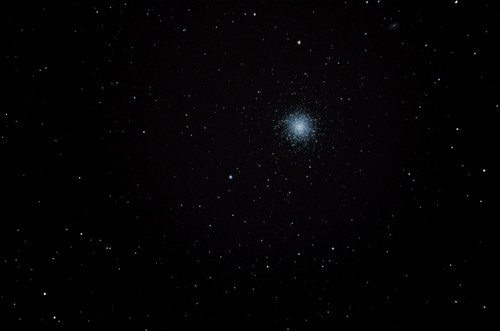
In addition to the Sculptor galaxy, I also took some images of M13 - the Great Globular Cluster in Hercules. It's one of my favorite targets visually and with the DSI-II camera. This one shows it in context and inclues a small spiral galaxy in the upper right that's visible if you zoom in to the large version. Overall a really nice night.

C65-Sculptor Galaxy on 10/19/09

Filed under: astronomy, Astrophotography, Caldwell Object, NGC, Observation Journal — Tags: C65, NGC253 — Ed @ 12:36 am

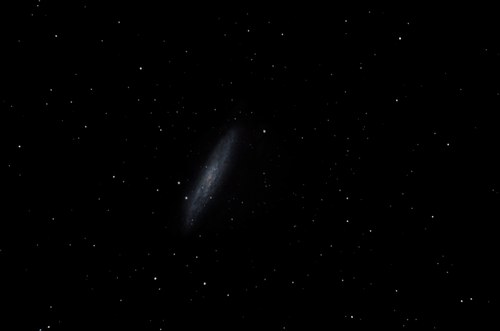
Tonight was as nice as last night, but again, quite cold. I decided to do some more wide-field imaging with my Nikon D50 using the 2" Orion SkyGlow Imaging Filter that I got a while back. I think it does a good job of lowering the overall sky noise that I've seen, particularly with this camera. I love wide field shots because they show context and this one is no exception to that. The Sculptor Galaxy fills my DSI-II camera almost completely and is neat to image with that, but it's also neat to see the context of this galaxy.

October 19, 2009

M31-The Andromeda Galaxy on 10/18/09

Filed under: astronomy, Astrophotography, Messier Objects, Observation Journal — Tags: M110, M31, M32 — Ed @ 12:21 am

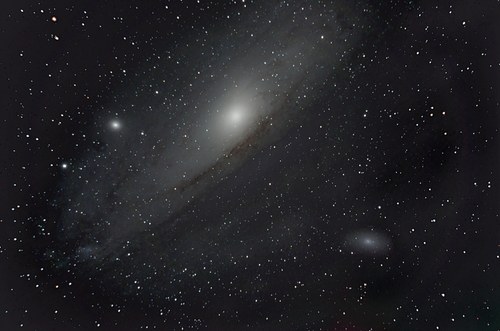
It was very cold this evening, but the sky was clear and so I finally had a chance to try out my new imaging filter with my Nikon D50 camera. I decided to image the Andromeda Galaxy, M31 and I think it did a good job. I need to take some good flats to get the levelling right, but overall, I'm pretty pleased with the image.

September 29, 2009

Visual Observing

Filed under: astronomy, Observation Journal — Ed @ 12:00 am

Tonight, the sky was fantastic - extremely clear. Even though the Moon was very bright, I just had to get the scope out. Unfortunately it was a bit windy for imaging, so I don't have any pictures. I did, however get an additional 7 Messier's observed so I'm just 10 away from the Messier award. I also took the opportunity to look at Jupiter, the Moon, Neptune (for the first time!) and Uranus. Neptune was hard to find and difficult to pick out - it was just like a little blue, faint star. Uranus, however, was resolvable into a blue disc at higher magnification. I hope to get some imaging of both of these sometime soon.

September 23, 2009

Trying out my Galileoscope

Filed under: astronomy, Observation Journal — Tags: Galileoscope — Ed @ 7:16 pm

Last night I had a chance (in between the clouds which have covered the sky for weeks) to try out my $20 Galileoscope. The Galileoscope is a project of the Internation Year of Astronomy. It's a simple scope that duplicates Galileo's telescope capabilities so people can cheaply experience a part of what Galileo experienced. The scope is made of plastic, but seems pretty sturdy and after assembly (which is pretty easy) it's reasonably easy to use. They can be purchased here. Note that it took over 3 months for me to get mine, so be prepared for a wait if you decide to order one. (I'd also recommend this not be your first scope just because I could see it being very frustrating for a first time user since you really can't see much with it.)

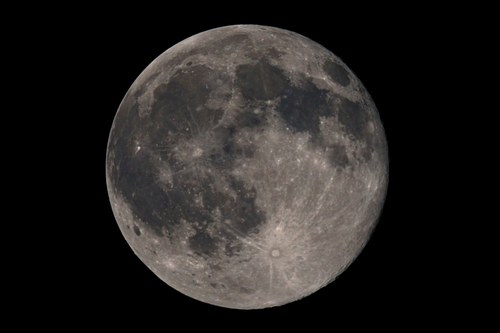
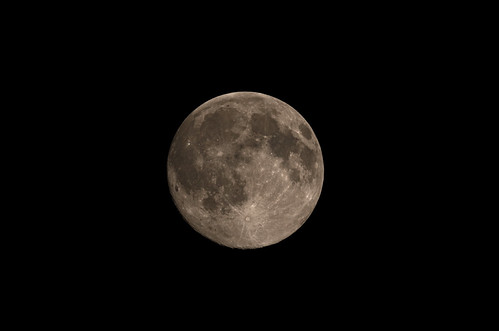
I attached it to my camera tripod and pointed it at the crescent moon. The Moon was crisp and clear once I focused the thing, which is somewhat difficult to do precisely (what do you expect for $20?). I was able to easily make out a number of craters and could easily see that the moon was not smooth, just as Galileo did. Next, I pointed it at Jupiter and all four Galilean satellites presented themselves on one side of the planet. I could just make out two cloudbands on Jupiter itself, which I'm fairly certain would not have been visible in Galileo's actual scope. The scope itself is probably quite a bit better than the original it's based upon. Finally, I pointed the scope at M13, the Great Globular Cluster in Hercules. While I could not make out the individual stars, the shape of the cluster was clearly visible.

Overall, I'm very pleased with this scope and hope to figure out a way to mount it on my LXD75 so that I can do some imaging through it. It's not very powerful or amazing and has plenty of flaws, but that's kind of the point - to see how Galileo saw.
September 10, 2009

Jupiter with Io on 8/12/09 with 20.5" Cassegrain at the Clarence T. Jones Observatory

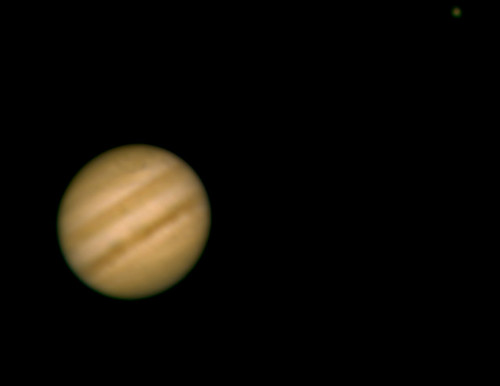
Okay, this image is from last month, but I just got around to process it. Due to the kindness of Bobby Thompson from the Barnard Astronomical Society, last month, I was able to use the Clarence T. Jones 20.5" Cassegrain telescope to take this shot of Jupiter and Io. My camera is not a good match for the scope and we had difficulty focusing accurately, but it was a lot of fun. This is much more detail than I normally see through my scope.

September 5, 2009

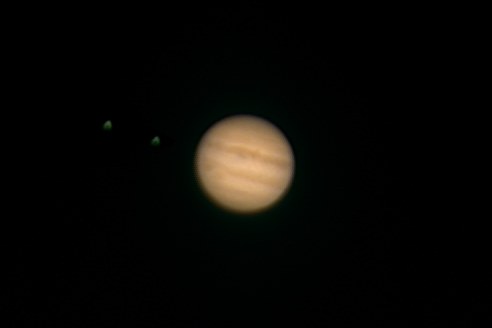
Jupiter on 9/4/09

Filed under: astronomy, Astrophotography, Jupiter, Observation Journal — Tags: Europa, Io, Time Lapse — Ed @ 2:03 am

Jupiter was beautiful through the eyepiece - it was the first time I've seen the Great Red Spot (GRS) visually. Simply stunning. I think the clarity was significantly helped by the precise focusing with my Bhatinov mask. Anyway, I took a bunch of images and stacked them into a movie. While it's not up to Hubble standards, you can see Jupiter rotating and the moons moving during the 45 minutes that I captured images. Click on the image above to go to the movie page and view it.