Category: Observation Journal

September 18, 2010

September 15, 2010

M8-Lagoon Nebula on 9/13/10 (reprocess)

Filed under: astronomy, Astrophotography, Messier Objects, Observation Journal — Tags: Lagoon Nebula, M8 — Ed @ 10:00 pm

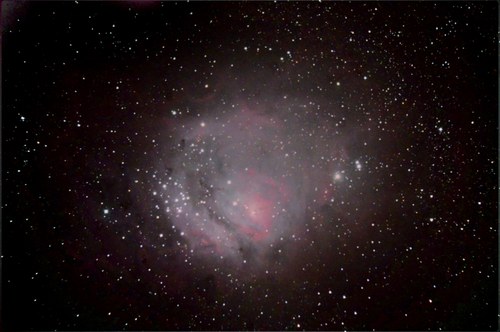
I did some reprocessing with flats and other things and was able to pull a lot more data out of my M8 image. I also have an offer from a flickr user to reprocess using my raw images so I'll let you know how that goes. If they do a good job, I'm hoping I can learn some new processing techniques.

September 14, 2010

M8-Lagoon Nebula on 9/13/10

Filed under: astronomy, Astrophotography, Messier Objects, Observation Journal — Tags: M8, Nebula — Ed @ 7:57 am

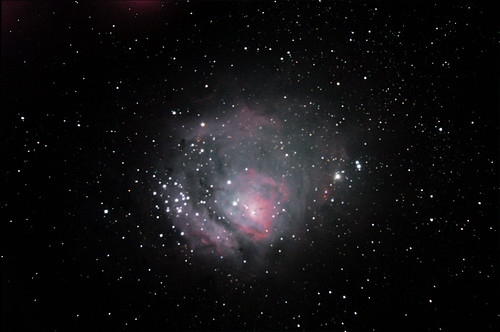
Last night was just about as nice as Sunday night and I was out again, this time imaging M8, the Lagoon Nebula. I also took some flats that I was able to subtract out in Photoshop which helped keep the center from being blown out. This image is a composite of an hour and I'm thinking that I might try to do a long term Messier Marathon where I image all of the Messiers for an hour of 4 minute exposures to do a longer term version of my 2008 messier project.

September 13, 2010

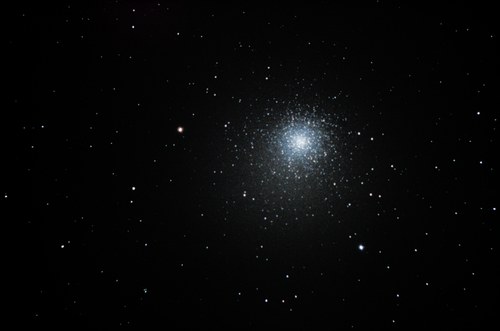
M13-Great Globular Cluster in Hercules on 9/12/10

Filed under: astronomy, Astrophotography, Messier Objects, Observation Journal — Tags: globular cluster, M13 — Ed @ 12:23 am

I got 5 good frames of M13 in before my camera's battery died (I actually had 2 bad frames, first of the night - they weren't horrible, just a little bit of movement). It was actually starting to get a bit chilly outside, so I was fine with going in. Overall a nice night with a lot of success with my new equipment.

September 12, 2010

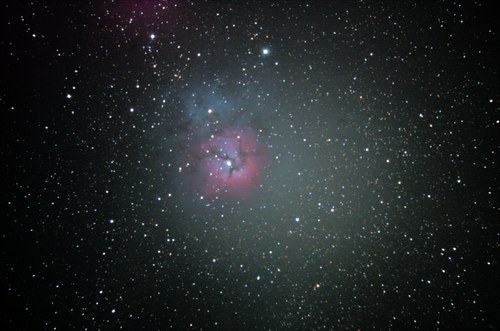
M20-Trifid Nebula on 9/12/10

Filed under: astronomy, Astrophotography, Messier Objects, Observation Journal — Tags: M20, Nebula — Ed @ 11:56 pm

Here's an hour's worth of the Trifid Nebula. I need to figure out a way to do flat frames with this scope because I believe with a flat frame, this would look way better. I really had to work to try to reduce the vignetting. That said, I'm really happy with the way it looks. The PHD Guiding on the LX200 was so good I was able to use every single frame I took. I'm loving this scope...

September 5, 2010

August 22, 2010

August 8, 2010

ISS transits the Sun - 8/8/10

Filed under: astronomy, Astrophotography, ISS, Observation Journal, Sun, sunspots — Ed @ 1:32 pm

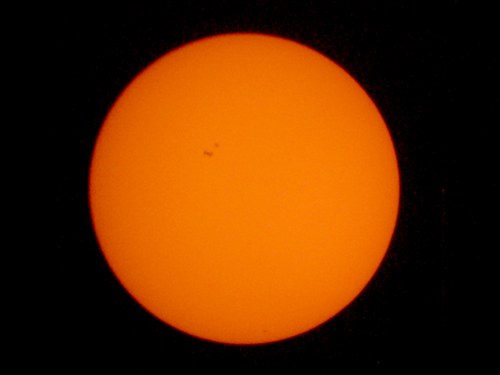
Today I did a bit of travelling (just to Collegedale) to do some daytime stargazing. On CalSky.com I was informed that a solar transit of the ISS would be happening near my location and I decided I just had to try to capture it. It was scheduled for 11:43:08am today and would last just under 1 second.

So, I packed up my gear and headed out. When I found a suitable spot to set up, I took out my equipment and realized that I had forgotten my telescope power cable. That's okay - I can set up by hand. I also forgot my compass, which I use to align the telescope with North, but I guessed at that, based on where the Sun was. So already things weren't going well, when my laptop battery went from saying I had 90 minutes of power (more than enough) to the next minute saying I had 8 minutes of power (not nearly enough). Despite all of this, I just did it manually - I hooked up the scope and pointed it at the Sun, set up the D50 and used the manual remote to trigger the shutter. When my watch (which I had synchronized before the trip) indicated a minute left I started taking photos as fast as the camera could take them. While it took pictures, I looked through the viewfinder which would go black every time it took a shot (it's a DSLR) and after about 4 minutes I stopped, not having seen a thing. So I packed up my gear and headed home.

When I got home, I put in my camera's memory card into my plugged in laptop and waded through 170 images before I finally came to this one. It's the only one that captured the ISS. Unfortunately, since I couldn't get the laptop running, I couldn't focus with the extreme precision I'd need to get a crisp outline of the station, but I'm very happy with this nevertheless. The ISS is clearly outlined against the disc of the Sun while two sunspots are also clearly visible.

I can't wait to try again (the next one near me is several months away) and next time I'll bring both my scope's power cord as well as my laptop's.