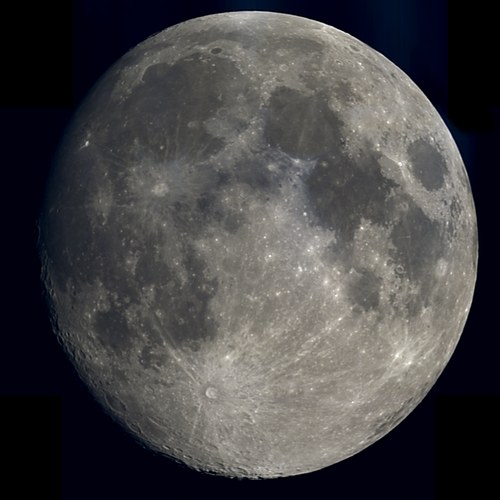
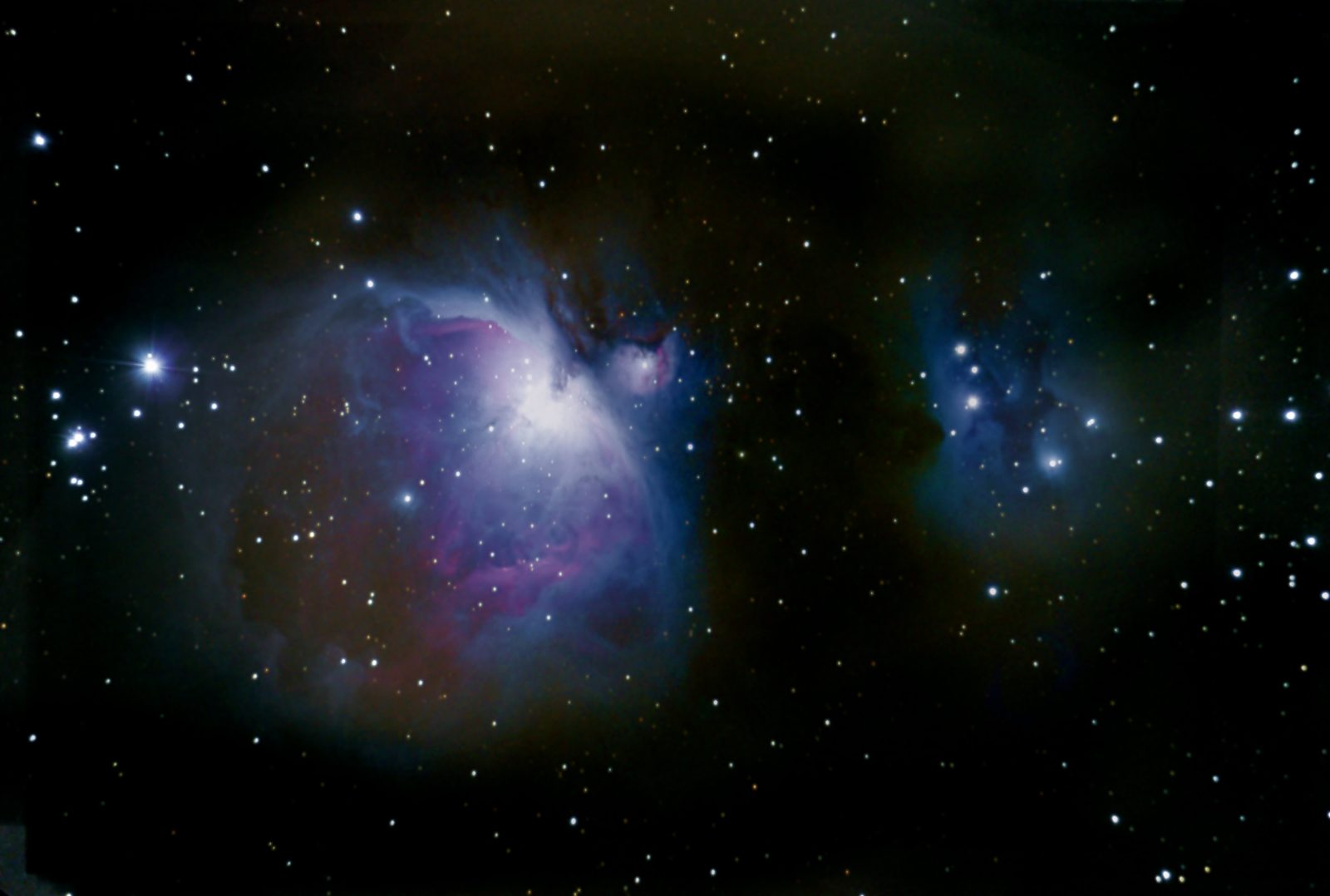
The Great Orion Nebula (M42) and the Running Man Nebula, photographed from Flintstone, Georgia

Flintstone Stargazing

Astronomical observations by a guy in Flintstone, Georgia

M42 – the Great Orion Nebula, February 2009

February 8, 2008

February 6, 2008

Windy, then clouds

Filed under: astronomy, Observation Journal — Ed @ 9:06 pm

I hadn't been able to get the scope out for several days because of the rain. Tonight, it was very clear with really dark skies and so I got the scope out. I knew it was windy and I wouldn't be able to hook up the camera (too much shaking), but figured I could get the polar scope realigned and then do some visual observing. It took me about 45 minutes to get the polar properly centered because it's really hard adjusting things when they show you an upside-down image. I kept moving the opposite set screw from what I wanted, but I finally found the center and then set the scope up. After running the Autostar alignment procedure I got the magic "Less than 5' from the pole" message which tells me it's as aligned as the scope can determine (though for really long-term photos, I might need to do some drift alignment to ensure it's perfectly on the pole). That was very encouraging since I'd had so much trouble with the polar scope during the hypertune that I was a bit worried I might have damaged something (other than the scratches). This tells me I'm probably okay.

Once the scope was aligned, I pointed it at Mars and used the opportunity to get the piggy-backed scope better aligned to the main one. After a couple minutes, the four older boys came out real quick to take a look. Everybody saw it through the refractor which is lower, around their eye level and then ran back inside. The temperature was around 50° out, but with the wind, it felt colder, particularly to boys in pajamas (they had their coats on). After a couple minutes of looking at the Pleiades the clouds rolled in and I packed everything up. The wind was really starting to pick up at that point anyway.

February 2, 2008

Saturn, Queen of the Skies

Filed under: astronomy, Astrophotography, Messier Objects, Observation Journal, Planets, Saturn — Tags: M81 — Ed @ 1:37 am


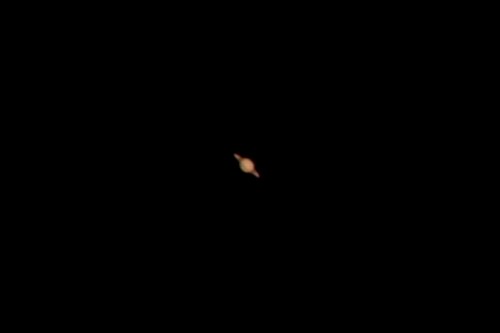
Saturn on 2/1/08

I stayed up late tonight and was finally able to see Saturn with the new scope. This image, however, is not from the 8" - it's from my Wal-Mart special scope. While this image was being captured, I was viewing the ringed planet through my bigger scope. It was beautiful. I could barely make out the Cassini division in the rings and could discern a few striations on the planet itself. Unfortunately it was getting so cold that frost was forming on my equipment and I had to head inside before i could get a higher magnification. I'll try for that soon.

Prior to getting my image of Saturn, I was able to get an image of M81 - Bode's Galaxy:

M81-Bode's Galaxy on 2/1/08

Bode's Galaxy is found near the big dipper - just past the part you drink out of. It's very close to M82 - the Cigar Galaxy.

Overall, a nice night - cold (30°F) but not unbearable. The mount worked really well with the exception that I believe I need to further align my polar scope. Other than that it tracked and slewed smoothly. Once I get these last couple kinks out I hope to be able to start doing some really long exposures.

January 31, 2008

I'm actually glad for the clouds tonight...

Filed under: astronomy, Clouds, Equipment — Tags: hypertune — Ed @ 10:01 pm

It has been raining on and off this evening so the clouds are covering the sky, but that was fine by me. It gave me a chance to finish working with my mount without feeling pressured to get viewing. Boy am I glad I did. After being a bit disappointed with the RA axis yesterday, I'd been thinking about it and had the idea that maybe I had put the worm drive on crooked and that's why it was sort of sticking. That's exactly what was wrong. I took the worm drive off and reattached it paying special attention to how I aligned it and when I was done, the mount moved like butter. I also had time to be able to align the polar scope as well as fully collimate the telescope. Now, whenever the clouds go away, I should be able to retrain the drives and get the thing fully set up and ready to go.

Hypertuning my mount

Filed under: Observation Journal — Ed @ 12:22 am


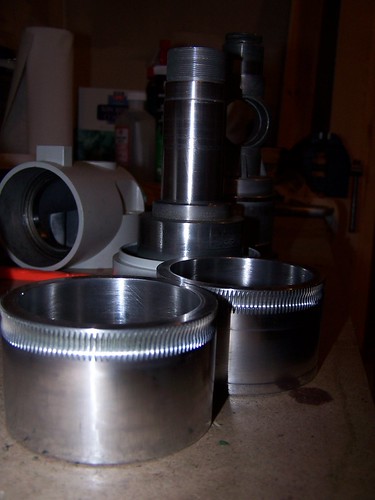
The newly smooth and shiny gears

I've spent the past two nights "hypertuning" my mount. I got the DIY Hypertune DVD and followed the instructions to completely take apart my mount and then rebuild it better than before. Above are the gears that I worked on - they all started with a dull aluminum finish and now they are shiny! Actually, now they are greasy and back inside the mount, but they are working much better. The Right Ascention axis is still having a bit of a problem, but it's much better than it was. I found the big problem it was having was that (most likely at the factory) someone dropped a small washer into the gear and it was just scraping away inside there until I found it. The washer isn't used anywhere on my scope and based on where it was, I don't think there was any way it got there after construction. I believe that I may need to work further on that particular axis, but the whole mount runs much, much more smoothly now. I'm going to need to get the polar scope realigned and re-train the motors, but after I take care of that, I should be able to start taking some long-term images. Let's hope it stays clear for tomorrow.

Oh, and I'd highly recommend the hypertune DVD. They guy does a great job of explaining what he's doing as he videos himself doing the work. My only suggestion would be to have specific instructions for the different mount types (he uses an LXD55 which is slightly different than my LXD75). It'd be nice if there was at least something printed that explained the few small diferences but otherwise, it was great. Fortunately for those differences, I was able to find this page which had an exploded view of all of the LXD75 mount parts.

January 30, 2008

10,000 Views!

Filed under: Blog — Tags: milestones — Ed @ 2:23 pm

10,000 Views!
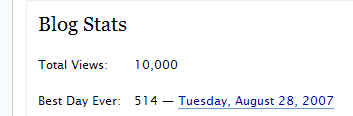
My stats counter today

I couldn't resist. I've had the blog up since July 23rd, and I've averaged a bit over 50 views a day. My single biggest day was from the lunar eclipse in August and I expect that I'll be seeing quite a bit of traffic with next month's lunar eclipse as well (assuming we have good weather). Actually, I'd like to invite anyone who reads the blog to a star party in my driveway on February 20th. We'll be starting at 8 - the eclipse begins at 8:43 and is total at 10:01. I'm planning on having my scopes set up and my cameras going. I'll supply hot chocolate and will be inviting the neighbors as well. If it's clear, we should have a great time. I'll post more details as the date approaches.

January 27, 2008

The Great Orion Nebula Shootout

Filed under: astronomy, Astrophotography, Equipment, Mars, Messier Objects, Observation Journal — Tags: M42, M43, Orion — Ed @ 11:52 pm

Tonight was beautiful - the Moon was not going to rise until late, and it was clear and about 40°F outside. All in all, really good conditions for me. I decided that tonight I would test out my new (cheapo) 70mm refractor that I blogged about the other day. I'd done some work on my mount, so I was hoping to also see if that had worked as well as I'd hoped and I'd be able to take some long exposures.

I set up the way I normally do, leveling the scope, using the polar scope to align the mount on Polaris and then running the alignment procedure with the Autostar software. I again got the magic, "You are less than 5' from the pole" message so my alignment was very good. I then took a good amount of time to view some different targets comparing the views in each scope. I had a look at Mars, M42-The Great Orion Nebula, The Double Cluster and all looked really, really good in both scopes. I actually started to wonder how much better my 8" scope was so I resolved to find out. I first hooked up my DSI II camera to the 70mm refractor and aimed at the Orion Nebula. Because I was using the diagonal on the scope, the image was originally a mirror image so I fixed it in the software afterward, but that's why the image from that scope is not oriented the same way as my other one. Here's the result:


M42/M43-The Great Orion Nebula on 1/27/08
Taken with my 70mm refractor

This is a combination of 18 15 second images plus 10 60(!) second images. The 60 second images were spot on - no movement that I could tell. It makes me want to try some 2-3 minute exposures on some of the fainter targets - I can't wait. Overall, it did what I believe is a very creditable job on the nebula. My only complaint (and this is a known issue with achromatic refractors) is that there is a bit of a purple halo around the brightest stars.

I next took the exact same series of images through my 8" Schmidt-Newtonian. Here's the image I got:
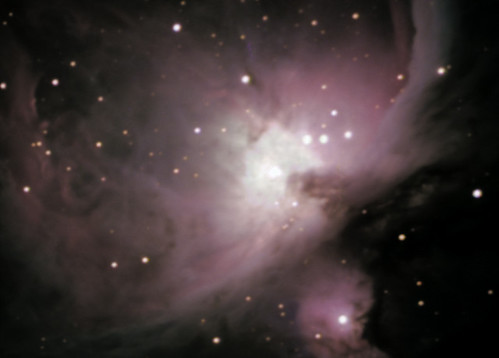
M42/M43-The Great Orion Nebula (8
M42/M43-The Great Orion Nebula on 1/27/08
Taken with my 8" Schmidt-Newtonian

Because the focal length is longer (812mm vs 700mm 600mm), the magnification is higher on the 8" scope than on the 70mm refractor. (Magnification is calculated by dividing the focal length by the eyepiece size. The eyepiece of the DSI II is aproximately 8mm so the magnification for the refractor would be approximately 87.5X 75X and the 8" scope would be 101.5X) That's why it appears more zoomed in. It also is much, MUCH brighter - there's quite a bit more detail. So I guess that answers the question as to whether they actually show the same amount of detail. The 8" is clearly much brighter and more powerful. I am really anxious to try the refractor on the Moon however, the larger field of view means I may be able to get the entire moon in one shot and refractors are known for providing better contrast/clarity on planets and lunar views. I also took images of Mars with both scopes that I'm processing now. I'll probably upload those tomorrow.

Overall, a really great night. I truly enjoyed the visual observation I did tonight - both scopes performed admirably and it was nice to be reminded of how much fun visual observation can be. I also was pleasently surpised at the results of my tests. I think I've got a great setup to capture a number of different types of images in the future.

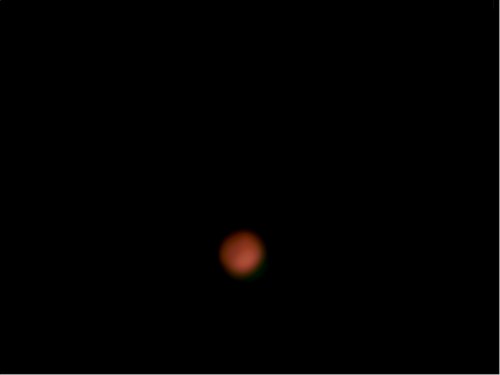
Update: Here's the Mars image from the refractor. Wow. Unfortunately, I couldn't tell until I procesed it, but the image I got from the 8" was slightly out of focus.
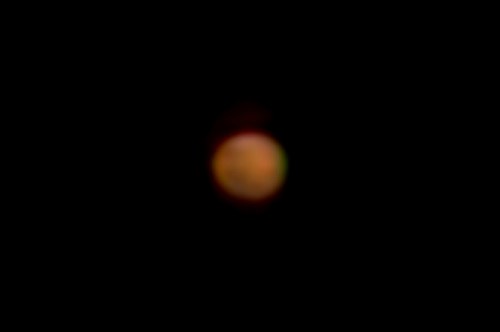
Mars on 1/27/08
Mars on 1/27/08
Taken with my 70mm refractor

This image was taken using not only the 70mm refractor, but the web cam that came with it. I paid $25 total for both (and a terrible tripod and eyepieces, which I didn't need). What a deal.
January 26, 2008

A match made in ...

Filed under: astronomy, Equipment, Observation Journal — Tags: Telescope — Ed @ 5:57 pm


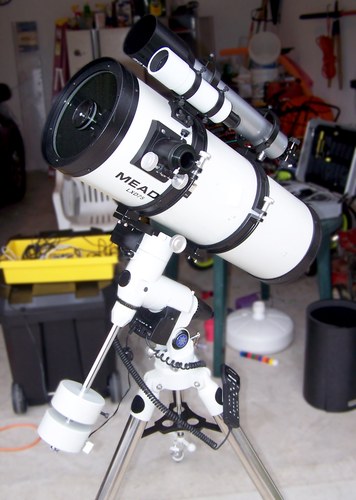
My Telescope Rig - 1/26/08

About two weeks ago, I walked into Wal-Mart and there in front of me was exactly what every web site on astronomy says not to buy. A department store telescope. The telescope was a Meade 70AZ-A with an included USB camera. FOR $25!!!! I could not pass it up. As it turns out, the tripod is terrible - it's made of aluminum foil and paper clips. The eyepieces are made from plastic. I knew that this would be the case. So why did I buy it? Three reasons: I wanted a refractor, I wanted a USB webcam that could fit on my scope and did I mention it was $25 (normally $100)?

Refractors, telescopes that use a lens instead of a mirror (like my other scopes), are generally considered best for planetary and lunar viewing and I'd wanted to get one for a while. The refractors I'd really like to get are very expensive and so I wasn't planning on upgrading any time soon, but did I mention the thing was on sale? For doing some wide-field imaging with the DSLR camera using the main telescope for autoguiding, I thought this would be a great, inexpensive, option.

Why did I need a new camera for my telescope? The cameras that I currently have are a Nikon D50, Meade DSI and Meade DSI II. The D50 is a DSLR which has high resolution and takes great wide-field images. It's very hard to focus and interact with and is best for taking long exposures. The Meade DSI cameras are fantastic cameras for low light, but they are CCD cameras which means that while I can take very short or long images, I can't take movies or capture hundreds of frames in a few seconds with them because they don't react fast enough - they're just good at other things. There are a number of programs that allow you to use a webcam to gather a couple hundred frames (15 a second or so) of the moon or planets and then software (like RegiStax) goes through and finds the best individual images and stacks them. This is how I've taken my best pictures of Mars so far. Basically, if the scope was $25 then the camera was free (or vice-versa). Either way, it was a good deal.

So, after getting the scope rings (from Orion) yesterday, I attached the scope to my rig this afternoon and made sure it was aligned with the main scope. I then did some maintenance work on my mount (I replaced some set screws, trained the motors and aligned the axes). I had done some other work on it the other day and when I aligned the scope the other night after my Autostar alignment procedure, it told me that it was less than 5' from the pole, which was a message I had never seen before. If I can consistently align the scope that well, I should be able to take some very long exposures without movement of the scope. I'm also getting the Hypertune DVD this week from ScopeStuff.com and hope to completely take apart my mount and put it back together again much better than before. I'll post images and commentary as I do that.

January 24, 2008

Mercury Setting

Filed under: astronomy, Astrophotography, Mars, Observation Journal, Planets — Tags: Mercury — Ed @ 7:36 pm


Gibbous Mercury on 1/24/08

Mercury was very bright in the western sky and set not long after the Sun. I was able to get the scope out in time to be able to shoot this image of the gibbous disk of the planet.

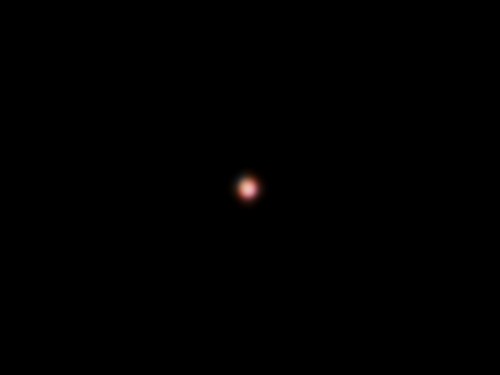
Later on, I also took this image of Mars, which turned out to not have very much detail, unfortunately.

Mars on 1/24/08
Mars - slightly out of focus - on 1/24/08

Ultimately, while it was certainly very cold, it was the wind that finally made me go inside. It was too difficult to keep things in the viewfinder at high magnification. And it was very cold. So, so cold. Otherwise it was a nice night out.

January 20, 2008