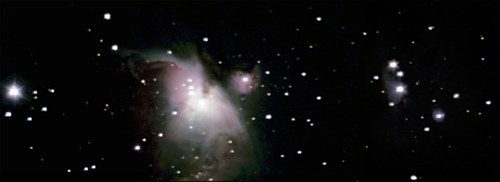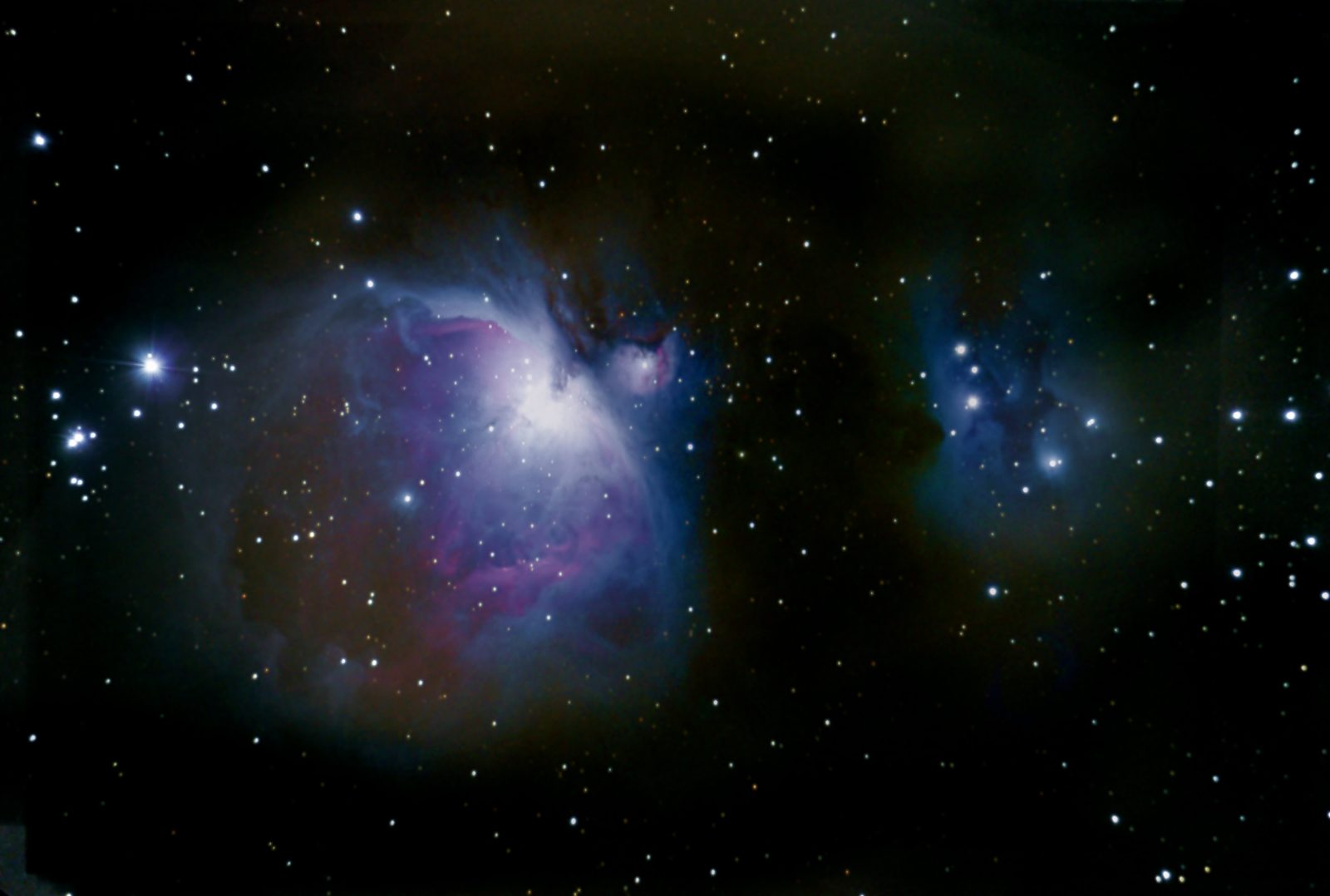
The Great Orion Nebula (M42) and the Running Man Nebula, photographed from Flintstone, Georgia

Flintstone Stargazing

Astronomical observations by a guy in Flintstone, Georgia

M42 – the Great Orion Nebula, February 2009

October 26, 2007

Comet 17P/Holmes

Filed under: astronomy, Astrophotography, Comets, Observation Journal — Tags: Comet 17P/Holmes — Ed @ 9:01 pm


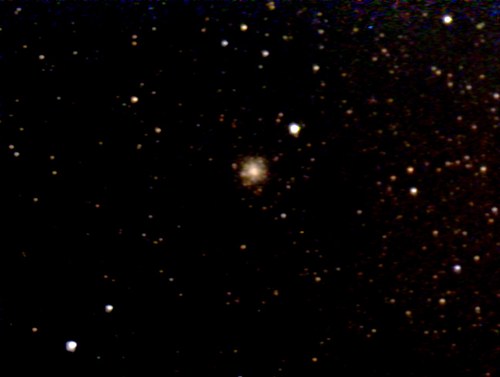
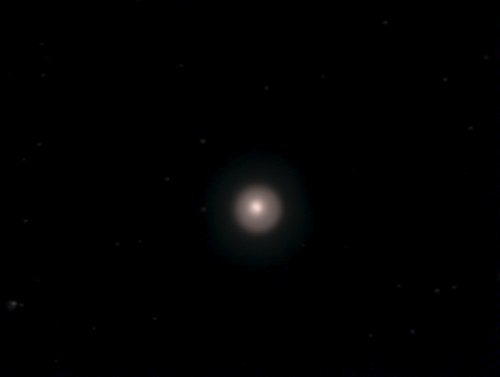
Comet 17P/Holmes (leveled to bring out detail) on 10/26/07

There she is - my first comet photo. This image is taken using my Meade DSI Color on my 4.5in (114mm) telescope. It is 100 stacked 2 second exposures. The comet is so bright that if I take any longer exposures than 2 seconds with my camera, it maxes it out and I lose detail.

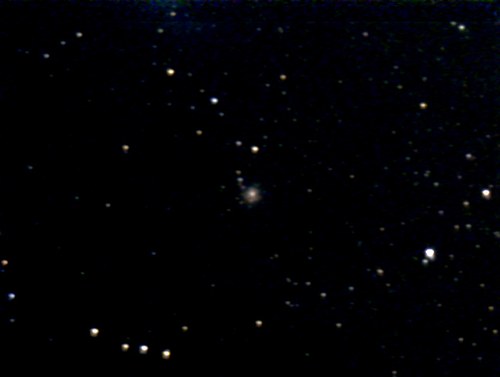
Tonight is perfect for stargazing and this new comet is easily visible both to the naked eye as well as through my telescope. In my scope and binoculars, it has a bit more of a gold cast to it, but this image seems a bit blue. I'm not sure why that is. In the image above, I've messed with the levels a bit to bring out the secondary coma area. Below is the image without the leveling. You can still see the wider coma, but it's fainter. Anyway - it's beautiful and I'd strongly recommend that if you haven't already done so that you go outside and look at it, particularly through binoculars or a telescope.
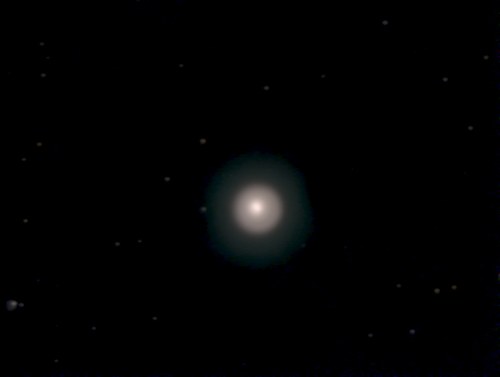
Comet 17P/Holmes (image 2) on 10/26/07
Comet 17P/Holmes (not leveled) on 10/26/07

October 25, 2007

No comet photo tonight, but...

Filed under: astronomy, Clouds, Comets, Observation Journal — Tags: Comet 17P/Holmes — Ed @ 9:14 pm

I did see the comet through binoculers. Actually, I saw it with my eye first - it's quite bright - easily visible in the northeast sky. With binoculars, it looks much larger and fuzzier than a star - it had kind of a gold cast to it. Unfortunately, the clouds rolled in and it isn't visible right now. If it clears up before super late, I'll get my scope out and get an image. Otherwise, I may just set my alarm and see if I can get it early. It shouldn't set until well after sunrise, so if the sky clears up during the night, I'd be able to get a photo then. It should be visible for quite some time, assuming it stays bright like this for a while, maybe even for months. Very, very cool.

A comet visible to the naked eye!

Filed under: astronomy, Comets — Tags: Comet 17P/Holmes — Ed @ 5:26 pm

I learned first at this post about a comet that has suddenly brightened to magnitude 2.8! That means it should be easily viewable in the evening sky nearly anywhere you have even moderately dark skies. The comet is Comet 17P/Holmes (history here) and is currently located in the constellation Perseus. It should basically appear as another star in that constellation (here is a map to find it - here's a wider view "map"). It should be visible in the northeast shortly after dark. 

We've been having much needed rain for the past several days (which meant no viewing, but we've had a serious drought so I'm actually glad for the weather we've had), but right now, skies are looking decent for viewing tonight (the moon will wash out some, but at mag 2.8, I should have no problem seeing it) and I fully plan on getting some photos. I'll post as soon as I've got them. My guess is that I won't be the only one doing that this evening. (Update: people have been taking a lot of photos since yesterday) This is big news in the astronomy world. How exciting!

October 19, 2007

A closeup of the Moon

Filed under: astronomy, Astrophotography, Moon, Observation Journal — Ed @ 11:49 pm


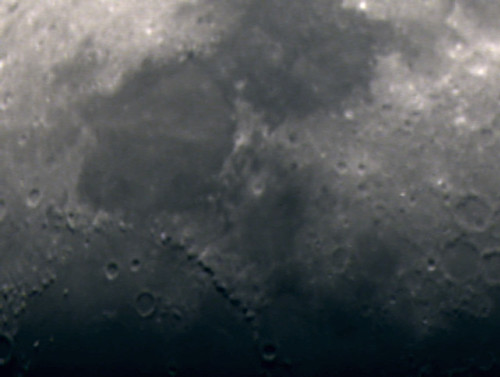
Mare Serenetatis/Mare Imbrium/MareTranquillitatis on 10/19/07

I'm borrowing Dave's telescope this evening so that I can take it on the Cub Scout camp out tomorrow (I'm doing the Astronomy belt loop with the kids and it's nice to have more than one telescope) and I thought I'd get familiar with it this evening. This is a nice closeup of the moon. The mare or seas that are pictured here are as follows: In the middle left is Mare Serenetatis - the Sea of Serenety. At the bottom is Mare Imbrium - the Sea of Rains. The nice mountain range in between them which shows up so nicely is Montes Caucasus. Finally, at the top is Mare Tranquillitatis - the Sea of Tranquility.

It was fun playing with a goto scope as well as one that has a larger mirror than my normal one. Thanks Dave!

October 17, 2007

Cloudy, but the Moon peeked through

Filed under: astronomy, Astrophotography, Moon, Observation Journal — Ed @ 8:58 pm


The Moon on 10/17/07

It's been cloudy the past few days around here, though we haven't had any rain. We haven't had rain in about a month, actually. Tonight, the clouds aren't completely covering everything and every so often the Moon would peek through. This image was taken during one of those peek times.

We really need some rain - it's pretty clear from how often I've had good viewing over the past month how little rain we've had. Of course it's nice to be able to do so much imaging, but I'd gladly trade that for a couple days of rain.

October 16, 2007

Reprocessing Omega Nebula (M17)

Filed under: astronomy, Astrophotography, Messier Objects, Observation Journal — Tags: M17 — Ed @ 10:54 pm


M17-Omega Nebula (Image 3) on 10/5/07

Two weeks ago, I posted two quickly stacked versions of M17 that were created using DeepSkyStacker. The two images I got varied in how I used the stacking software and produced two images that wound up being either washed out or pixelated in the details. They just didn't look all that great. Tonight, since it's cloudy out, I figured I could take the time to reprocess that image and see what results I could get.

The image above was actually processed using the Entropy Weighted Average method (which I've found to give the best results so far on the images I've used DeepSkyStacker on), but so was the brighter of the two images from last time. The big difference was in how I adjusted the luminence curves after the stacking was done. I think the image above is about as good as I could get with the 450 seconds of exposure time I had available. There's a lot more subtlety in the colors and more detail in the darker areas of the Nebula. To see what much better telescopes than mine get for this nebula, you can go here for amateur images or here for Hubble Space Telscope images. Considering the size of my telescope and the limited exposure time (7.5 minutes) I think this image holds up pretty well against some of the amateur images.

October 15, 2007

The Dumbbell Nebula

Filed under: astronomy, Astrophotography, Messier Objects, Observation Journal — Tags: Dummbell Nebula, M27 — Ed @ 10:13 pm


M27-Dumbbell Nebula on 10/15/07

This image is a 25 minute exposure of M27 - The Dumbbell Nebula. I've imaged this before, but never for this long. This image shows a lot more detail than my previous effort. Tonight, prior to observing, I collimated my telescope which I believe made a big difference in how crisp the image was. My previous version had a lot of coma visible in the stars. This one really didn't have that problem nearly as much. I also made sure to get a good focus with my Hartman Mask. All of this paid off with the longer exposure to give a nice depth to this image.

The Moon is back

Filed under: astronomy, Astrophotography, Moon, Observation Journal — Ed @ 9:14 pm


The Moon on 10/15/07

Actually, the Moon made its first appearance in a while last night, but I wasn't quick enough to catch it before it set so this is my first picture of the moon since September's full moon. Because it's so low on the horizon, we're seeing it through the thickness of the atmosphere which gives it the reddish orange color. It will be getting higher each night until it will be full in a couple of weeks, so good, dark viewing is going to start being harder to come by unless I begin viewing in the mornings. Eesh - I'm not a huge fan of getting up early, but I'm also interested in getting some more of the early morning sights like Venus and Saturn. Tonight I'm taking a long exposure shot of The Dumbbell Nebula and then I'm off to bed.

October 14, 2007

The Sword of Orion

Filed under: astronomy, Astrophotography, Messier Objects, Observation Journal — Tags: M42, M43, Orion — Ed @ 2:21 pm


M42-The Great Orion Nebula Panorama on 10/14/07

The other day I got up early and got some shots of the Great Orion Nebula (M42). I was so thrilled by this fantastic deep sky object that I decided to get up early this morning as well. This picture is the result. I got several good images which were stacked and composited to create the panorama you see here. On the left of the image is Na'ir al Saif (officially known as Iota Orionis), a second maginute star which in my previous images bled over into the Orion Nebula(M42). To the left of center is the great orion Nebula with its sweeping reds, blues and purples. Just to the right of that is the smaller de Mairan's Nebula(M43) . I'm not exactly sure why this is considered a separate object, but it is. It's actually part of the Orion Nebula, because the gap you see is not actually a gap, it's dust that obscures our view of that part of the nebula. On the right of the image is NGC 1981, an open star cluster that has just a bit of nebulosity to it - the nebulosity is only partly captured in this image. You can read about the NGC (New General Catalogue) at its Wikipedia Entry.

In the night sky, the area that this panorama images is the sword of Orion (which hangs from his belt). You would turn this image 90° to the left to see the way that it would be seen in the early morning sky right now. These are the three "stars" that make up his sword. Unlike the majority of the objects I take images of, they are visible to the naked eye under normal viewing conditions.

October 13, 2007