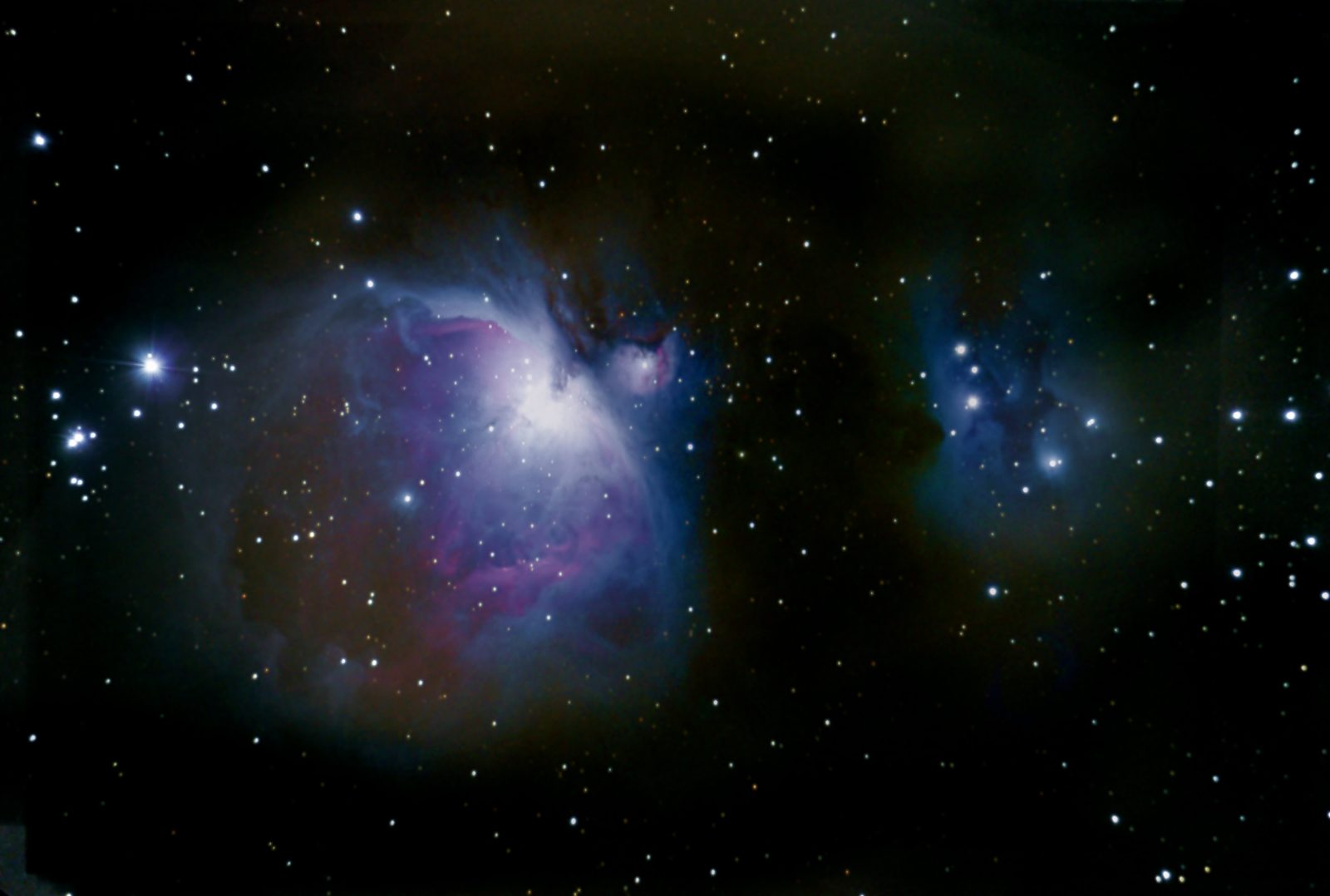
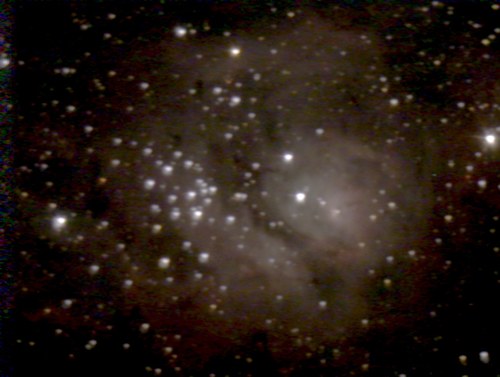
The Great Orion Nebula (M42) and the Running Man Nebula, photographed from Flintstone, Georgia

Flintstone Stargazing

Astronomical observations by a guy in Flintstone, Georgia

M42 – the Great Orion Nebula, February 2009

October 6, 2007

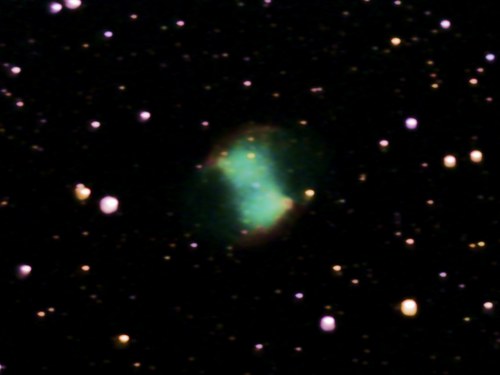
M27 - The Dumbbell Nebula


M27-Dumbbell Nebula on 10/5/07

Tonight was beautiful out and I decided to take the opportunity to try out some of the software I've been looking at for stacking and compositing. I mostly took a bunch of images that I will process later. M27 was the exception - I decided to just go ahead and process it tonight. I still think it looks more like an apple core than a dumbbell... I also saw a spectacular meteor which was bright yellow and broke into a couple pieces before disappearing. No photo though - it's way too fast.

October 3, 2007

This evening's sky

Filed under: Clouds, Observation Journal — Ed @ 9:29 pm


The setting sun on 10/3/07

You can tell from this shot of the setting sun that I probably won't be getting much viewing in this evening. That's really okay with me. I've had such great weather for so long that I've only gotten to bed at a reasonable hour once in the past several weeks. It also allows me to spend some time looking at some software for processing my images that AnnMarie discussed in this excellent post about her processing an image of Andromeda. Her results are top notch.

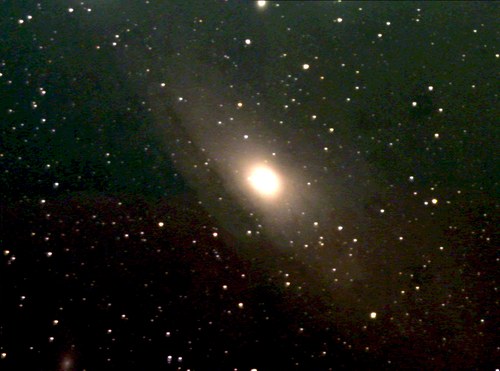
The Andromeda Galaxy

Filed under: astronomy, Astrophotography, Messier Objects, Observation Journal — Tags: M110, M31, M32 — Ed @ 9:03 am


M31-Andromeda Galaxy on 10/2/07

I've taken images of Andromeda before, but after looking at other images of M31(Andromeda), I realized that I had only been imaging the center of the galaxy. Last night, I took 5 images (one of each quarter of this image and one in the center) and combined them in photoshop. What I had minimized in other images I had taken and had thought was just noise was actually the stars and dust lanes of the galaxy. This image brings that out much better than my others. Also, I had known that M32 and M110 were right next to Andromeda, but had never really seen them in my previous images. That's because my previous images weren't of a large enough area. You can see M32 near the top of the photo and M110 in the bottom left. I plan on retaking this kind of image soon because I want to take much longer exposures. You can just barely see one of the dust lanes and the start of another. With a longer exposure, I should be able to pull out a lot more detail.

October 2, 2007

M8-The Lagoon Nebula

Filed under: astronomy, Astrophotography, Messier Objects, Observation Journal — Tags: Lagoon Nebula, M8 — Ed @ 11:05 pm


M8-The Lagoon Nebula on 10/2/07

After counting stars with my kids, I turned my attention to some Messier Objects I had not captured before which I'll post later. M8 I had imaged before, but not with my DSI so I took this shot which is a 390 second exposure. You can really see the nebulosity in this - I'm very happy with this image. I'll be posting more soon.

Counting stars with the kids

Filed under: astronomy, ISS, Observation Journal — Tags: International Space Station, kids, worthwhile — Ed @ 9:32 pm


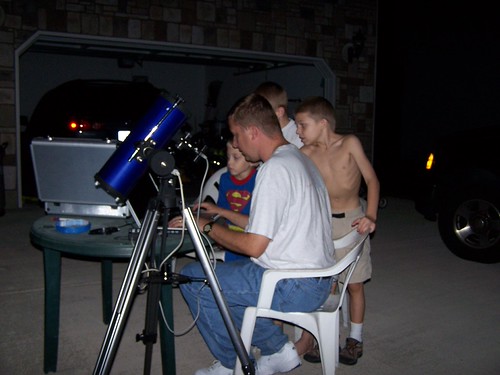
My kids and I doing some stargazing

Tonight has been absolutely gorgeous. Three of my children stayed up a little bit later than normal (until after 9:00) to take part in the Great Worldwide Star Count. First, though, we went out early to catch the International Space Station which was going to be visible in the south. It was really bright!. Then, we lay down on some blankets in our front yard and looked at the constellation Cygnus like we were supposed to. The kids determined that we could see stars up to 5th magnitude based on the charts they provided. We then uploaded the results using my laptop which I had out for my evening's stargazing. I plan to post a number of other pictures later on this evening.

It's not too late to participate in the Great Worldwide Star Count! They are accepting observations through the 15th of this month.

International Space Station at 8:39pm tonight

Filed under: astronomy, ISS — Tags: International Space Station — Ed @ 7:45 pm

The Internation Space Station will be rise above the southwest horizon and head northeast until entering Earth's shadow at 8:44pm near the constellation Cygnus. It should be the brightest thing in the sky and it will go a bit beneath (visually) Jupiter in the sky. Also, if my software is right, there is a Progress mission that should be with it as well and very bright also. While they still may be visible after they enter the Earth's shadow, they will probably be much harder to see. The neat thing is that Cygnus is the constellation that people are supposed to view for the Great Worldwide Star Count over the next two weeks. It looks great for that tonight and I'll be out in my driveway with my kids counting stars. You should participate too!

Note: I've noticed that this post gets a lot of hits, I'm assuming from searches. The ISS's orbit brings it over different parts of the world continuously so while on this particular day it was visible in Flintstone, GA at 8:39pm, there's no guaranteeing it'll be there at that time tonight. That said, if you'd like to find out when it'll be visible in your particular area, please visit Heavens Above. They have a nifty utility that'll calculate all that kind of stuff. In the mean-time, have a look around.

October 1, 2007

Star counting must wait...

Filed under: Clouds, Observation Journal — Ed @ 9:33 pm

There are too many clouds this evening (particularly in front of Cygnus) to do the Great Worldwide Star Count. I'll be trying again as soon as the weather cooperates. Ah well. I did see a shooting star in the north, though. I think the stars are twinkling more tonight than I've ever seen before - that's a sign of lots of atmospheric disturbance which results in bad seeing conditions. I'm also seeing a lot of halos around stars as well as Jupiter - that means there's a lot of humidity in the air.

Fortunately the star count continues for the next couple weeks so keep viewing!

Great Worldwide Star Count starts tonight! Please participate.

Filed under: astronomy — Tags: family, fun, kids, worthwhile — Ed @ 1:11 pm

The Great Worldwide Star Count starts tonight. This is a great opportunity to get kids involved in looking at the night sky and actually helps the science of astronomy. If you didn't see my earlier post on this, the Great Worldwide Star Count is an effort to map light polution around the world. Basically what they are asking people to do is to go to a web site and follow these instructions. You don't have to know anything about astronomy - as a matter of fact you may learn something!

To participate, you'll be going outside where you can see the sky an hour after sunset. You'll look almost straight up and compare what you see with the diagrams that the web site provides. You don't actually have to count stars - you just have to make an effort to figure out which of the magnitude charts looks most like what you see. Also, just from my own personal experience, don't just quickly walk outside and look up. Spend a few minutes allowing your eyes to adjust to the dark. Then make an effort to see the fainter stars in the constellation. Sometimes, you can see stars better by looking to the side of them since most people's eyes have more sensitivity outside of the middle of the field of view. You'll log your observations on their web site afterward and that's it!

This is also a great event to get kids involved in. They can participate just like adults can (as a matter of fact, their eyes may be better than adults). I'm planning on having my kids out with me tonight observing and will post some pictures on the site.

Tonight's viewing conditions look very promising right now and so it would be a great night for you to step outside and strike a blow for Science™ or something. And just for reference, last night at my house in Flintstone, GA I was able to easily see 5th magnitude stars and maybe a few beyond that. It was beautiful outside.

Finally, there's nothing preventing you from staying outside longer and looking at the heavens. In my part of the country, there are several other things you can obseve right now. Jupiter is the bright star in the south-southwest early in the evening. The Big Dipper is low in the north-northwest after sunset. Sagittarius is in the south and looks like a teapot. Since the moon doesn't rise until late, if your skies are dark, you should be able to see the milky way running from Sagittarius in the south toward the north-northeast across the entire sky. Last night it was really beautiful. As a bonus for going out early, the ISS will be visible in the south at 8:17pm. 

We plan on having a lot of fun and hope you do too. If you participate, please leave a comment here with what you saw and did. I'd love to hear about it.