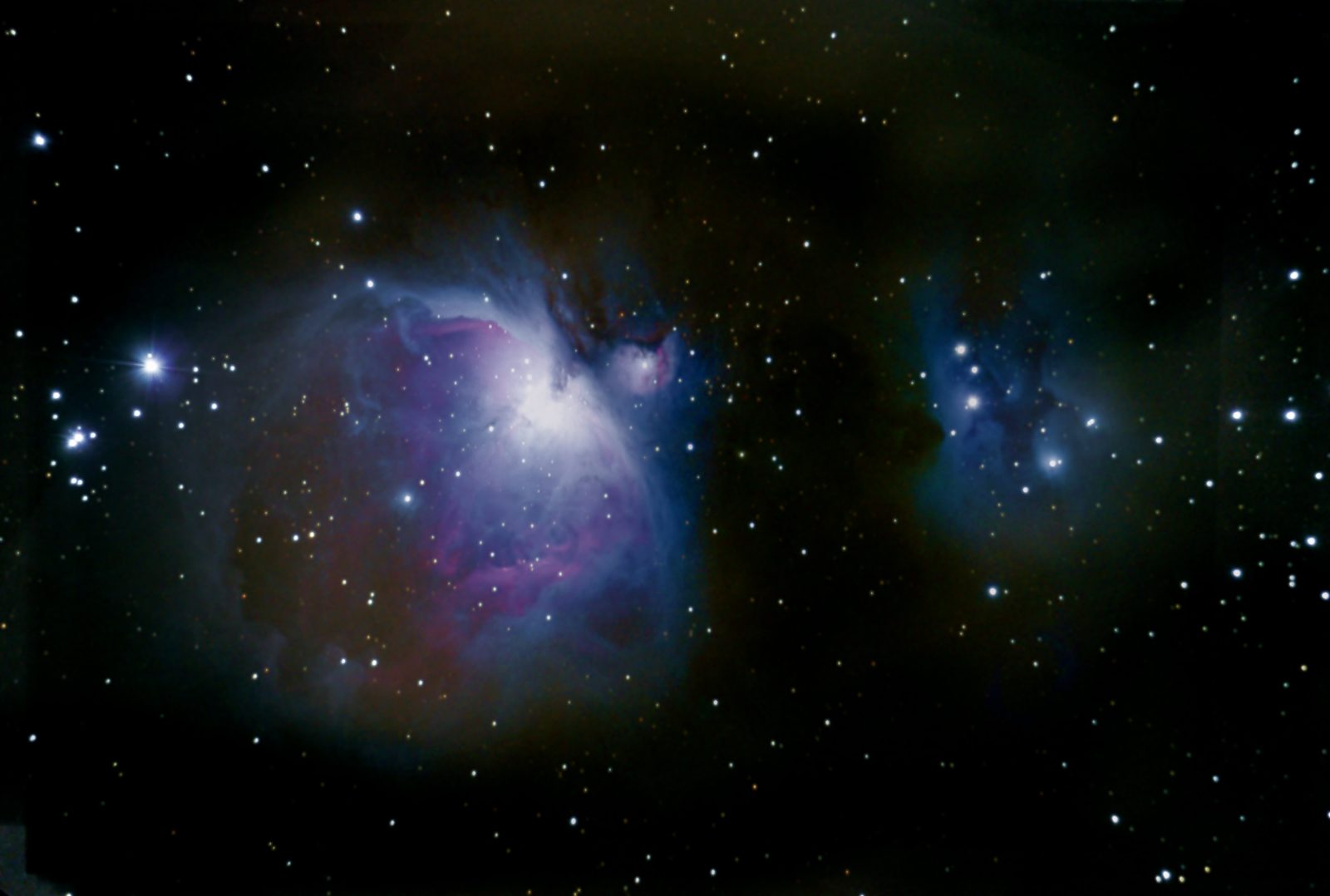
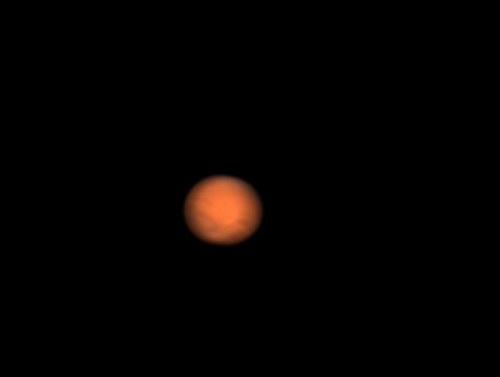
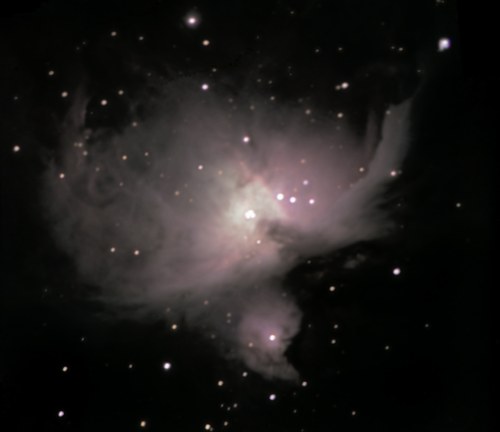
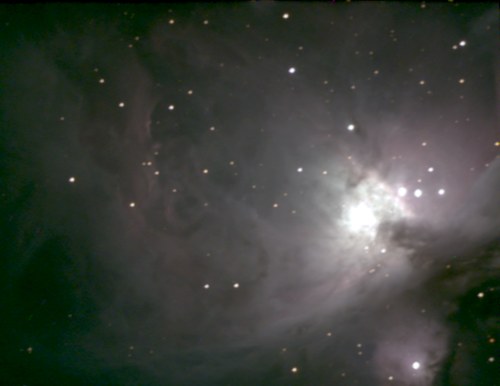
The Great Orion Nebula (M42) and the Running Man Nebula, photographed from Flintstone, Georgia

Flintstone Stargazing

Astronomical observations by a guy in Flintstone, Georgia

M42 – the Great Orion Nebula, February 2009

Category: astronomy

January 12, 2008

Crescent Moon

Filed under: astronomy, Astrophotography, Moon, Observation Journal — Ed @ 11:04 pm


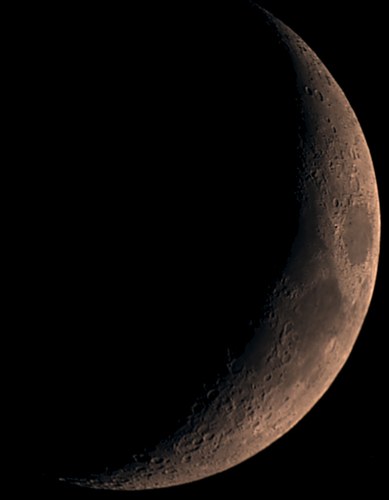
The Moon on 1/12/08

The Moon set before I could get my scope set up last night, so tonight's the first chance I've had to image the Moon with my new telescope. It did not disappoint. Visually, the Moon was stunning and there was tremendous detail, particularly when I used the 7mm eyepiece. Unlike my previous scope, the Moon does not quite fit in the area that the camera captures, so I had to stitch two images together.

January 7, 2008

Mars on 1/6/08

Filed under: astronomy, Astrophotography, Mars, Observation Journal, Planets — Ed @ 1:59 am


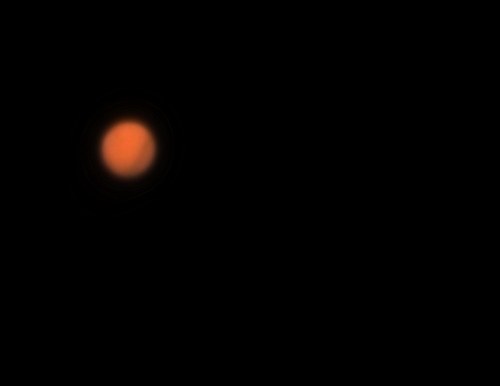
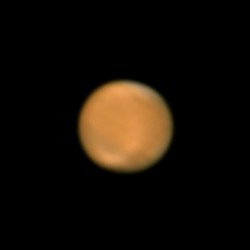
Mars on 1/6/08

Here's tonight's Mars photo - I plan on restacking it sometime when I've got more time. That's when a lot more detail came out in the images I processed from the images I captured on the 3rd. These raw images look better than those I took last time, so I'm hopeful the results will look better as well. Mars is receeding pretty quickly and so I'm trying to get some good images while it's still close enough to get some detail.

January 6, 2008

M97-Owl Nebula

Filed under: astronomy, Astrophotography, Messier Objects, Observation Journal — Tags: M97, Owl Nebula — Ed @ 11:41 pm


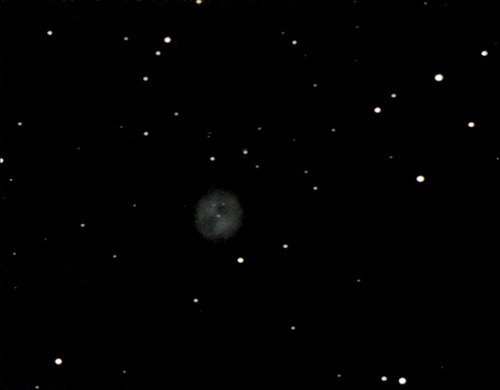
M97-Owl Nebula on 1/6/08

Seeing conditions weren't very good tonight and so just finding this was difficult (it's very, very dim). The Owl Nebula is a planetary nebula and really looks like an owl (as opposed to the Dumbbell Nebula which looks like an apple core). It is actually somewhat similar in shape to the Dumbbell Nebula, but is smaller and less colorful. The small star in-between the eyes of the nebula is the star that exploded creating this nebula.

M33-Pinwheel Galaxy

Filed under: astronomy, Astrophotography, Messier Objects, Observation Journal — Tags: Galaxy, M33 — Ed @ 10:40 pm


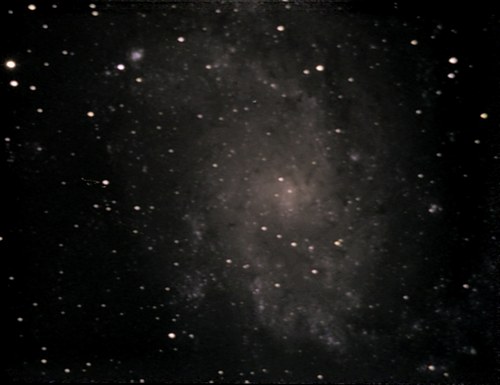
M33-Pinwheel Galaxy on 1/6/08

When I first saw M33 through the scope, it was pretty faint (there's a fair amount of moisture in the air tonight). But, with the camera, wow. I liked this so much I took an hour of images (at different exposure lengths to bring out more details) and wound up using the best 29min 30sec. M33 is known as the Triangulum Galaxy or the Pinwheel Galaxy. I hope you enjoy this image as much as I do.

January 4, 2008

The Running Man Nebula (and more)


NGC1973/75/77 on 1/3/08

This is really one of the first objects outside the planets, the moon and the Messier catalog that I have imaged. It is from the New General Catalogue which is one of the largest general catalogs of deep sky objects. If you're interested, you can read about it at the link.

NGC1973/75/77, also known as the Running Man Nebula, is a nebula found just north of the Great Orion Nebula, which I've been imaging quite a lot lately. I imaged this area before in my post several months ago on Orion's Sword. That image was created with my 4 1/2 inch Tasco scope. This one is created with my new scope. You can easily see how much more detail is present in this one - how much more nebulosity was captured by the larger 8" mirror and with the much better DSI II.

I also was able to image M82-The Cigar Galaxy again, but most of the images didn't turn out very well, so it's not too much better than the one from the other night.

M82-Cigar Galaxy on 1/3/08

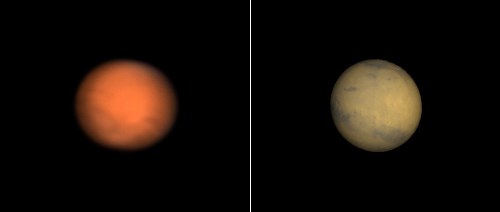
Finally, I really debated today whether or not the image of Mars I got was really that detailed or if the brightness/color variations might have been caused by dirt on the eyepiece. This evening I saw an image someone had created where they compared their image of Mars to the way Starry Night software displayed Mars (it's sky simulation software) because it should display it pretty much as it looks. Here's the result:

Mars on 1-3-08 Comparison
Mars Comparison: My Image (left) | Starry Night Simulation (right)

After looking at it this way, I feel much more confident in my image. I need to try it again with a better eyepiece.

Update: I re-stacked the best 140 images of Mars and then worked with it a bit further in Photoshop. Here's the result.

Mars-Restacked on 1/3/08
Marson 1/3/08 - Restacked

Comet 8P/Tuttle - My Coolest Comet Photo Yet

Filed under: astronomy, Astrophotography, comet, Comets, Observation Journal — Tags: Comet 8P/Tuttle — Ed @ 1:14 am


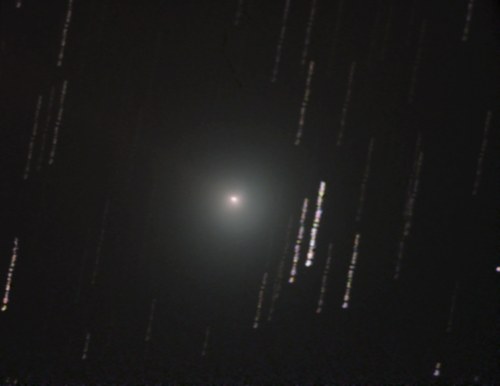
Comet 8P/Tuttle on 1/3/08

Rather than have the software track on a star like I normally do, I decided to have it track on the comet instead. Boy am I glad I did. I've seen these kinds of photos before, but never taken one. Comet 8P/Tuttle is moving so fast against the background of stars that in the 16 minutes it took to take this image (66 x 15s) you can see the background stars moving while the comet stays nice and center. Comet Holmes, which I've imaged innumerable times, really wouldn't move in the time spans that I was taking images. It was clearly moving day to day, but it might only move twice as far as this in a day.

Anyway, I took a number of other images tonight, but I'm going to go outside and see if I can see any of the meteor shower and then go to bed. I'll process tomorrow evening, if I have time.

Update: I went outside for about 15 minutes - that's all I could take - and saw 4 meteors. The first was the best - it was bright blue streaking through Cassiopeia, then broke into several smaller fragments before disappearing. The others weren't nearly as exciting (though one was green). Particularly since it's 20°F out right now with a little bit of a breeze. I'm off to bed. Let me know if anyone stayed/got up to watch and saw anything exciting. Or maybe you shouldn't - I'm not sure I want to know what I missed.

Mars on 1/3/08

Filed under: astronomy, Astrophotography, Mars, Observation Journal, Planets — Ed @ 12:50 am


Mars on 1/3/08

I tried something different tonight in order to capture an image of Mars. I used my original Deep Sky Imager Color and attached it to my eyepiece projection device that I normally use with the DSLR. It allows me to project using an eyepiece onto the camera's sensor. In doing this, it also allows me to enlarge the image by moving the camera further away from the eyepiece and adjusting the focus. It allowed me to capture this image of mars. I really had to work with the levels and contrast and stuff to bring out this level of detail. I believe it's real detail and not just artifacts of my adjustments. Part of my problem though was that the eyepiece wasn't very clean and so there were lots of smudges and bits of debris that would create shadows on the individual frames (this image is 300+ stacked frames). Because the image moved around though, I believe that those shadows average out over the image leaving the detail seen here. Or, I could be wrong. Tomorrow I'm going to try it again but with a cleaner eyepiece adn we'll see how things compare.

As it is now, though, I'm really, really happy with this image.

January 3, 2008

Quadrantids meteor shower tonight at 1am

Filed under: astronomy — Tags: events, meteor shower — Ed @ 4:58 pm

Just a heads up to everyone that the shortest meteor shower of the year, the Quadrantids, is tonight from about 1am until dawn. While short, it's considered a pretty intense shower and according to Sky and Telescope, they "... can be quite intense, with some people reporting more than one meteor per minute from dark observing sites." Because the moon rises late (4 am) and is just a sliver there will be plenty of darkness to view these. They will appear to be coming from the Northeast, but that means they'll appear to be fanning out away from that direction. At least from my experience you generally see more straight above you, but at least you'll know which way they're generally coming from. I hope to be able to set up a camera to record some meteors, but we'll see if that works. Due to the nature of meteor showers, you can't use a telescope to take pictures since they move so fast and you never know which direction they'll be coming from. Let me know if you see them. If I do, I'll have a report, of course. :)

Man is it cold

Filed under: astronomy, Astrophotography, Messier Objects, Observation Journal — Tags: M42, M43, Orion — Ed @ 12:50 am

Tonight has been around 20°F, but I was silly enough to set up the telescope - the skies were just too inviting. Though the wind had died down from last night's hurricaine, it was still a bit windy at times tonight. I'm not sure if it was that, the cold or something else, but I had great difficulty aligning the scope tonight - it took almost an hour and it still wasn't right. I'm sure at least part of the issue was me wanting to hurry and get the thing aligned so I could start imaging from inside the relative warmth of my garage, but regardless it was a bit frustrating. I took some time to look around, particularly at Mars this evening - it's still nice and bright in the evening sky and I could see it pretty clearly in my telescope. I also was able to show it off to some neighborhood kids who were crazy enough to be out in this cold and walked by. I didn't take any pictures of it, though. Instead, I went back to M42-The Great Orion Nebula that I imaged on New Years Eve. I decided to get more images of M43 - deMairen's Nebula which is kind of stuck on one end of the M42 since that area of the image was a bit grainy. I got maybe 60-70 good shots of it that I stacked and added to those I took the other night. I also actually composited what's called the Luminence channel with the image. This is something I haven't done before and I'll explain how it works in a later post. For folks involved in CCD astrophotography they'll know what I mean. They also might wonder why I've never used it before. The answer is because I'm lazy. I'm also planning on adding some longer exposures to the image (once I have the chance to take them) to see if that brings out more of the faint areas of the nebula. I believe it should. My concern is that i don't want to overexpose other areas of the image. I'd really like to keep the Trapezium visible.

The combination is an 18 minute 8s exposure (271 4 second exposures). I think this is shaping up pretty nicely. This is what I wound up with:

M42-Great Orion Nebula on 1/2/08

Sometimes I worry that I post too many of the same images on my site - this makes 3 of this in a row - but for me, learning about astronomy is a process and I use the blog to share what I'm learning and how I'm learning it. I guess that's one of the things I really like about this is that I get a lot of advice as I go from people which obviously helps me learn more and get more out of the hobby, but also I think by discussing what I do, I tend to learn it better myself.

January 1, 2008

No stargazing tonight, but some reprocessing

Tonight started off cloudy, but I can see the stars clearly now. The wind is blowing like crazy though. Weather.com says up to 35mph, but I'd bet we're getting over 50 at times. The garage door has been creaking ominously all evening. I figured it would be better to play it safe with the telscope. I'm not sure I could get over my telescope being blown over in the wind.

Instead, here's a reprocessed Orion Nebula from last night which I re-stacked with DeepSkyStacker. I think this image does a better job of displaying the nebulosity than the one from yesterday.
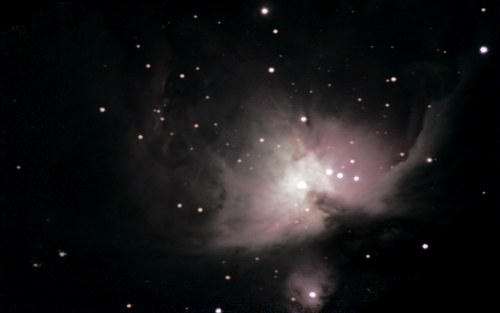
M42-Great Orion Nebula on 12/31/07 - reprocessed

Also, here are 2 images for Pierre, a commenter who asked about what the individual frames I'm seeing look like (though they may be interesting to others as well). I've also included a long-winded explanation of how I do my astrophotography image gathering so if you're interested in that, read on...
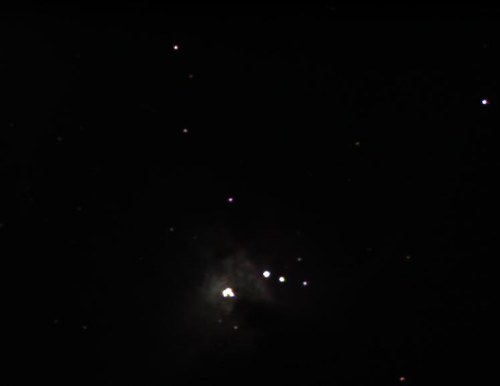
M42 for Pierre - Single
M42 single 4 second image

This first image is what I see when I take a 4 second exposure. You can clearly see the Trapezium and the other stars are nearly maxed out on brightness. The area of the nebula lit by the Trapezium stars is showing up faintly, but there's not a huge amount to see. That's because the stars are pushing the top end of the histogram so hard. There's actually quite a bit more detail there and that's why I normally adjust the gamma (in the Envisage software, it's called "Shadow Enhance", but it's really just a gamma adjustment). Below is what that does for me.
M42 for Pierre - Gamma adjusted single
M42 single 4 second image - gamma adjusted

Obviously there's a lot more detail there. As a matter of fact you can see some geostationary satellite streaking along in the upper right left quarter of the picture which really wasn't visible in the image above at all. (Side note: probably 1/3 of all images I take of Orion have a satellite going through it because it's in the southern part of my sky and that's where geostationary satellites are as well, above the equator. As a matter of fact, I've seen as many as 4 in the same image before) Now, since I'm capturing these images in a FTS format, changing the gamma doesn't change the underlying data, which is good because I want to reprocess these later and I'd rather work with raw data. As a matter of fact, if you have used the RAW format in your camera, it's pretty much the same kind of thing - there's a lot more data than a standard 8-bit image. In the case of FTS, it can store a massive amount of data - each of the frames above is 5MB in FTS format (compared to less than 15K each in JPG). It's this raw data that allows software like DeepSkyStacker to pull out so much detail in the images later.

Another important thing to note is that these images automatically have dark frames subtracted from them. Any digital camera chip has noise in it that gets amplified the warmer it is and the longer an exposure is taken. For images of daylight or really any well lit scenes, this noise is absolutely overwhelmed by the amount of light coming into the camera so you'd never see it. With astrophotography, you are taking pictures of things that are extremely faint (though Orion is somewhat an exeption - it's considered very bright for a deep sky object, but it's still pretty dim) and so you use long exposures. In this case, that noise in the camera can be pretty significant. It can add new "stars" to your image, which might seem exciting at first -hey, I discovered a new star - but wears out its welcome quickly thereafter. To combat this problem, I take exposures at numerous temperatures for many different time periods and the resulting images are subtracted from the final images. For example, I'll take a 4 second dark frame at 34°F and use that to be subtracted from the images I'm taking above since that's the exposure time and the temperature at which it was taken (fortunatly, my camera has a built in thermometer since it's important to know the camera temperature) This helps the end result be much more true to the light that's coming in. There are other kinds of adjustment images that can be used - bias and flat frames - but I haven't had a chance to really use them. They can make a difference in the quality of your work (they account for areas of the image that are dimmer than they should be as well as some other things), but dark frames are simple to do (my capturing software does it automatically) and make a massive difference right off the bat. My capturing software (Autostar Envisage - it came with my camera) automatically can create the composite image which normally looks pretty good, and so that tends to be what I'll throw onto my blog the night I take something. If I've gotten good results, I then will often pull the raw data into DeepSkyStacker or RegiStax or something else to reprocess it. Such is the case with the image near the top of this post.

I hope this helps y'all understand how I do some of what I do and if anyone has any other questions, please feel free to add a comment. I really enjoy these kinds of posts, but it's not something I tend to think of on my own.