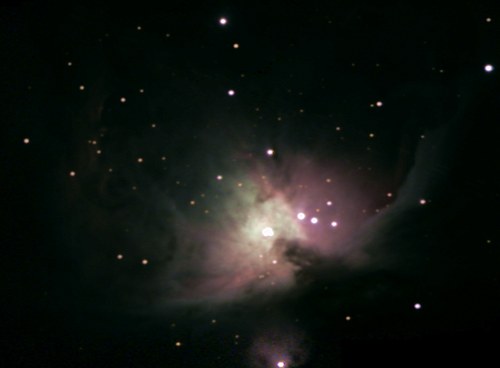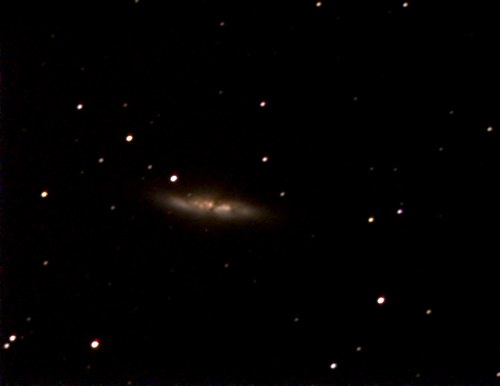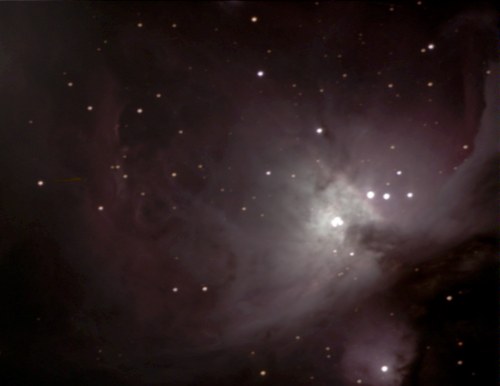
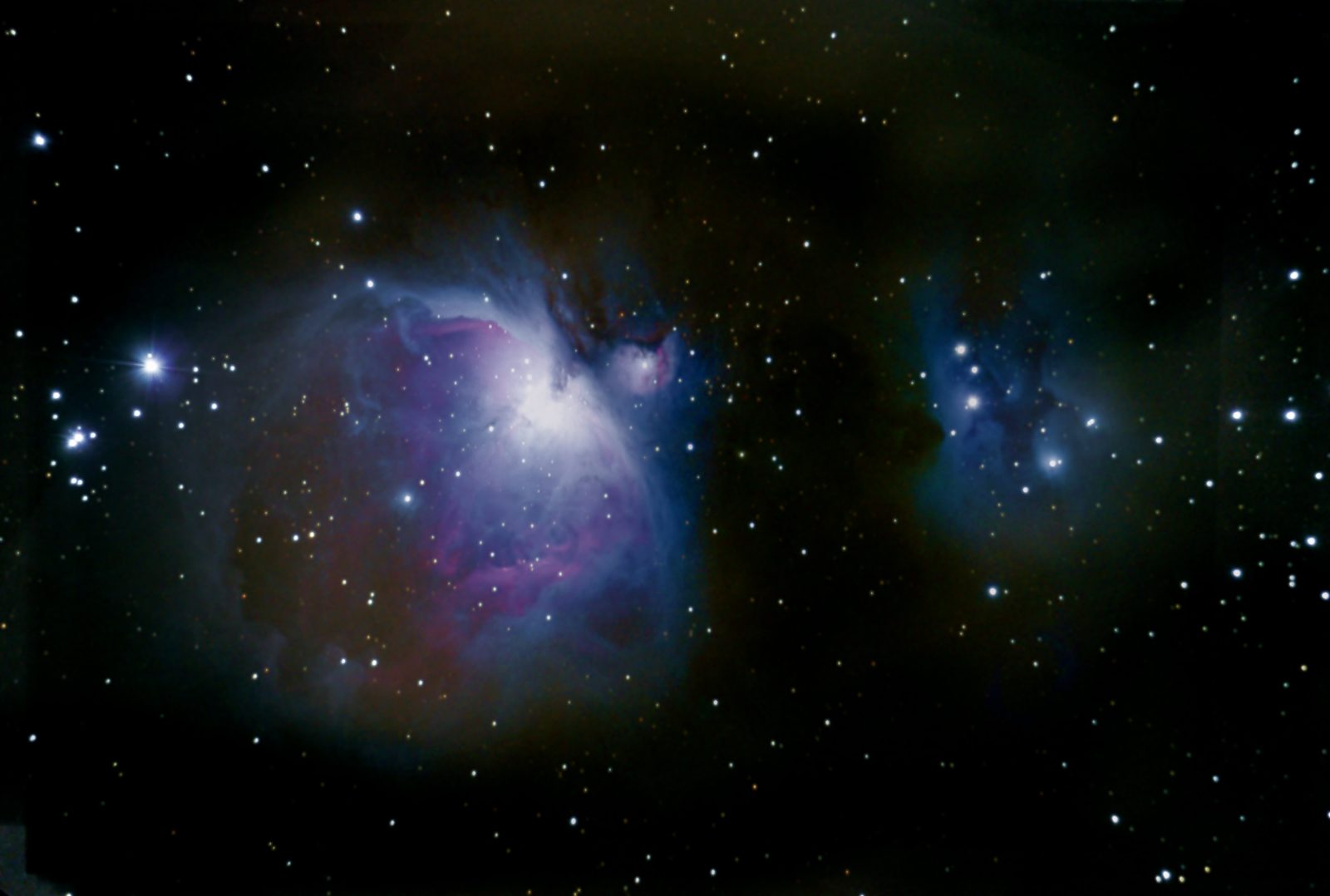
The Great Orion Nebula (M42) and the Running Man Nebula, photographed from Flintstone, Georgia

Flintstone Stargazing

Astronomical observations by a guy in Flintstone, Georgia

M42 – the Great Orion Nebula, February 2009

Category: astronomy

December 31, 2007

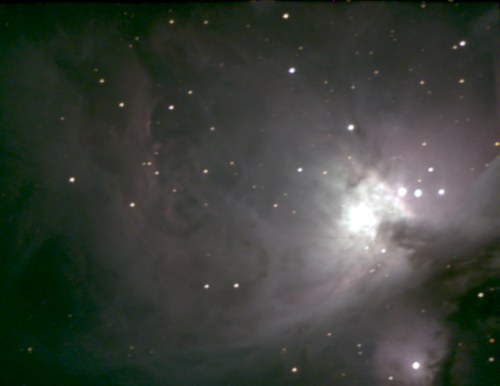
M42-Great Orion Nebula on New Years Eve 2007

Filed under: astronomy, Astrophotography, Messier Objects, Observation Journal — Tags: Happy New Year, M42, M43, Orion — Ed @ 11:59 pm


M42-Great Orion Nebula on 12/31/07

I finally figured out how to do Drizzle images and this is a quick first attempt. I thought it an appropriate target for New Years Eve since the Orion Nebula is basically cosmic fireworks. Note that you can see the Trapezium in the center of the Nebula in this image - I could never resolve that in my previous scope. Tonight was very nice with intermittent clouds and I had a good time figuring out how to get more out of my scope. Happy New Year!

The Cigar and Bode Galaxies on 12/30/07

Filed under: astronomy, Astrophotography, Messier Objects, Observation Journal — Tags: M81, M82 — Ed @ 9:43 am


M82-Cigar Galaxy on 12/30/07

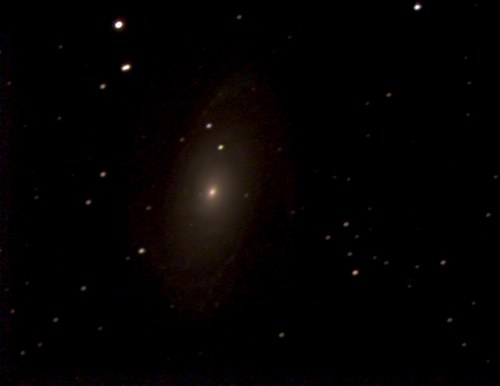
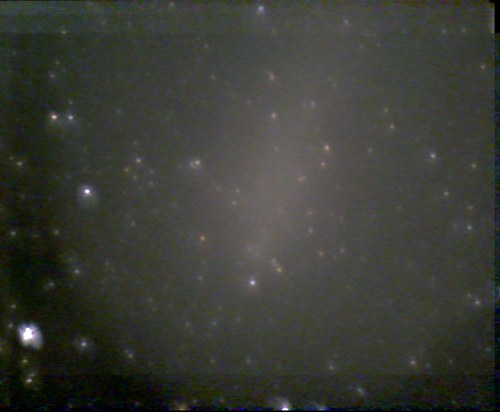
I had never captured M81 and M82 before (they're quite close to one another) because they had been pretty much below the horizon during normal viewing times for a while. Now, however, they are visible by 11 from my driveway. M82 is really colorful and bright and really is cigar shaped. M81 is fainter, but much larger (I can't wait to do some much longer exposures on it). Below is the image of M81 that I captured:

M81-Bode's Galaxy on 12/30/07

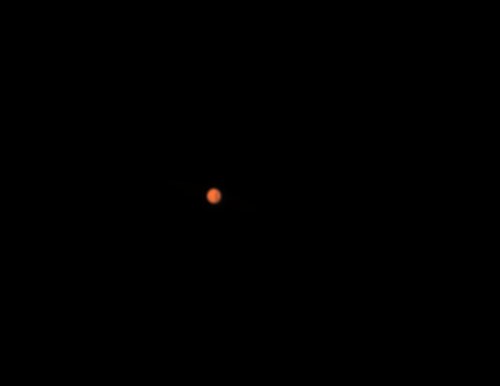
Mars on 12/30/07

Filed under: astronomy, Astrophotography, Mars, Observation Journal, Planets — Ed @ 9:39 am


Mars on 12/30/07

The red planet was really bright this evening and so I brought as much magnification as I could to show the details. Unfortunately, that just meant my 3X Barlow. I really think that if I can get my hands on a Powermate 5X I should be able to see quite a lot of detail. Actually, through the telescope visually, I could easily make out the polar cap and different shaded areas of the planet. This image captures some of that, but not as much as I would like. I'm going to work on this to see if I can get more detail in future images. That said, I'm still really happy with this image - it's the best I've ever captured of Mars by quite a lot. One other thing is that my friend Damon suggested a method for "punching up" the images I've got of Mars, but that'll have to wait for a bit. I promise to upload the "punched up" version once I'm done with it.

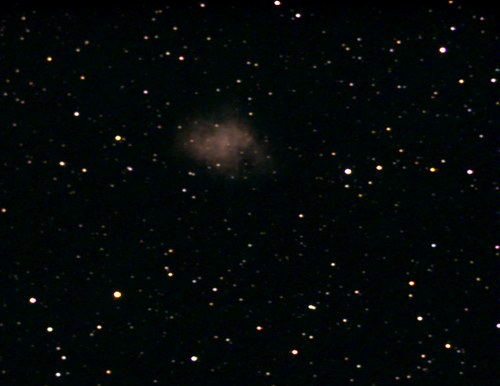
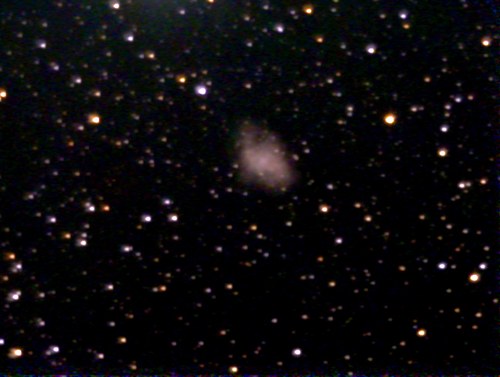
M1-Crab Nebula on 12/30/07

Filed under: astronomy, Astrophotography, Messier Objects, Observation Journal — Tags: Crab Nebula, M1 — Ed @ 9:25 am


M1-Crab Nebula on 12/30/07

After capturing Orion last night, my next target was M1, the Crab Nebula. I wasn't willing to take a long exposure, but just took a 225 second one. See how this compares to the 600 second one I took with my smaller Tasco:

M1-Crab Nebula on 10/10/07

In the one from October, I had to really stretch the image to pull out the nebula, but in this much shorter exposure, the Nebula is larger and there's more detail and subtlety.

December 30, 2007

First light with my LXD75/Meade DSI Color II

Filed under: astronomy, Astrophotography, Equipment, Messier Objects, Observation Journal — Tags: M42, Orion — Ed @ 11:27 pm


M42-Great Orion Nebula on 12/30/07

This is the first image I took with the new scope and all I can say is WOW! I had a lot of trouble with the scope early in the evening (I'll discuss that in a post tomorrow), but by 10:00 I was ready to go and as my first imaging target I chose M42-The Great Orion Nebula. Immediately, I could see the difference both from the new camera, which had a better color display and a larger image area, and from the telescope, which resolved stars much more precisely and which pulled in MUCH more light. For this image, I hadn't yet captured dark frames which are used to remove noise in the image and so there is a bit of background noise, but I couldn't wait and so I plunged ahead anyway.

In the image above, I took 8 second exposures which were stacked. At that exposure level, you can still make out the Trapezium (the four bright stars in the center of the nebula) as four stars. The resolving detail on this scope is significantly better than my Tasco and this is a good example where that's clearly visible.

Below is a bit longer exposure (I used 15second exposures) and you can see even more detail in the nebula.

M42-Great Orion Nebula on 12/30/07

I haven't quite figured out how to get my computer to guide my scope to enable automatic capturing of panoramas using Drizzle, but that's my next project. Once I'm able to do that, I'll be taking shots of the full nebula for sure.

I also took a number of other shots including Mars (with some detail!), M81 and M82. I'll post about those tomorrow, but if you want to see them in the meantime, you can click on my flickr links on the right.

December 29, 2007

Quick test with the new scope (no photos)

Filed under: astronomy, Clouds, Observation Journal — Tags: Telescope — Ed @ 9:42 pm

Tonight has been very cloudy - the only stars visible are in the east and only just beyond first magnitude are visible - I could only just make out the belt of Orion periodically.

Despite the lousy conditions, I decided I couldn't wait any longer and I got the new scope out. Since I couldn't see Polaris, to polar align the scope, I guessed and then did the alignment on the few stars I could see. Once it was aligned, I dialed in Mars and took a look through the scope. WOW! In spite of the terrible viewing, it was the best viewing of Mars I've ever had. By a huge margin. In my Nagler 7mm with the 3X Barlow, I could easily make out different areas of brightness and darkness on the surface and every so often could see the white icecaps of the pole (I'm not sure whether it's north or south). Amazing. Through the eyepiece, it was larger than Jupiter was in my old scope and significantly brighter. Once I get some decent viewing and my camera, I fully expect to see some really spectacular views. Beyond Mars, I also dialed up the Great Orion Nebula and the scope stopped turning in one of the directions it's supposed to turn. I could hear the motor whirring, but it wasn't moving so I figured I should call it a night and I took down the scope.

I had had this problem when I assembled the scope and so I was able to quickly field-strip the mount and I re-set and then tightened the gears so they would mesh properly. I briefly tested it (while still inside) and it worked fine after that. I've decided to call it a night, since conditions seem to be getting worse outside.

Overall, my impression is that the extra 3 1/2 inches of aperature and the much better optics make a huge difference. In addition to just the light gathering capacity, I also noticed that stars were much, much sharper in the new scope. I don't know if that's a function of aperature or just a better mirror. I can't wait to get the camera set up and start doing some serious viewing.

December 20, 2007

My Christmas Present

Filed under: astronomy, Equipment — Tags: Christmas gift, Telescope — Ed @ 11:20 pm


My Christmas Present

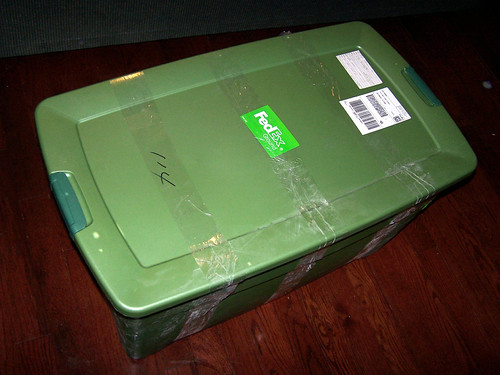
Since we're headed to my parent's house for Christmas, we did Christmas here at my house yesterday morning. Betsy, the boys and I had a grand old time, but one thing was missing - my big gift. It wasn't really a surprise, since I had won an auction on eBay and paid for it myself, but I was still about as excited as I could be about it. It just hadn't arrived yet. It arrived today. It was shipped in this big green Rubbermaid container. I couldn't wait to get the lid off.
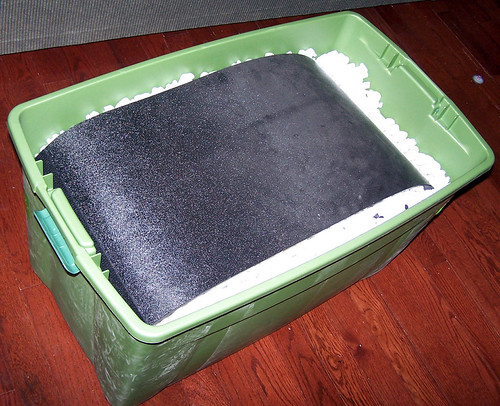
The box has been opened!

This is what I found inside. I was a bit surprised at first since I wasn't sure what the big black thing was. It turned out to be a dew shield. After digging through the packing peanuts for a bit, this is what I found:
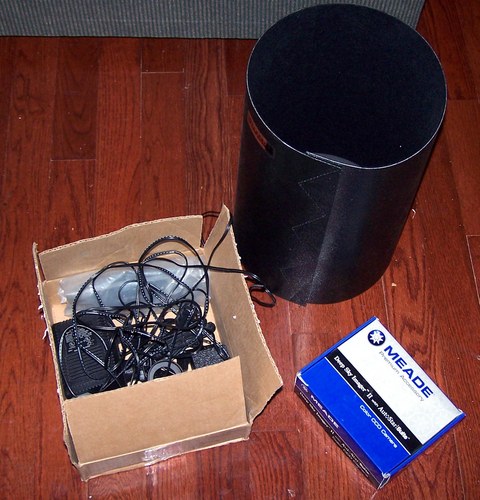
The associated parts and extras

The dew shield had now been assembled (it just velcros together) and you can see my new astrocam on the bottom right - it's a Meade DSI Color II. I have a Meade DSI Color I, but this one has a bit better resolution, greater sensitivity and built-in cooling. In the box is not only a power adapter, but a 26mm Super Plossl eyepiece and a 7mm TeleVue Nagler Type 6 eyepiece. I didn't realize at the time of the auction how expensive those are. They go on eBay for over $200. That was a pleasant surprise!

Looking down the barrel

Next out of the crate was the OTA or Optical Tube Assembly. You may have figured out by now that my big gift was a new telescope (with some extras). This is my new scope and here are it's specs:

Telescope specs
My Telescope Specs

It's a Meade LXD75 8" Schmidt-Newtonian. It has a 203mm primary mirror (compared to the 114mm primary in my other scope). This does not collect twice as much light - it collects closer to 3.5 or more times the light of my other scope because the light gathering is proportional to the area, not the diameter and the central obstruction of the secondary mirror is nearly the same size in both. What that means is that I will be able to gather much more light more quickly leading to much deeper and more beautiful deep sky images. It also means I can get greater magnification of things like planets. I cannot wait to see Mars, Saturn and other planets!

The LXD75 Mount
The LXD75 Mount

This is the mount after I had assembled it. The mount is WAY sturdier than my old one (the one with two broken legs) and also is a Go-To mount. This means that instead of moving the scope by hand, I can instead have the motors tell it exactly where to go and what to track.

The Autostar controller
The Autostar Controller

I will use both the Autostar controller (pictured above) as well as a computer interface to my laptop. This will open up lots of new possibilities for photography. I'm hoping to start being able to take some tracked shots of the space station, for example. We'll see how that goes. As it turns out , Once I had gotten it all assembled, the motors didn't seem to be engaging and when I opened them up, I found that two of the gears had slipped out of position and were loose. This site proved to be invaluable for figuring out what was wrong, how to fix it and especially how do get the box open without breaking the telescope. A big thanks to Michael L. Weasner. While his post is really about the LXD55, the gearing is the same on both mounts.

My new LXD75 8
My new LXD75 8" Schmidt-Newtonian

And here's the assembled telescope! I collimated it - it was actually pretty close to right on and then made sure that the controller and stuff was working well in my living room. Of course it's pea soup outside tonight so I can't see anything and since we're leaving tomorrow for Christmas, it won't see first light until next week, but I'll have the camera attached and put up photos as soon as I do. I can't wait! Merry Christmas to me!

And a Merry Christmas to all of you as well!
December 16, 2007

The Moon on 12/16/07

Filed under: astronomy, Astrophotography, comet, Moon, Observation Journal — Tags: Comet 17P/Holmes — Ed @ 9:23 pm


The Moon on 12/16/07

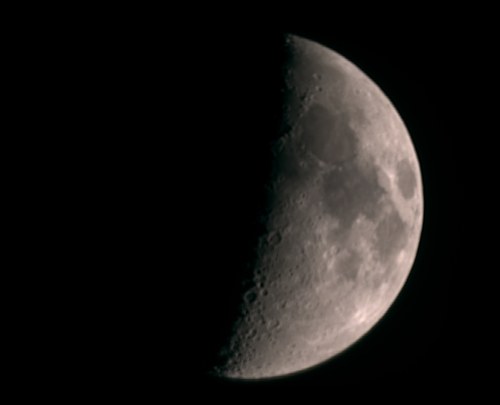
It's really cold outside, but the sky is pretty clear after a couple cloudy days. The Moon is nearly half full now and the light from the Sun is displaying the craters near the terminator in stark relief. It was really beautiful through the eyepiece of my scope - there's just so much more detail than you can see in these images.

I also tried to get an image of Comet 17P/Holmes, which is absolutely huge now. Even with my focal reducer it's way too big for a single shot. I did a manual drizzle to get a bit more of the comet in view, but ran out of time to get the whole thing - I really just got the main body and not the end of the tail.

Comet 17P/Holmes on 12/16/07

December 12, 2007

The Moon through the clouds

Filed under: astronomy, Astrophotography, Moon, Observation Journal — Ed @ 9:00 pm


The Moon on 12/12/07

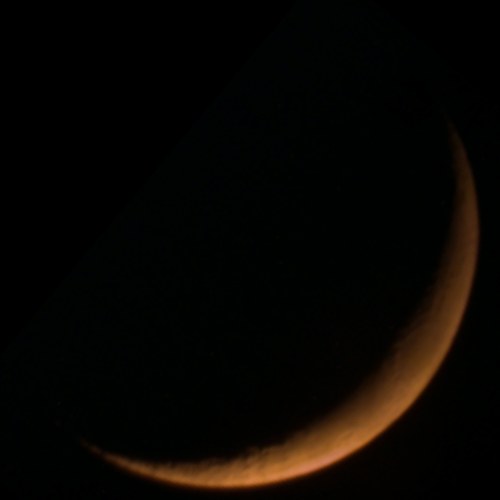
Tonight has had pretty thick clouds with occasional openings. I was able to aim the scope during one of these openings and then took this image which is a composite of nine 2 second long images. Normally with the moon in this phase, I'd be using exposure times of a fraction of a second (maybe .05 or less), but this was taken through light clouds and so I needed a longer exposure time. I think it turned out rather nice. I always think the moon looks the most elegant when it's a slender crescent.