The Eclipse Continues

This is about 25 minutes after it started.
Astronomical observations by a guy in Flintstone, Georgia
This is about 25 minutes after it started.

The Eclipse Has Begun (2-20-08)
Here we go!
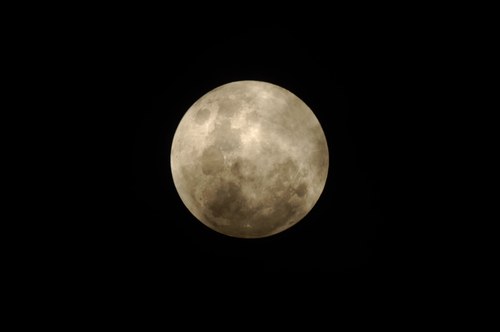
Moon (T-25m to eclipse) on 2-20-08
Clouds have rolled in, but the Moon is still visible. 25 minutes until the eclipse starts!
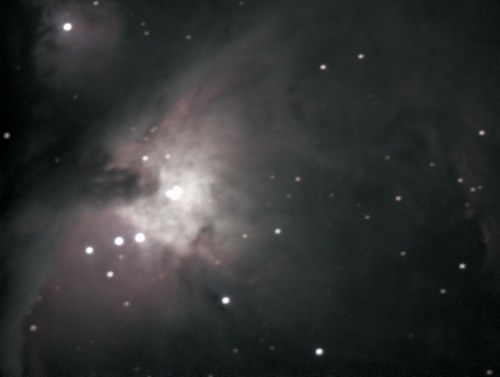
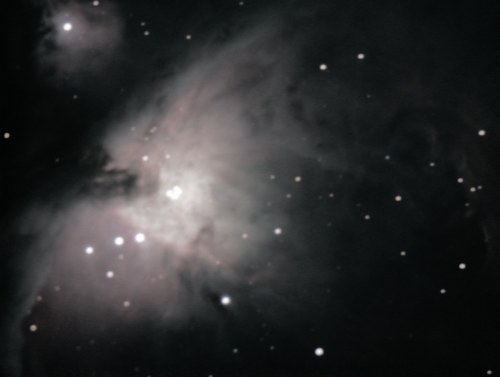
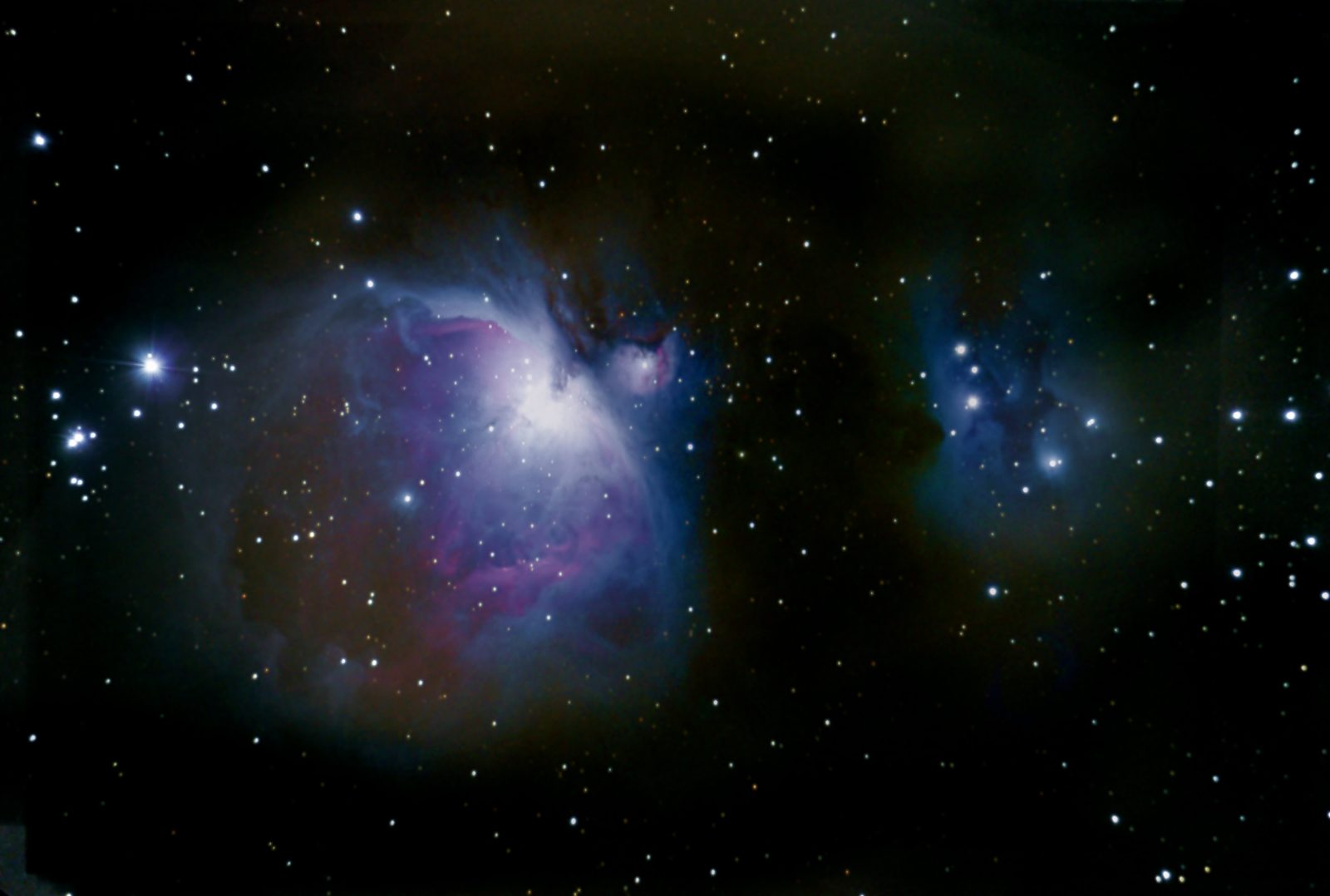
Tonight, I decided to do a test to compare some of the Meade Deep Sky Imager (DSI) models. I personally own a DSI Color and a DSI II Color camera. My friend Dave lent me his original DSI camera which is black and white and uses colored filters. I thought it would be an interesting test to see how they compared. The results were not what I expected. I chose one of my favorite targets - M42-The Great Orion Nebula and I started with the original black and white DSI. I took 4 second exposures of each of the channels - Red, Green, Blue and then a Luminance channel as well. I composited 50 images of each to create these and then I combined them in Photoshop. The result is above. Wow. The detail was way beyond what I expected, particularly considering this is the first generation DSI camera. I then took fifty 4 second images with the DSI Color. Here is the result:
While this is a fine image, the result is nowhere near the quality of the DSI. This is pretty much what I expected. Of course, now that I'm thinking about it, to really compare I probably should have used 200 images stacked because with the DSI image I used 50 of each channel and there were 4 channels. Oh well.
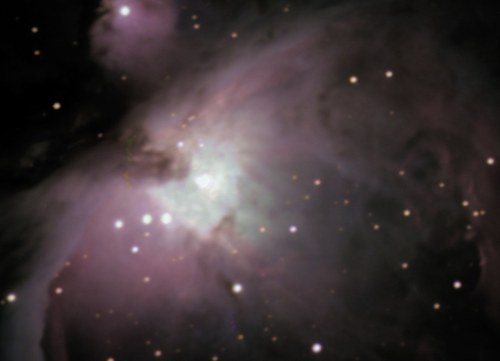
Finally I got out my DSI II Color. This camera has a larger chip so I resized the image down to compare it to the other one, but the results are not as good as I'd hoped. Here's what I got:
Some of the differences between these images are in the way that they were processed. Also, the filters I use for the DSI camera are not pure RG & B filters - the red is actually slightly Orange for example - so the color I'm getting there is going to vary somewhat.
I think the results speak for themselves. For detail, the original black and white DSI camera gave the best shot hands down. I don't have a DSI II black and white version, but I'd bet it'd be even better, with lower noise. The downside to the original DSI camera is that by using the filters, you can't get instant results - it takes some time to combine the images and you have to swap the filters out and stuff all of which takes a lot more time and effort, but for the highest quality images, I think it's clear that the results of that effort are worth it.
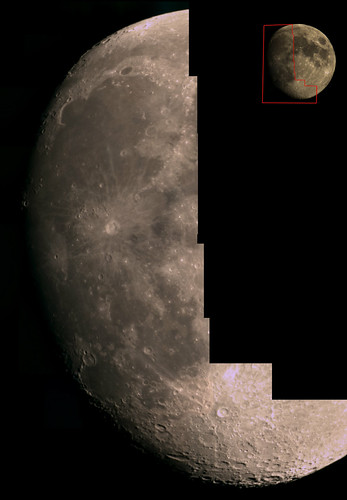
Moon Terminator Detail on 2/17/08
Tonight, we had storms and then all of a sudden, it was clear - very humid, but clear. I brought the scope out and after setting up realized there was too much wind for any long exposures, so I headed straight for the Moon. It was quite bright, casting shadows on the ground and after taking an overall shot (used above to display the detailed area) I decided to use my 3X Barlow to take a series of images that I could combine into a larger panorama. The terminator is the line where the shadow and light come together as the moon grows or shrinks and is usually the most interesting place to look at the moon. This is because shadows are magnified near the terminator because of the angle that the light shines on the features found there. I was able to stitch together this series of 18 images that cover the entire length of the terminator. If you'd like to really see the detail click on the image and you can see a much larger version (go to "all sizes") or see notes about some of the features visible in the image. You can see how Sinus Iridum which I imaged yesterday has changed just in the past 24 hours.

Sinus Iridum-Bay of Rainbows on 2/17/08
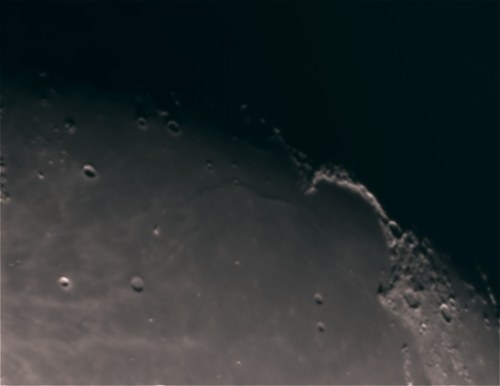
Here are the two areas of detail that I imaged this evening. Sinus Iridum - The Bay of Rainbows is always one of my favorite areas of the moon - the smooth plain (okay it has some ripples) and the beatiful curve of the rim are striking and if conditions are just right sometimes top of the rim is illuminated but the plain is not which results in what looks like a mountain range to nowhere.
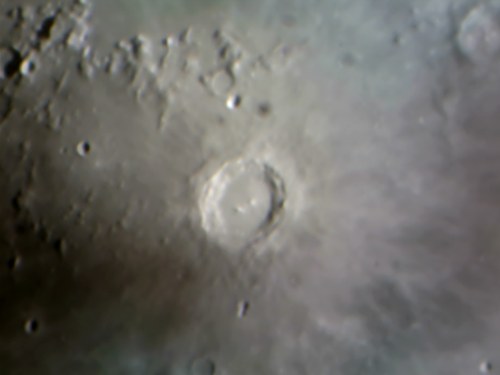
The image below is of Copernicus Crater one of the largest craters on the moon. Each of these images was captured using my cheapo Meade web cam - I captured 60s worth of video on each and then used Registax to pull out detail. Both of these features can be found in my previous post featuring an image of the moon this evening - they are both found in the top part of the image.
Added: This image shows how Sinus Irudum connects to Mare Imbrium - the Sea of Rains. It was not taken using the webcam - it was taken with my Meade DSI II Color camera and then stacked in RegiStax.
Tonight started off very cloudy and I planned on just staying inside. At around 9:50 though, when I walked by the window, I thought I saw stars. After going outside, sure enough it had cleared. While it was still somewhat hazy, the Moon is bright enough to be clearly visible to the scope and so I figured I should get some shots. I also took some lunar crater detail shots and some images of Saturn that I need to process before I upload them so it'll probably be some time tomorrow before they show up here. It's also quite warm out - somewhere around 55°F so I've been quite comfortable.
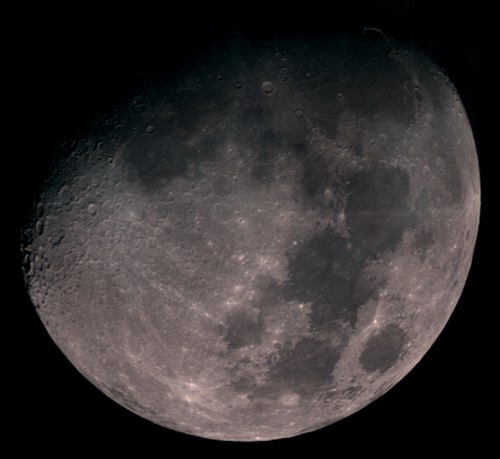
Tonight was very nice, but a bit windy (which made it feel colder than the 45°F that the thermometer was reading). It also meant that the telescope would shake a bit too much to get many long term exposures. Realizing this, I decided to start with the Moon. When imaging the moon I used an exposure of .003s through my refractor which is quick enough to block out most of the wind movement. I thought this image came out nice and sharp. When looking, particularly at higher magnification, visually I could see a lot of turbulence between me and the Moon. Actually, I suppose that most of that turbulence is close to me. It's probably just the first 100 miles or so that are turbulent. After that it's clear for the next 180,000 miles.
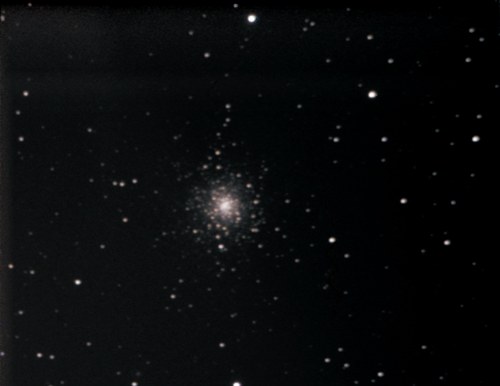
After getting the moon, I thought I'd have a go at the only globular cluster Messier object visible in the early evening, M79. I was able to get one hundred 30s images that were stacked to give me the image above.
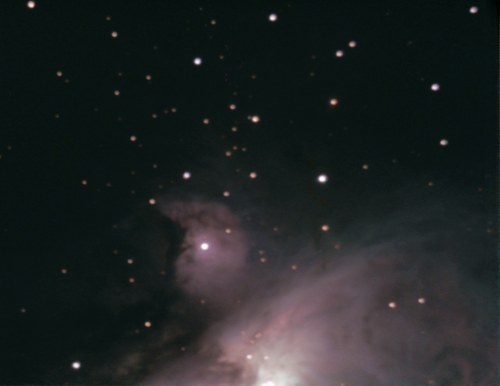
M43-de Mairan's Nebula on 2/10/08
Finally, I thought I'd take a look at something brighter since the wind was picking up so I pointed the scope at M43-de Mairan's Nebula which is the "knob" on the end of the Great Orion Nebula. I took a bunch of 8s exposures and it turned out okay. I then tried to pull the image into DeepSkyStacker, but it seems that the newest version of that software is having some problems with finding stars in images. The guy who writes the software updates it pretty often so I'm hoping he'll have a fix soon. and I'll be able to reprocess a number of images that I've taken recently.
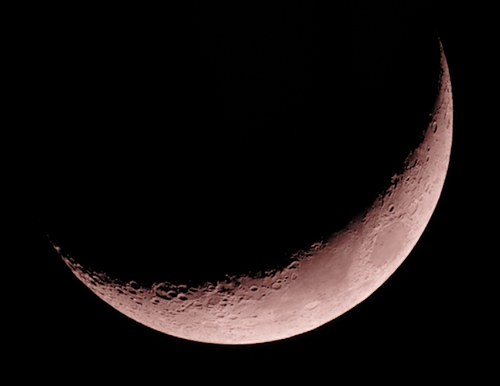
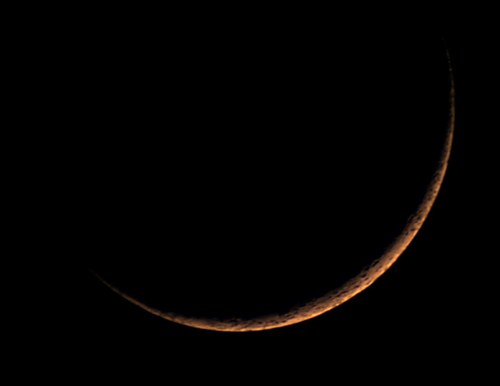
The sliver crescent Moon was irresistable tonight. It looked so elegant in the western sky that I rushed to get the telescope out and set up in time to take some pictures. Tonight is beautiful and clear and I plan to be out a while.
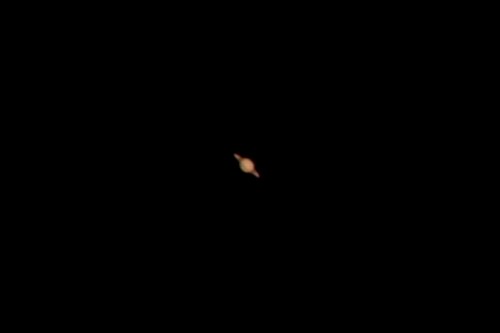
I stayed up late tonight and was finally able to see Saturn with the new scope. This image, however, is not from the 8" - it's from my Wal-Mart special scope. While this image was being captured, I was viewing the ringed planet through my bigger scope. It was beautiful. I could barely make out the Cassini division in the rings and could discern a few striations on the planet itself. Unfortunately it was getting so cold that frost was forming on my equipment and I had to head inside before i could get a higher magnification. I'll try for that soon.
Prior to getting my image of Saturn, I was able to get an image of M81 - Bode's Galaxy:
Bode's Galaxy is found near the big dipper - just past the part you drink out of. It's very close to M82 - the Cigar Galaxy.
Overall, a nice night - cold (30°F) but not unbearable. The mount worked really well with the exception that I believe I need to further align my polar scope. Other than that it tracked and slewed smoothly. Once I get these last couple kinks out I hope to be able to start doing some really long exposures.