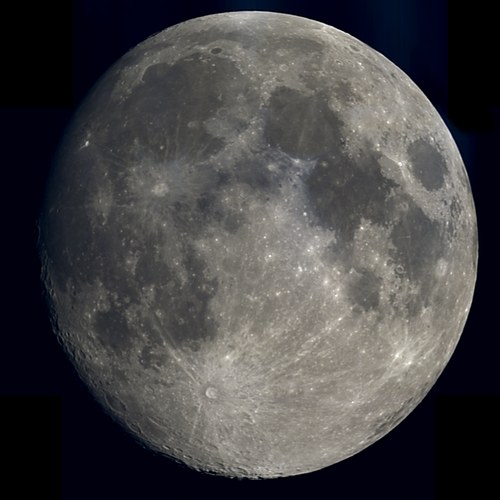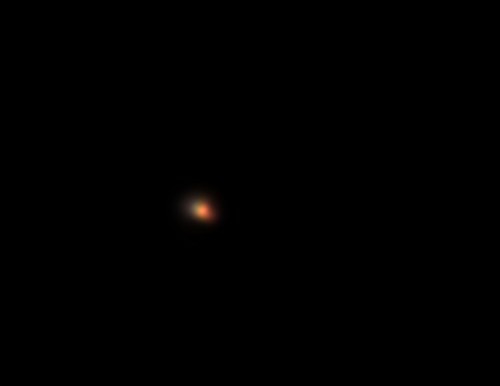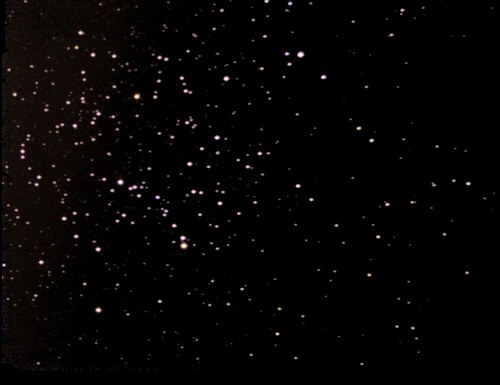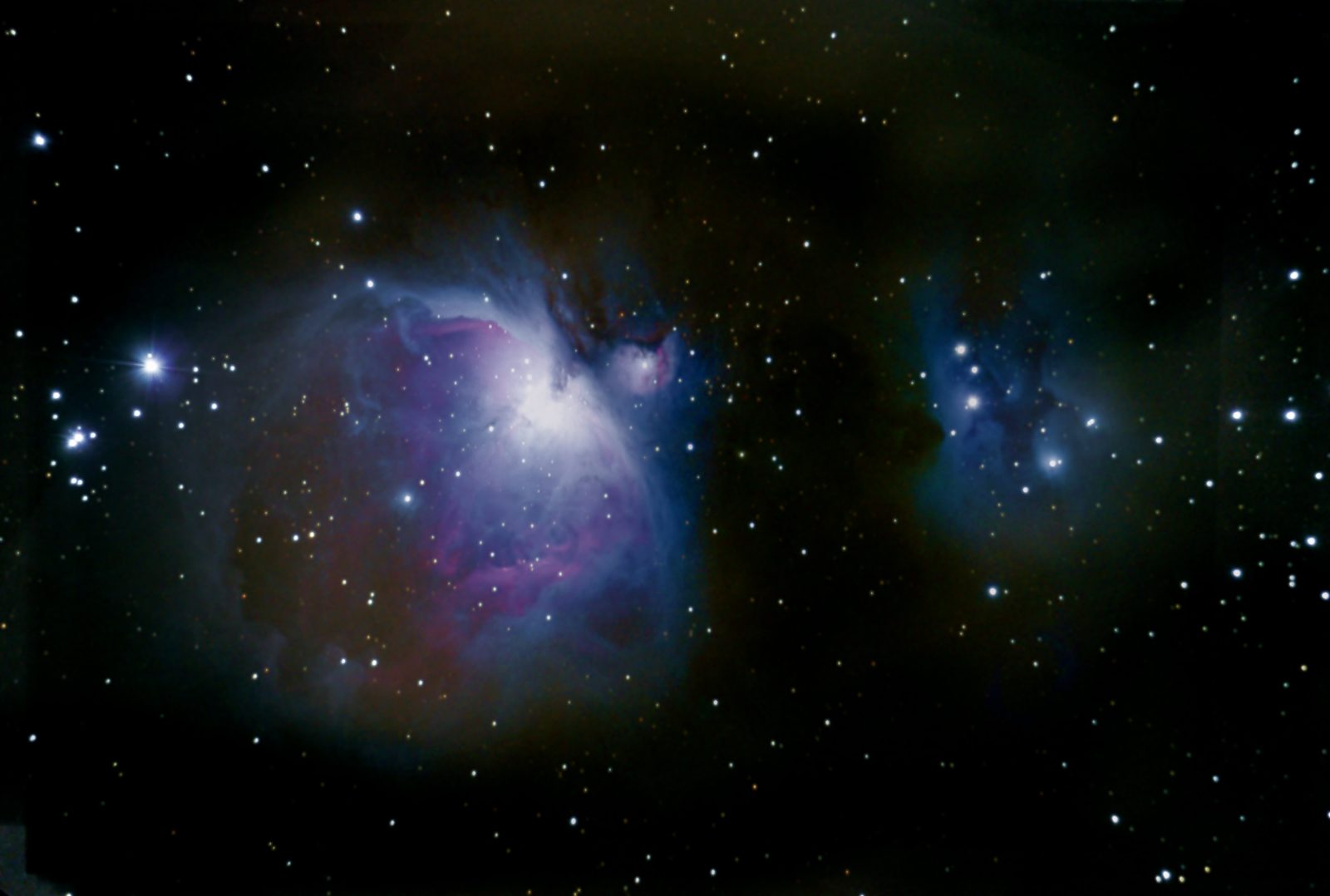
The Great Orion Nebula (M42) and the Running Man Nebula, photographed from Flintstone, Georgia

Flintstone Stargazing

Astronomical observations by a guy in Flintstone, Georgia

M42 – the Great Orion Nebula, February 2009

Category: Astrophotography

January 27, 2008

The Great Orion Nebula Shootout

Filed under: astronomy, Astrophotography, Equipment, Mars, Messier Objects, Observation Journal — Tags: M42, M43, Orion — Ed @ 11:52 pm

Tonight was beautiful - the Moon was not going to rise until late, and it was clear and about 40°F outside. All in all, really good conditions for me. I decided that tonight I would test out my new (cheapo) 70mm refractor that I blogged about the other day. I'd done some work on my mount, so I was hoping to also see if that had worked as well as I'd hoped and I'd be able to take some long exposures.

I set up the way I normally do, leveling the scope, using the polar scope to align the mount on Polaris and then running the alignment procedure with the Autostar software. I again got the magic, "You are less than 5' from the pole" message so my alignment was very good. I then took a good amount of time to view some different targets comparing the views in each scope. I had a look at Mars, M42-The Great Orion Nebula, The Double Cluster and all looked really, really good in both scopes. I actually started to wonder how much better my 8" scope was so I resolved to find out. I first hooked up my DSI II camera to the 70mm refractor and aimed at the Orion Nebula. Because I was using the diagonal on the scope, the image was originally a mirror image so I fixed it in the software afterward, but that's why the image from that scope is not oriented the same way as my other one. Here's the result:


M42/M43-The Great Orion Nebula on 1/27/08
Taken with my 70mm refractor

This is a combination of 18 15 second images plus 10 60(!) second images. The 60 second images were spot on - no movement that I could tell. It makes me want to try some 2-3 minute exposures on some of the fainter targets - I can't wait. Overall, it did what I believe is a very creditable job on the nebula. My only complaint (and this is a known issue with achromatic refractors) is that there is a bit of a purple halo around the brightest stars.

I next took the exact same series of images through my 8" Schmidt-Newtonian. Here's the image I got:
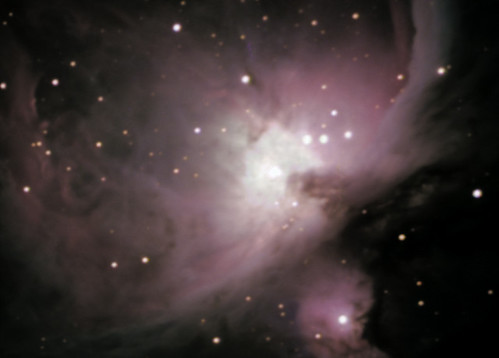
M42/M43-The Great Orion Nebula (8
M42/M43-The Great Orion Nebula on 1/27/08
Taken with my 8" Schmidt-Newtonian

Because the focal length is longer (812mm vs 700mm 600mm), the magnification is higher on the 8" scope than on the 70mm refractor. (Magnification is calculated by dividing the focal length by the eyepiece size. The eyepiece of the DSI II is aproximately 8mm so the magnification for the refractor would be approximately 87.5X 75X and the 8" scope would be 101.5X) That's why it appears more zoomed in. It also is much, MUCH brighter - there's quite a bit more detail. So I guess that answers the question as to whether they actually show the same amount of detail. The 8" is clearly much brighter and more powerful. I am really anxious to try the refractor on the Moon however, the larger field of view means I may be able to get the entire moon in one shot and refractors are known for providing better contrast/clarity on planets and lunar views. I also took images of Mars with both scopes that I'm processing now. I'll probably upload those tomorrow.

Overall, a really great night. I truly enjoyed the visual observation I did tonight - both scopes performed admirably and it was nice to be reminded of how much fun visual observation can be. I also was pleasently surpised at the results of my tests. I think I've got a great setup to capture a number of different types of images in the future.

Update: Here's the Mars image from the refractor. Wow. Unfortunately, I couldn't tell until I procesed it, but the image I got from the 8" was slightly out of focus.
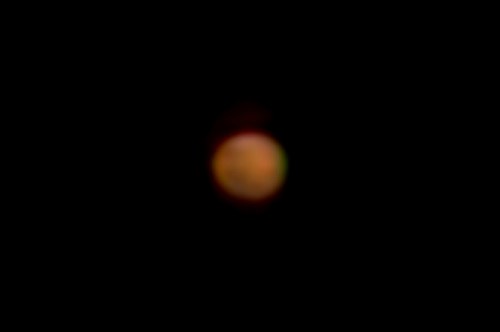
Mars on 1/27/08
Mars on 1/27/08
Taken with my 70mm refractor

This image was taken using not only the 70mm refractor, but the web cam that came with it. I paid $25 total for both (and a terrible tripod and eyepieces, which I didn't need). What a deal.
January 24, 2008

Mercury Setting

Filed under: astronomy, Astrophotography, Mars, Observation Journal, Planets — Tags: Mercury — Ed @ 7:36 pm


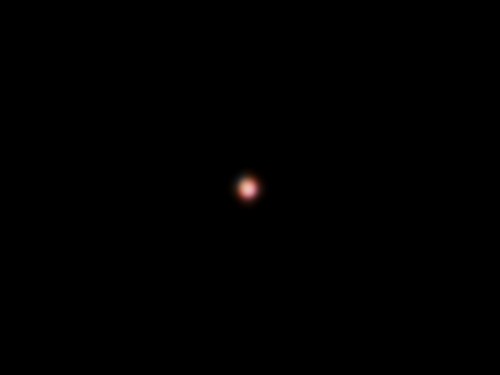
Gibbous Mercury on 1/24/08

Mercury was very bright in the western sky and set not long after the Sun. I was able to get the scope out in time to be able to shoot this image of the gibbous disk of the planet.

Later on, I also took this image of Mars, which turned out to not have very much detail, unfortunately.

Mars on 1/24/08
Mars - slightly out of focus - on 1/24/08

Ultimately, while it was certainly very cold, it was the wind that finally made me go inside. It was too difficult to keep things in the viewfinder at high magnification. And it was very cold. So, so cold. Otherwise it was a nice night out.

January 20, 2008

Mercury on 1/20/08

Filed under: astronomy, Astrophotography, Observation Journal, Planets — Tags: Mercury — Ed @ 10:31 pm


Mercury on 1/20/08

Tonight was very, very clear and I was able to see Mercury visually shortly after sundown. I was able to get the telescope set up quickly enough to be able to take a quick shot. This one was with my 5X Barlow, which while it magnifies the target quite a bit also makes focusing very difficult. Because Mercury was on the horizon, it's tough to get a good focus and since you're looking through so much air, it's also difficult to get a still image. It appeared to be a slightly gibbous disc in the scope and that's pretty much what the camera captured. According to Starry Night software that's pretty much what I should have seen.

I made sure the kids were able to see it and knew what it was. It was easy to see for almost an hour after sunset so if you have the chance, check it out over the next couple of days.

January 12, 2008

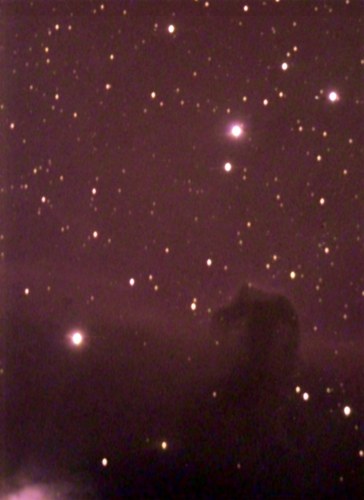
The Horsehead Nebula on 1/12/08

Filed under: astronomy, Astrophotography, Observation Journal — Tags: Barnard 33, Horsehead Nebula, Nebula — Ed @ 11:09 pm


The Horsehead Nebula on 1/12/08

I had tried to view the Horsehead Nebula (Barnard 33) on a couple of occasions before (my telescope's Autostar controller allows me to just request that it point toward it). Unfortunately, I didn't know if I was really looking at it because I couldn't see anything but stars. It turns out it knew what it was doing. I attached the camera and took a bunch of 30 second exposures and after stacking them and working with levels, the horse head just popped right out. I may try to re-image this with the IR filter off to see if it pulls in more of the red. Anyway, I'm pretty pleased with this.

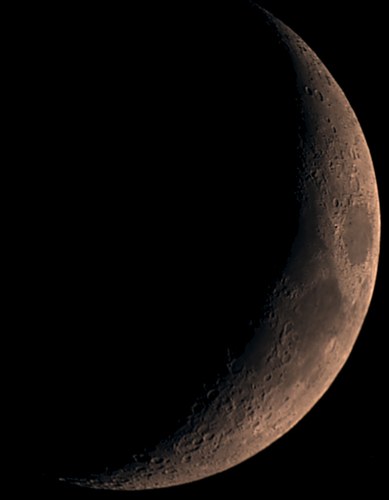
Crescent Moon

Filed under: astronomy, Astrophotography, Moon, Observation Journal — Ed @ 11:04 pm


The Moon on 1/12/08

The Moon set before I could get my scope set up last night, so tonight's the first chance I've had to image the Moon with my new telescope. It did not disappoint. Visually, the Moon was stunning and there was tremendous detail, particularly when I used the 7mm eyepiece. Unlike my previous scope, the Moon does not quite fit in the area that the camera captures, so I had to stitch two images together.

January 7, 2008

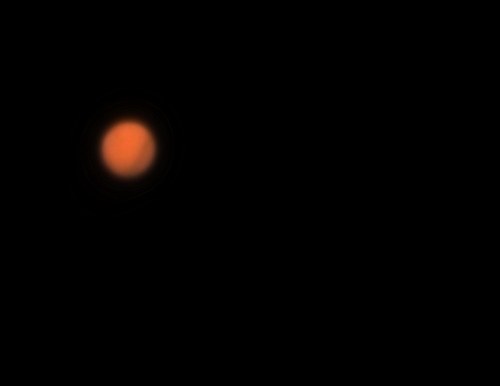
Mars on 1/6/08

Filed under: astronomy, Astrophotography, Mars, Observation Journal, Planets — Ed @ 1:59 am


Mars on 1/6/08

Here's tonight's Mars photo - I plan on restacking it sometime when I've got more time. That's when a lot more detail came out in the images I processed from the images I captured on the 3rd. These raw images look better than those I took last time, so I'm hopeful the results will look better as well. Mars is receeding pretty quickly and so I'm trying to get some good images while it's still close enough to get some detail.

January 6, 2008

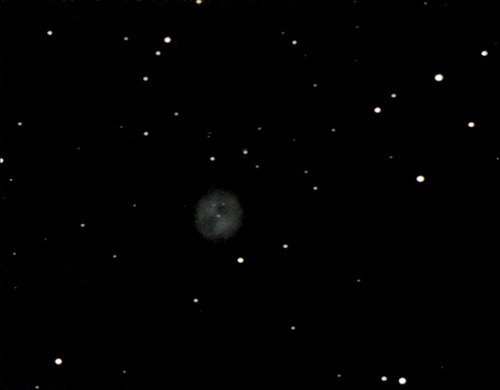
M97-Owl Nebula

Filed under: astronomy, Astrophotography, Messier Objects, Observation Journal — Tags: M97, Owl Nebula — Ed @ 11:41 pm


M97-Owl Nebula on 1/6/08

Seeing conditions weren't very good tonight and so just finding this was difficult (it's very, very dim). The Owl Nebula is a planetary nebula and really looks like an owl (as opposed to the Dumbbell Nebula which looks like an apple core). It is actually somewhat similar in shape to the Dumbbell Nebula, but is smaller and less colorful. The small star in-between the eyes of the nebula is the star that exploded creating this nebula.

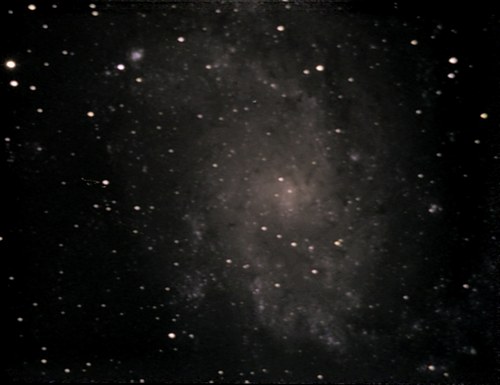
M33-Pinwheel Galaxy

Filed under: astronomy, Astrophotography, Messier Objects, Observation Journal — Tags: Galaxy, M33 — Ed @ 10:40 pm


M33-Pinwheel Galaxy on 1/6/08

When I first saw M33 through the scope, it was pretty faint (there's a fair amount of moisture in the air tonight). But, with the camera, wow. I liked this so much I took an hour of images (at different exposure lengths to bring out more details) and wound up using the best 29min 30sec. M33 is known as the Triangulum Galaxy or the Pinwheel Galaxy. I hope you enjoy this image as much as I do.