Category: Messier Objects

March 10, 2008

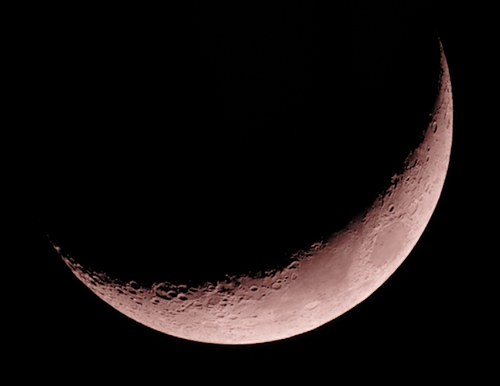
The Moon on 3/10/08

Filed under: astronomy, Astrophotography, Messier Objects, Moon, NGC, Observation Journal — Tags: M42, M43, M81, M82, NGC1973 — Ed @ 10:36 pm


The Moon on 3/10/08

The moon was a graceful crescent tonight and set not long after I took this photo. I've spent the rest of the night working on learning how to get better astrophotos with my Nikon D50. I'll post my Orion Nebula photo (what else?) later after it's done processing.

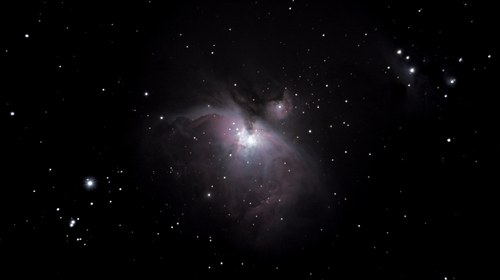
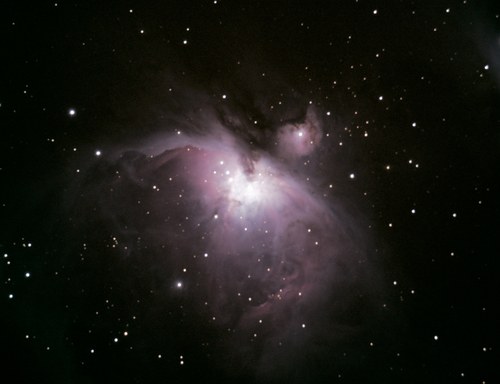
Update: Here's the Orion photo - I've combined ISO 400 images with ISO 1600 - it allowed me to pick up more of the faint nebulosity.

M42-The Great Orion Nebula on 3/10/08

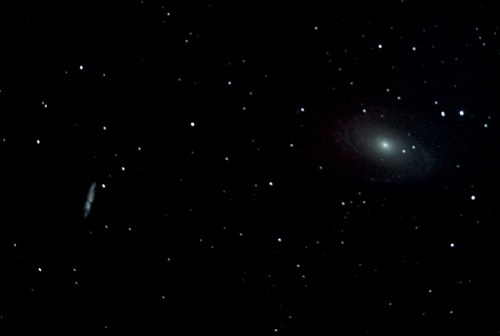
Further Update: Here's the photo of M81-Cigar Galaxy and M82-Bode's Galaxy that I took. Unfortunately, it's just a bit out of focus, but does show the relative positions of these two galaxies.

M81 and M82 on 3/10/08
M81-Cigar Galaxy and M82-Bode's Galaxy on 3/10/08

March 9, 2008

M82-Bode's Galaxy on 3/8/08

Filed under: astronomy, Astrophotography, Messier Objects, Observation Journal — Tags: M82 — Ed @ 10:45 pm


M82-Bode's Galaxy on 3/8/08

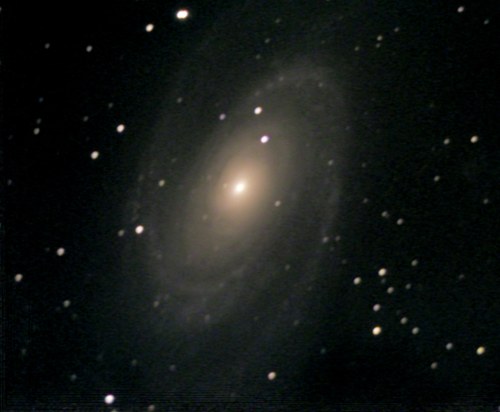
Tonight was kind of hazy so I decided to just get one image. I've imaged Bode's Galaxy before, but never for very long. It's actually quite large and a reasonably easy-to-find target. It and the Cigar Galaxy are located off the end of the big dipper and are gravitationally related. Astronomers think that Bode's is responsible for the wierd shape and properties of the Cigar Galaxy. Anyway, this image does a nice job capturing this galaxy. I hope to get better alignment and take some really long exposures of it, particularly with the DSLR - with a wider field of view it's pretty easy to get both Bode's and the Cigar Galaxies in the same image.

I'm going to probably try for Day 2 of my Photo Messier Marathon on Friday, assuming the skies are clear - the Moon will have set by the time the objects I'm looking for will be up. If I can't get it in before then, I'll probably need to wait until the end of the month.

Photo Messier Marathon 2008 - Day 1


Photo Messier Marathon 2008 - Day 1

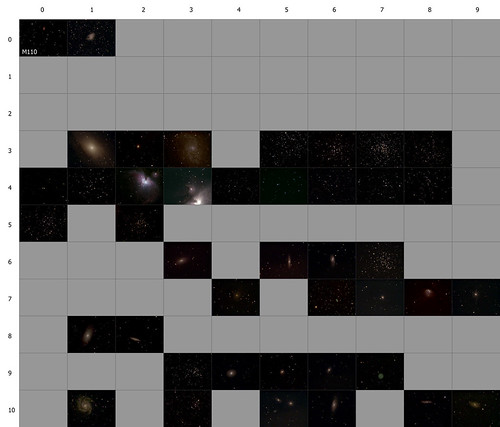
Here's the composite image of all 43 of the Messier Objects I captured last night. Each image is made of fifteen 15s images stacked (225s total). I'm hoping to fill the entire grid out by the end of the month. Here's a link to all of the images captured thus far as part of this Photo messier Marathon.

One Third of a Messier Marathon

Tonight, I started a Photographic Messier Marathon. The traditional Messier Marathon consists of trying to visually spot all 110 Messier Objects in a single night. There's only one time of year where it's really possible to do and you have to coordinate with the Moon (if it's out, it's harder to see the faint ones). Tonight is one of the two possible nights to complete this, as well as April 5/6, during 2008. I decided instead to see if I could take a photo of each of the Messier Objects. Unfortunately, I didn't think it through as well as I should have - I started off (and decided to keep going) stacking fifteen 15 second images for each object. That meant that in addition to the time finding/centering each object, which was made easier because of the goto on my mount (though I still had to find most of them, I started very close) that I had to spend about 4 minutes each taking the image. This averaged out to 10 1/2 minutes per object. This wound up being too much time to get through everything and so I decided to break it up into at least 3 nights (which actually makes my job much easier - I don't have to avoid the moon as completely). Tonight I got through 43 objects. Using this list, I started with M77 and got all the way through M101. I'll pick up again as soon as I can and hope to finish them all on the morning of April 6th. It's way too late(early) for me to mess with the images, but I'll put the whole gang up tomorrow after I've had some sleep. I got a lot of great images.

March 6, 2008

March 6th viewing report

Filed under: astronomy, Astrophotography, Messier Objects, NGC, Observation Journal — Tags: M105, NGC2392, NGC3384, NGC3389 — Ed @ 11:48 pm

Tonight was nice with moderately good seeing and relatively warm temperatures (50°). While we were setting up (my wife came out too), some a neighbor stopped by to say hi and see what we were up to. They brought along two friends who were visiting from out of town - the husband was from Togo (which would qualify as way out of town). Once I got the scope aligned, I showed them Mars, Orion and Saturn. It was fun talking to them - my wife had been to Africa - Niger, Ivory Coast and a couple other places, but had missed Togo - and we had a nice discussion about geography and the stars. It was fun to meet them and I think they genuinely enjoyed the sights, particularly Saturn (who doesn't love Saturn?).


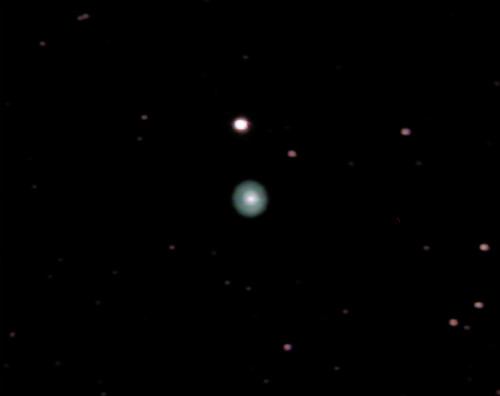
NGC2392-Eskimo Nebula on 3/6/08

After they headed on, I hooked up the camera and went to NGC2392-The Eskimo Nebula. This was a Sky and Telescope recommended target for March and I'm going to try to see all of their recommendations this month. The Nebula was easily visible in the telescope as a small fuzzy and in the camera was more visible as a blue slightly bigger fuzzy. It's really a neat looking deep sky object. Unfortunately, to really see it well, I think I'd need a bigger scope with a much longer focal length - I couldn't really get any detail with my Barlow on it (I did try).

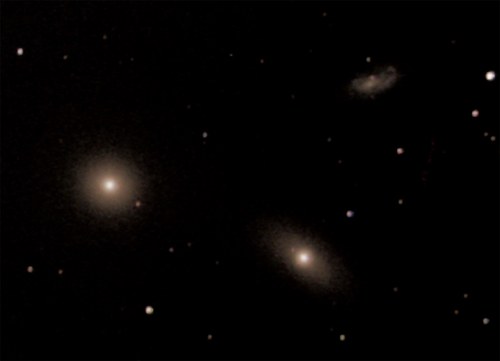
I also took a couple other images, but I haven't had time to process those. Here's an image from last night though - the M105 group of galaxies:

M105 Group on 3/5/08

All three were visible in the scope and obviously visible in the camera. There are a number of clusters like this in Leo. I need to recharge the battery on the D50 and get some wide angle shots - I should be able to get a number of galaxies in several shots.

M65 on 3/5/08

Filed under: astronomy, Astrophotography, Messier Objects, NGC, Observation Journal — Tags: M65, NGC3623 — Ed @ 1:28 am


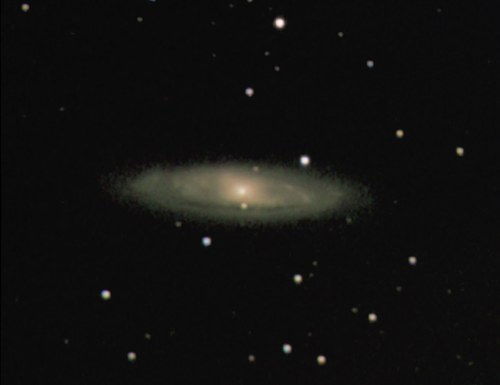
M65 on 3/5/08

I got started late tonight (around 10pm) and I'm just going to post one of the images I got for now - this is M65, one of the galaxies that make up the Leo Triplet. I could see all three in the eyepiece, but didn't have a chance to capture all of them tonight. I did, however get another group of 3 galaxies that I'll probably process tomorrow - it's getting late. It was a nice night with little wind and decent viewing. It was fun to get some new targets.

February 27, 2008

Cold and Just a Bit Windy


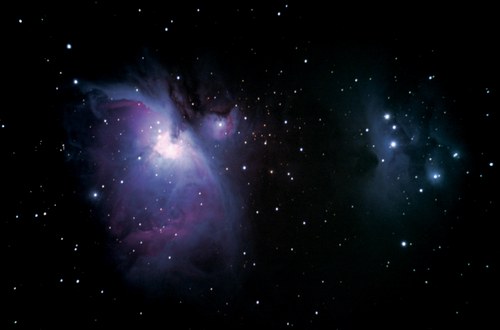
M42-The Great Orion Nebula

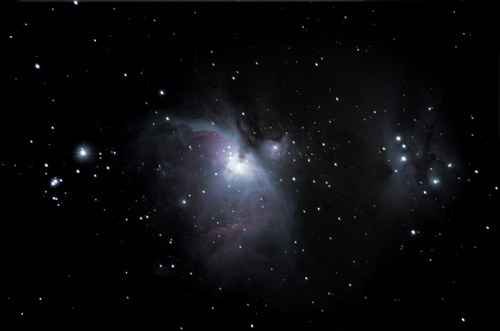
Tonight was cold enough that even with all of my layers on I went inside periodically to warm up. Unfortunately, there was enough of a breeze that I had trouble getting and long exposures and clouds kept showing up when the breeze died down. I took a few images of M33 and M45, but wound up adding to my M42 Orion Nebula images. The image above now contains 37+minutes of data including a couple 5 minute shots and it's really starting to show more nebulosity. The Running Man Nebula (NGC1973) which is on the right is also really starting to show up. If I can get a night without wind, I'm hoping to add a couple 10 minute images so that we'll be able to see even more of the structure of this wonderful deep sky object. Sorry to keep harping on Orion, but I'm still figuring out how to use the DSLR camera successfully with dimmer objects. I hope to have some images of something else soon. :)

February 23, 2008

M42-Great Orion Nebula on 2/23/08


M42-Great Orion Nebula on 2/23/08

I've imaged the Orion Nebula a very large number of times, particularly with my DSI cameras. I hadn't had access to the Nikon D50 DSLR camera for a while (it belongs to my office) and so I had never used the camera on deep sky objects before. I also had not (until the eclipse) used it on my new telescope, the LXD75. I knew it would have a broader field of view, but how much broader, I really had no idea until I tried it. I took a several guided (using my Meade 70AZ-A as a guide scope with my DSI) 2 minute images of the Orion Nebula and then stacked them in DeepSkyStacker. I was extremely pleased with the result, particularly since this only represents 6 images. Normally I stack many more than that to get more detail. I need to try this camera out on some other objects to see what it's capable of, but if it holds up, I may wind up selling my DSI II and buying a DSLR just for astrophotography. This is the best image of M42 I've ever made. I can't wait to take more.

Unfortunately, while taking some image of M45-The Pleiades, I realized that while I had brought my dew shield out to the telescope, I'd never put it on and the scope was starting to frost over. I guess further imaging will have to wait until another night.

Update: I reprocessed the image, this time, using flat frames, dark frames and bias frames (technical stuff that help me get a better image). I focused on just the main nebula and worked to bring out the detail and this was the result:

M42-Great Orion Nebula (reprocessed) on 2/23/08
A reprocessed, cropped version of the above M42 image

There's a lot more detail there and I believe that if I can get a few more long exposures, I should have a really, really nice image.

February 19, 2008

Meade Deep Sky Imager Shootout

Filed under: astronomy, Astrophotography, Equipment, Messier Objects, Observation Journal — Tags: M42, Orion — Ed @ 11:47 pm


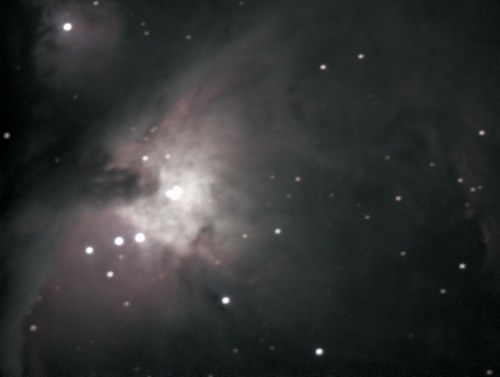
M42 with DSI

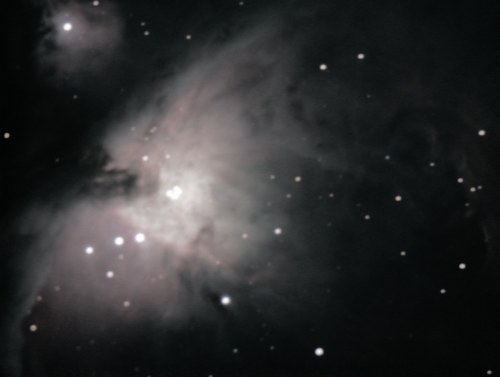
Tonight, I decided to do a test to compare some of the Meade Deep Sky Imager (DSI) models. I personally own a DSI Color and a DSI II Color camera. My friend Dave lent me his original DSI camera which is black and white and uses colored filters. I thought it would be an interesting test to see how they compared. The results were not what I expected. I chose one of my favorite targets - M42-The Great Orion Nebula and I started with the original black and white DSI. I took 4 second exposures of each of the channels - Red, Green, Blue and then a Luminance channel as well. I composited 50 images of each to create these and then I combined them in Photoshop. The result is above. Wow. The detail was way beyond what I expected, particularly considering this is the first generation DSI camera. I then took fifty 4 second images with the DSI Color. Here is the result:
M42 with DSI Color
M42 with DSI Color

While this is a fine image, the result is nowhere near the quality of the DSI. This is pretty much what I expected. Of course, now that I'm thinking about it, to really compare I probably should have used 200 images stacked because with the DSI image I used 50 of each channel and there were 4 channels. Oh well.

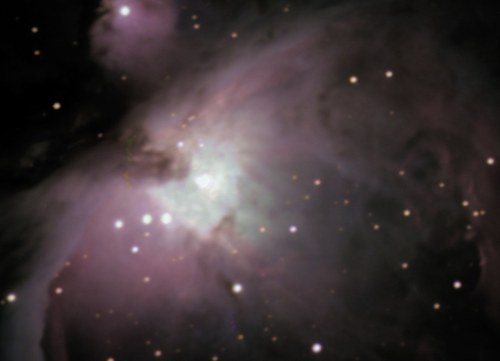
Finally I got out my DSI II Color. This camera has a larger chip so I resized the image down to compare it to the other one, but the results are not as good as I'd hoped. Here's what I got:
M42 with DSI II Color

Some of the differences between these images are in the way that they were processed. Also, the filters I use for the DSI camera are not pure RG & B filters - the red is actually slightly Orange for example - so the color I'm getting there is going to vary somewhat.

I think the results speak for themselves. For detail, the original black and white DSI camera gave the best shot hands down. I don't have a DSI II black and white version, but I'd bet it'd be even better, with lower noise. The downside to the original DSI camera is that by using the filters, you can't get instant results - it takes some time to combine the images and you have to swap the filters out and stuff all of which takes a lot more time and effort, but for the highest quality images, I think it's clear that the results of that effort are worth it.
February 10, 2008

Tonight's astrophotography

Filed under: astronomy, Astrophotography, Messier Objects, Moon, Observation Journal — Tags: M43, M79 — Ed @ 10:39 pm


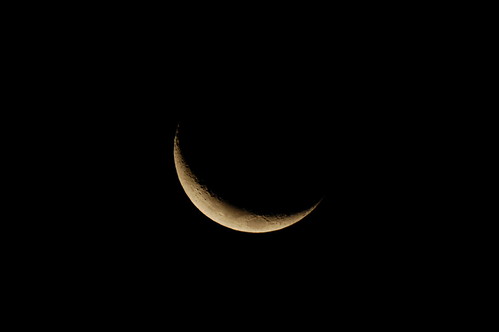
The Moon on 2/10/08

Tonight was very nice, but a bit windy (which made it feel colder than the 45°F that the thermometer was reading). It also meant that the telescope would shake a bit too much to get many long term exposures. Realizing this, I decided to start with the Moon. When imaging the moon I used an exposure of .003s through my refractor which is quick enough to block out most of the wind movement. I thought this image came out nice and sharp. When looking, particularly at higher magnification, visually I could see a lot of turbulence between me and the Moon. Actually, I suppose that most of that turbulence is close to me. It's probably just the first 100 miles or so that are turbulent. After that it's clear for the next 180,000 miles.

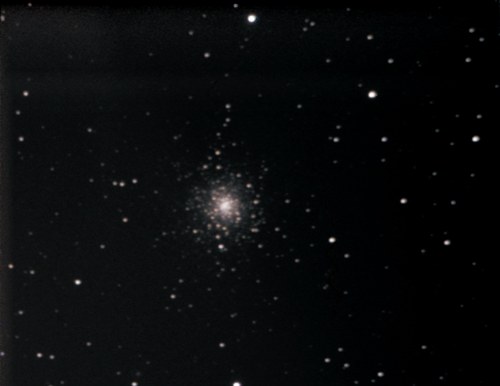
M79 on 2/10/08
M79 on 2/10/08

After getting the moon, I thought I'd have a go at the only globular cluster Messier object visible in the early evening, M79. I was able to get one hundred 30s images that were stacked to give me the image above.

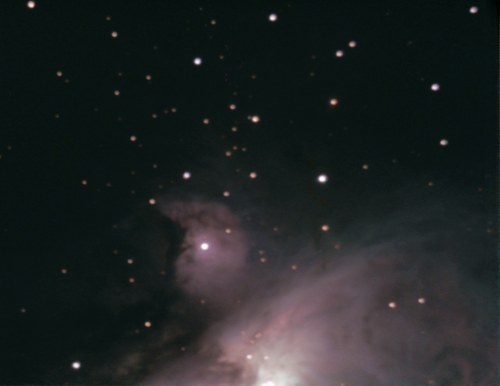
M43-de Mairan's Nebula on 2/10/08

Finally, I thought I'd take a look at something brighter since the wind was picking up so I pointed the scope at M43-de Mairan's Nebula which is the "knob" on the end of the Great Orion Nebula. I took a bunch of 8s exposures and it turned out okay. I then tried to pull the image into DeepSkyStacker, but it seems that the newest version of that software is having some problems with finding stars in images. The guy who writes the software updates it pretty often so I'm hoping he'll have a fix soon. and I'll be able to reprocess a number of images that I've taken recently.