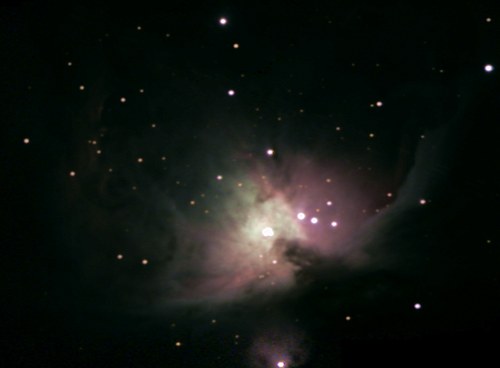
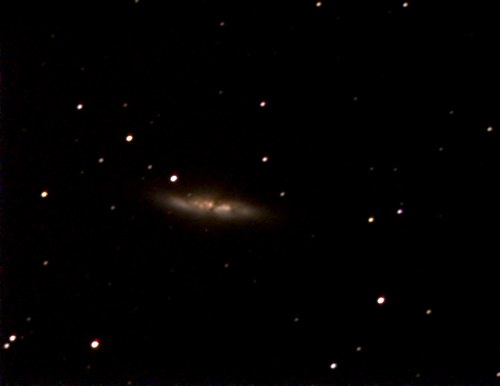
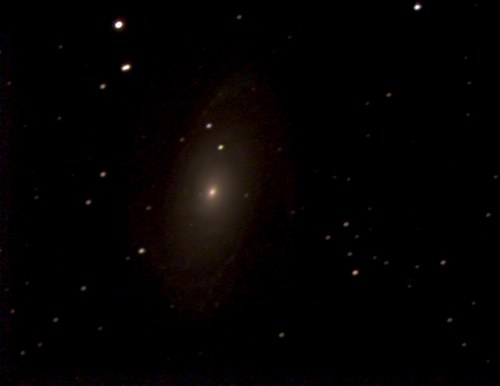
Category: Messier Objects

February 2, 2008

Saturn, Queen of the Skies

Filed under: astronomy, Astrophotography, Messier Objects, Observation Journal, Planets, Saturn — Tags: M81 — Ed @ 1:37 am


Saturn on 2/1/08

I stayed up late tonight and was finally able to see Saturn with the new scope. This image, however, is not from the 8" - it's from my Wal-Mart special scope. While this image was being captured, I was viewing the ringed planet through my bigger scope. It was beautiful. I could barely make out the Cassini division in the rings and could discern a few striations on the planet itself. Unfortunately it was getting so cold that frost was forming on my equipment and I had to head inside before i could get a higher magnification. I'll try for that soon.

Prior to getting my image of Saturn, I was able to get an image of M81 - Bode's Galaxy:

M81-Bode's Galaxy on 2/1/08

Bode's Galaxy is found near the big dipper - just past the part you drink out of. It's very close to M82 - the Cigar Galaxy.

Overall, a nice night - cold (30°F) but not unbearable. The mount worked really well with the exception that I believe I need to further align my polar scope. Other than that it tracked and slewed smoothly. Once I get these last couple kinks out I hope to be able to start doing some really long exposures.

January 27, 2008

The Great Orion Nebula Shootout

Filed under: astronomy, Astrophotography, Equipment, Mars, Messier Objects, Observation Journal — Tags: M42, M43, Orion — Ed @ 11:52 pm

Tonight was beautiful - the Moon was not going to rise until late, and it was clear and about 40°F outside. All in all, really good conditions for me. I decided that tonight I would test out my new (cheapo) 70mm refractor that I blogged about the other day. I'd done some work on my mount, so I was hoping to also see if that had worked as well as I'd hoped and I'd be able to take some long exposures.

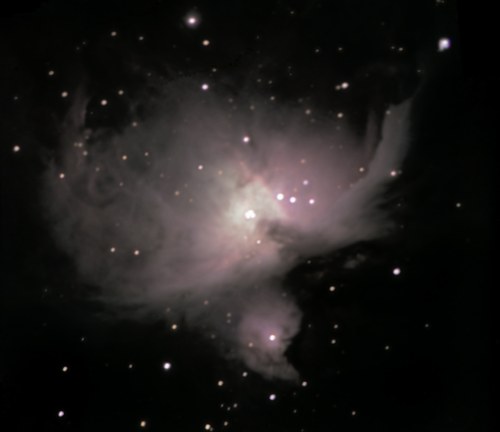
I set up the way I normally do, leveling the scope, using the polar scope to align the mount on Polaris and then running the alignment procedure with the Autostar software. I again got the magic, "You are less than 5' from the pole" message so my alignment was very good. I then took a good amount of time to view some different targets comparing the views in each scope. I had a look at Mars, M42-The Great Orion Nebula, The Double Cluster and all looked really, really good in both scopes. I actually started to wonder how much better my 8" scope was so I resolved to find out. I first hooked up my DSI II camera to the 70mm refractor and aimed at the Orion Nebula. Because I was using the diagonal on the scope, the image was originally a mirror image so I fixed it in the software afterward, but that's why the image from that scope is not oriented the same way as my other one. Here's the result:


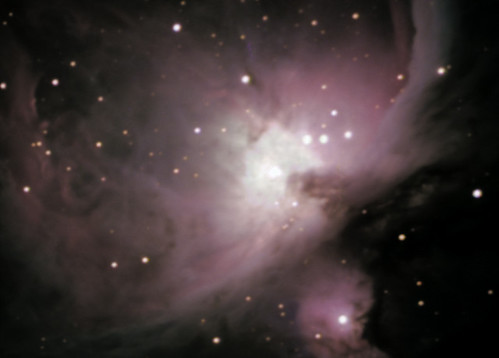
M42/M43-The Great Orion Nebula on 1/27/08
Taken with my 70mm refractor

This is a combination of 18 15 second images plus 10 60(!) second images. The 60 second images were spot on - no movement that I could tell. It makes me want to try some 2-3 minute exposures on some of the fainter targets - I can't wait. Overall, it did what I believe is a very creditable job on the nebula. My only complaint (and this is a known issue with achromatic refractors) is that there is a bit of a purple halo around the brightest stars.

I next took the exact same series of images through my 8" Schmidt-Newtonian. Here's the image I got:

M42/M43-The Great Orion Nebula (8
M42/M43-The Great Orion Nebula on 1/27/08
Taken with my 8" Schmidt-Newtonian

Because the focal length is longer (812mm vs 700mm 600mm), the magnification is higher on the 8" scope than on the 70mm refractor. (Magnification is calculated by dividing the focal length by the eyepiece size. The eyepiece of the DSI II is aproximately 8mm so the magnification for the refractor would be approximately 87.5X 75X and the 8" scope would be 101.5X) That's why it appears more zoomed in. It also is much, MUCH brighter - there's quite a bit more detail. So I guess that answers the question as to whether they actually show the same amount of detail. The 8" is clearly much brighter and more powerful. I am really anxious to try the refractor on the Moon however, the larger field of view means I may be able to get the entire moon in one shot and refractors are known for providing better contrast/clarity on planets and lunar views. I also took images of Mars with both scopes that I'm processing now. I'll probably upload those tomorrow.

Overall, a really great night. I truly enjoyed the visual observation I did tonight - both scopes performed admirably and it was nice to be reminded of how much fun visual observation can be. I also was pleasently surpised at the results of my tests. I think I've got a great setup to capture a number of different types of images in the future.

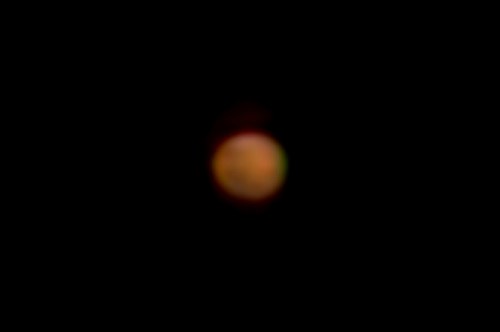
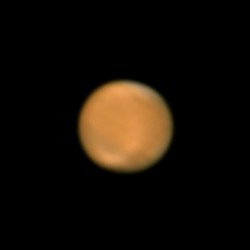
Update: Here's the Mars image from the refractor. Wow. Unfortunately, I couldn't tell until I procesed it, but the image I got from the 8" was slightly out of focus.

Mars on 1/27/08
Mars on 1/27/08
Taken with my 70mm refractor

This image was taken using not only the 70mm refractor, but the web cam that came with it. I paid $25 total for both (and a terrible tripod and eyepieces, which I didn't need). What a deal.

January 20, 2008

January 6, 2008

M97-Owl Nebula

Filed under: astronomy, Astrophotography, Messier Objects, Observation Journal — Tags: M97, Owl Nebula — Ed @ 11:41 pm


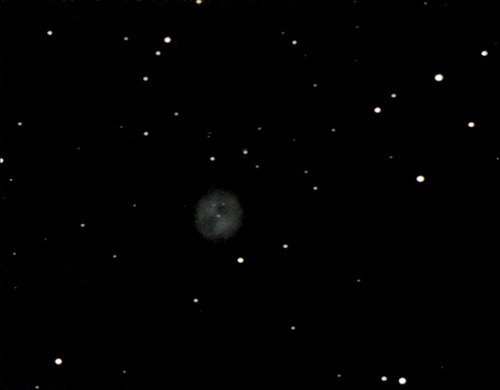
M97-Owl Nebula on 1/6/08

Seeing conditions weren't very good tonight and so just finding this was difficult (it's very, very dim). The Owl Nebula is a planetary nebula and really looks like an owl (as opposed to the Dumbbell Nebula which looks like an apple core). It is actually somewhat similar in shape to the Dumbbell Nebula, but is smaller and less colorful. The small star in-between the eyes of the nebula is the star that exploded creating this nebula.

M33-Pinwheel Galaxy

Filed under: astronomy, Astrophotography, Messier Objects, Observation Journal — Tags: Galaxy, M33 — Ed @ 10:40 pm


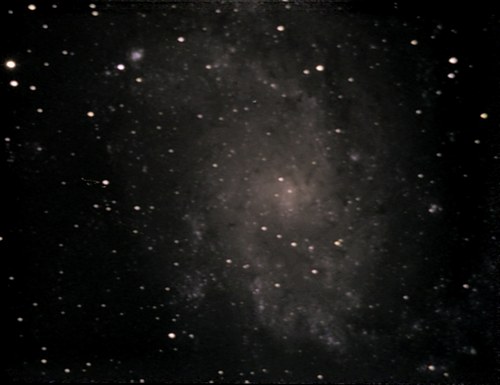
M33-Pinwheel Galaxy on 1/6/08

When I first saw M33 through the scope, it was pretty faint (there's a fair amount of moisture in the air tonight). But, with the camera, wow. I liked this so much I took an hour of images (at different exposure lengths to bring out more details) and wound up using the best 29min 30sec. M33 is known as the Triangulum Galaxy or the Pinwheel Galaxy. I hope you enjoy this image as much as I do.

January 4, 2008

The Running Man Nebula (and more)


NGC1973/75/77 on 1/3/08

This is really one of the first objects outside the planets, the moon and the Messier catalog that I have imaged. It is from the New General Catalogue which is one of the largest general catalogs of deep sky objects. If you're interested, you can read about it at the link.

NGC1973/75/77, also known as the Running Man Nebula, is a nebula found just north of the Great Orion Nebula, which I've been imaging quite a lot lately. I imaged this area before in my post several months ago on Orion's Sword. That image was created with my 4 1/2 inch Tasco scope. This one is created with my new scope. You can easily see how much more detail is present in this one - how much more nebulosity was captured by the larger 8" mirror and with the much better DSI II.

I also was able to image M82-The Cigar Galaxy again, but most of the images didn't turn out very well, so it's not too much better than the one from the other night.

M82-Cigar Galaxy on 1/3/08

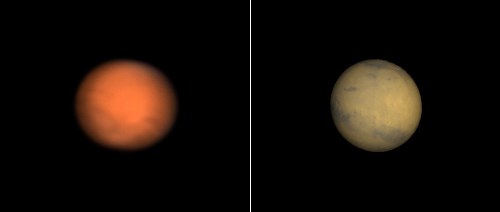
Finally, I really debated today whether or not the image of Mars I got was really that detailed or if the brightness/color variations might have been caused by dirt on the eyepiece. This evening I saw an image someone had created where they compared their image of Mars to the way Starry Night software displayed Mars (it's sky simulation software) because it should display it pretty much as it looks. Here's the result:

Mars on 1-3-08 Comparison
Mars Comparison: My Image (left) | Starry Night Simulation (right)

After looking at it this way, I feel much more confident in my image. I need to try it again with a better eyepiece.

Update: I re-stacked the best 140 images of Mars and then worked with it a bit further in Photoshop. Here's the result.

Mars-Restacked on 1/3/08
Marson 1/3/08 - Restacked

January 3, 2008

Man is it cold

Filed under: astronomy, Astrophotography, Messier Objects, Observation Journal — Tags: M42, M43, Orion — Ed @ 12:50 am

Tonight has been around 20°F, but I was silly enough to set up the telescope - the skies were just too inviting. Though the wind had died down from last night's hurricaine, it was still a bit windy at times tonight. I'm not sure if it was that, the cold or something else, but I had great difficulty aligning the scope tonight - it took almost an hour and it still wasn't right. I'm sure at least part of the issue was me wanting to hurry and get the thing aligned so I could start imaging from inside the relative warmth of my garage, but regardless it was a bit frustrating. I took some time to look around, particularly at Mars this evening - it's still nice and bright in the evening sky and I could see it pretty clearly in my telescope. I also was able to show it off to some neighborhood kids who were crazy enough to be out in this cold and walked by. I didn't take any pictures of it, though. Instead, I went back to M42-The Great Orion Nebula that I imaged on New Years Eve. I decided to get more images of M43 - deMairen's Nebula which is kind of stuck on one end of the M42 since that area of the image was a bit grainy. I got maybe 60-70 good shots of it that I stacked and added to those I took the other night. I also actually composited what's called the Luminence channel with the image. This is something I haven't done before and I'll explain how it works in a later post. For folks involved in CCD astrophotography they'll know what I mean. They also might wonder why I've never used it before. The answer is because I'm lazy. I'm also planning on adding some longer exposures to the image (once I have the chance to take them) to see if that brings out more of the faint areas of the nebula. I believe it should. My concern is that i don't want to overexpose other areas of the image. I'd really like to keep the Trapezium visible.

The combination is an 18 minute 8s exposure (271 4 second exposures). I think this is shaping up pretty nicely. This is what I wound up with:

M42-Great Orion Nebula on 1/2/08

Sometimes I worry that I post too many of the same images on my site - this makes 3 of this in a row - but for me, learning about astronomy is a process and I use the blog to share what I'm learning and how I'm learning it. I guess that's one of the things I really like about this is that I get a lot of advice as I go from people which obviously helps me learn more and get more out of the hobby, but also I think by discussing what I do, I tend to learn it better myself.

January 1, 2008

No stargazing tonight, but some reprocessing

Tonight started off cloudy, but I can see the stars clearly now. The wind is blowing like crazy though. Weather.com says up to 35mph, but I'd bet we're getting over 50 at times. The garage door has been creaking ominously all evening. I figured it would be better to play it safe with the telscope. I'm not sure I could get over my telescope being blown over in the wind.

Instead, here's a reprocessed Orion Nebula from last night which I re-stacked with DeepSkyStacker. I think this image does a better job of displaying the nebulosity than the one from yesterday.
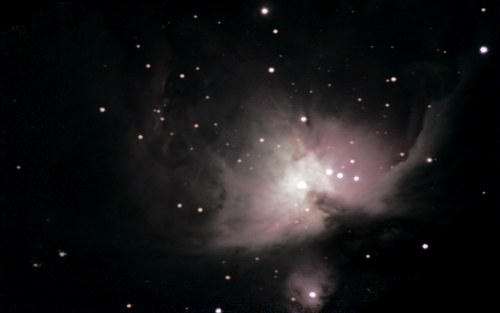
M42-Great Orion Nebula on 12/31/07 - reprocessed

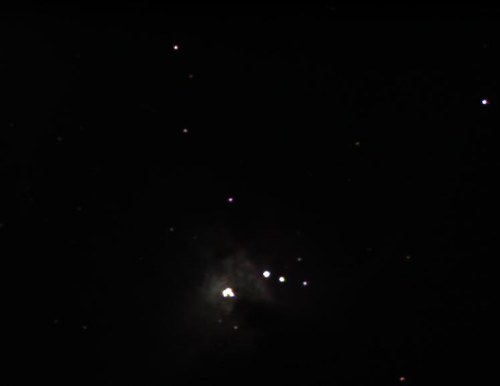
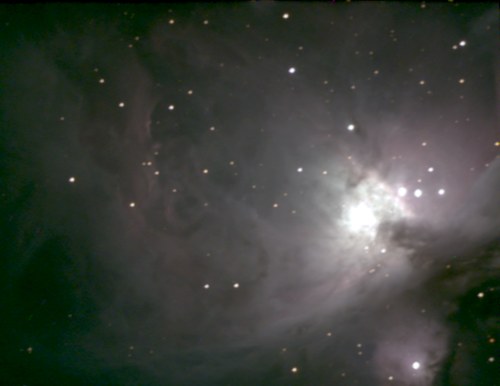
Also, here are 2 images for Pierre, a commenter who asked about what the individual frames I'm seeing look like (though they may be interesting to others as well). I've also included a long-winded explanation of how I do my astrophotography image gathering so if you're interested in that, read on...
M42 for Pierre - Single
M42 single 4 second image

This first image is what I see when I take a 4 second exposure. You can clearly see the Trapezium and the other stars are nearly maxed out on brightness. The area of the nebula lit by the Trapezium stars is showing up faintly, but there's not a huge amount to see. That's because the stars are pushing the top end of the histogram so hard. There's actually quite a bit more detail there and that's why I normally adjust the gamma (in the Envisage software, it's called "Shadow Enhance", but it's really just a gamma adjustment). Below is what that does for me.
M42 for Pierre - Gamma adjusted single
M42 single 4 second image - gamma adjusted

Obviously there's a lot more detail there. As a matter of fact you can see some geostationary satellite streaking along in the upper right left quarter of the picture which really wasn't visible in the image above at all. (Side note: probably 1/3 of all images I take of Orion have a satellite going through it because it's in the southern part of my sky and that's where geostationary satellites are as well, above the equator. As a matter of fact, I've seen as many as 4 in the same image before) Now, since I'm capturing these images in a FTS format, changing the gamma doesn't change the underlying data, which is good because I want to reprocess these later and I'd rather work with raw data. As a matter of fact, if you have used the RAW format in your camera, it's pretty much the same kind of thing - there's a lot more data than a standard 8-bit image. In the case of FTS, it can store a massive amount of data - each of the frames above is 5MB in FTS format (compared to less than 15K each in JPG). It's this raw data that allows software like DeepSkyStacker to pull out so much detail in the images later.

Another important thing to note is that these images automatically have dark frames subtracted from them. Any digital camera chip has noise in it that gets amplified the warmer it is and the longer an exposure is taken. For images of daylight or really any well lit scenes, this noise is absolutely overwhelmed by the amount of light coming into the camera so you'd never see it. With astrophotography, you are taking pictures of things that are extremely faint (though Orion is somewhat an exeption - it's considered very bright for a deep sky object, but it's still pretty dim) and so you use long exposures. In this case, that noise in the camera can be pretty significant. It can add new "stars" to your image, which might seem exciting at first -hey, I discovered a new star - but wears out its welcome quickly thereafter. To combat this problem, I take exposures at numerous temperatures for many different time periods and the resulting images are subtracted from the final images. For example, I'll take a 4 second dark frame at 34°F and use that to be subtracted from the images I'm taking above since that's the exposure time and the temperature at which it was taken (fortunatly, my camera has a built in thermometer since it's important to know the camera temperature) This helps the end result be much more true to the light that's coming in. There are other kinds of adjustment images that can be used - bias and flat frames - but I haven't had a chance to really use them. They can make a difference in the quality of your work (they account for areas of the image that are dimmer than they should be as well as some other things), but dark frames are simple to do (my capturing software does it automatically) and make a massive difference right off the bat. My capturing software (Autostar Envisage - it came with my camera) automatically can create the composite image which normally looks pretty good, and so that tends to be what I'll throw onto my blog the night I take something. If I've gotten good results, I then will often pull the raw data into DeepSkyStacker or RegiStax or something else to reprocess it. Such is the case with the image near the top of this post.

I hope this helps y'all understand how I do some of what I do and if anyone has any other questions, please feel free to add a comment. I really enjoy these kinds of posts, but it's not something I tend to think of on my own.
December 31, 2007

M42-Great Orion Nebula on New Years Eve 2007

Filed under: astronomy, Astrophotography, Messier Objects, Observation Journal — Tags: Happy New Year, M42, M43, Orion — Ed @ 11:59 pm


M42-Great Orion Nebula on 12/31/07

I finally figured out how to do Drizzle images and this is a quick first attempt. I thought it an appropriate target for New Years Eve since the Orion Nebula is basically cosmic fireworks. Note that you can see the Trapezium in the center of the Nebula in this image - I could never resolve that in my previous scope. Tonight was very nice with intermittent clouds and I had a good time figuring out how to get more out of my scope. Happy New Year!

The Cigar and Bode Galaxies on 12/30/07

Filed under: astronomy, Astrophotography, Messier Objects, Observation Journal — Tags: M81, M82 — Ed @ 9:43 am


M82-Cigar Galaxy on 12/30/07

I had never captured M81 and M82 before (they're quite close to one another) because they had been pretty much below the horizon during normal viewing times for a while. Now, however, they are visible by 11 from my driveway. M82 is really colorful and bright and really is cigar shaped. M81 is fainter, but much larger (I can't wait to do some much longer exposures on it). Below is the image of M81 that I captured:

M81-Bode's Galaxy on 12/30/07